Written by the PetFitness team and reviewed by our Certified Canine Fitness Trainers. Last updated October 31, 2026.
A treadmill for dogs sounds like a luxury until the first week it rains every day, or the vet says your dog needs to lose eight pounds, or your two-year-old Lab is bouncing off the walls at 9pm in a third-floor apartment. Then it starts to look like the most practical piece of fitness equipment a dog owner can buy. The problem is that the market is confusing: there are treadmills built for dogs, treadmills built for people that dogs can sometimes use, free-spinning slatmills that look like something from a kennel club, and prices from a couple of hundred dollars to several thousand. This guide is about choosing the right one. It covers whether you need a dog treadmill at all, whether the human treadmill in your garage will do, the four types and who each suits, how to size one for your dog, which features matter and which are marketing, what you should expect to pay, and how to set it up at home. If you already have a treadmill and want to teach your dog to use it, our dog treadmill training guide is the step-by-step method.
The short version
- Who it’s for: dogs in apartments or bad-weather climates, overweight dogs on a plan, high-energy dogs that need more than two walks, seniors and rehab dogs that need slow controlled walking, and owners with limited mobility. It adds to walks, it doesn’t replace them.
- Human treadmill: works for most dogs under about 40 pounds at a walking pace if it goes down to 0.5 to 1 mph and you supervise every second. Belt is too short for big dogs and there are no side rails.
- Motorized dog treadmill: the right answer for most pet dogs. Longer belt, low deck, side panels, slow minimum speed, quiet motor. Roughly $500 to $2,000.
- Slatmill: no motor, the dog powers it and sets the pace. Best for fit adult dogs, sport and working breeds, and anyone who wants real conditioning. Roughly $700 to $2,500.
- Sizing rule: belt length at least twice your dog’s body length (front of chest to back of rump), wide enough for a slight sideways step, and a weight rating comfortably above your dog’s weight.
- Features that matter: minimum speed of 0.5 mph, 0.1 mph increments, side panels, a safety key or auto-stop, a low deck, a remote, and a quiet motor. Incline is nice, apps are not.
- Before buying: try one at a rehab clinic, dog gym or mobile dog fitness service if you can. Some dogs never take to it, and that’s cheaper to find out at $40 a session than $1,200.
Do you need a treadmill for your dog at all?
Be clear about what a treadmill does and doesn’t do before spending money. It gives a dog a controlled walk or trot at an exact speed for an exact time, indoors, in any weather, with no squirrels, no other dogs and no pulling. That’s a very useful thing for a specific set of dogs. It does not sniff, it does not provide mental stimulation beyond the first week, and it does not teach a dog anything about the world. A dog that only ever exercises on a treadmill is a fit, under-stimulated dog. Think of it the way you’d think of a treadmill for yourself: a supplement to real walks, not a substitute.
The dogs that get the most out of one are easy to list. Overweight dogs on a weight loss plan, because consistent daily low-impact walking is the single hardest part of the plan to deliver and a treadmill makes it automatic. High-drive breeds in apartments or small yards, where two leash walks a day don’t come close to burning what they need. Dogs in places with brutal summers or long icy winters, where there are weeks when walking is unsafe, especially for flat-faced breeds that can’t handle heat. Senior and arthritic dogs that need slow, even, flat-surface walking for joint health and lose muscle fast without it. Dogs in rehab after surgery or injury, once the vet clears controlled walking. And owners who, for whatever reason, can’t walk as far or as often as their dog needs. If your dog is young, healthy, lean and gets an hour of real walking a day already, a treadmill is a nice-to-have, and the money is better spent on a balance disc and some core work.
A few dogs should not use one. Puppies under about a year (growth plates are still open and repetitive belt work is exactly the wrong load; see our puppy exercise guide), dogs with uncontrolled heart or breathing conditions, dogs recovering from surgery before the vet clears them, and dogs with a serious noise or movement phobia that you haven’t worked through with a trainer. If your dog is in one of those groups, stop here and talk to your vet first.
Can a dog use a human treadmill?
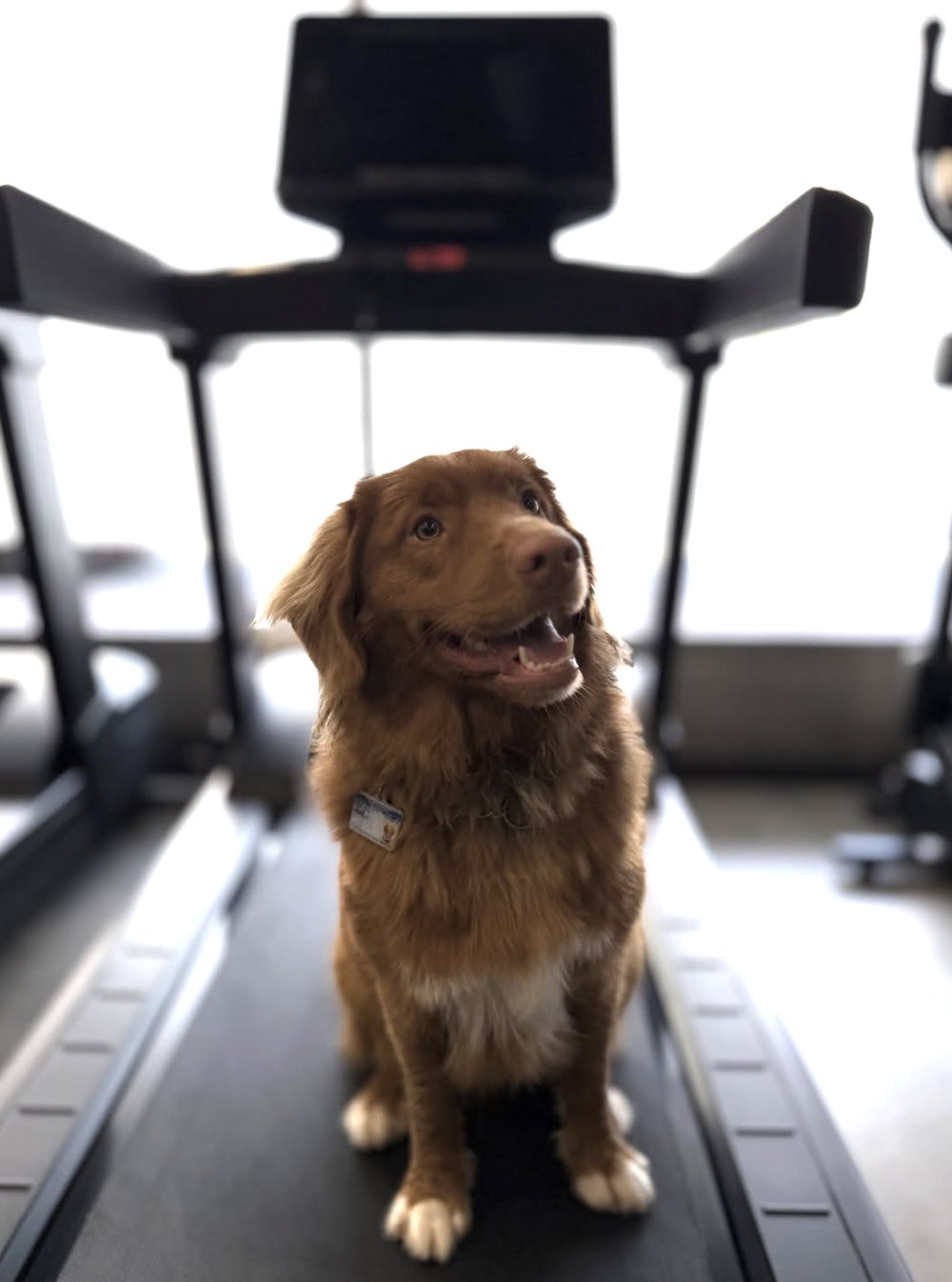
Often, yes, and if you already own one it’s the obvious place to start. The limits are physical. A standard home treadmill belt is around 20 inches wide and 55 inches long, which is fine for a walking Beagle and far too short for a trotting German Shepherd, whose stride needs most of that length before the belt runs out behind him. Most human treadmills bottom out at 0.5 to 1 mph, which is a comfortable walk for a small or medium dog but too fast as a starting speed for a tiny dog or a nervous one. There are no side panels, so a dog that steps sideways steps off, and the console sits at the front at chest height for a person, which puts it right in a large dog’s face. The motor is also tuned for a 150-pound human in running shoes, so it’s loud and it starts with a jolt that a dog-specific machine is designed to avoid.
The practical rule: a human treadmill works for dogs under about 40 pounds at a walking pace, with you standing beside it holding a loose leash, never tied off, for every minute of every session. For medium dogs it’s a maybe, depending on belt length and how calm the dog is. For large and giant breeds, and for any dog you want to trot rather than walk, it’s the wrong tool. One more thing: using a human treadmill for a dog will void most warranties and dog nails do mark the belt, so if it’s a new or expensive machine, factor that in.
The four types of dog treadmill
| Type | How it works | Best for | Watch out for | Typical price |
|---|---|---|---|---|
| Motorized dog treadmill | Like a human treadmill but built for dogs: longer belt, lower deck, side panels, quiet motor, slow minimum speed, remote control. | Most pet dogs. Beginners, seniors, overweight dogs, rehab, anyone who wants to set an exact speed and time. | Cheap models with a short belt, a loud motor or a 1 mph minimum. Check the belt length against your dog, not the marketing weight limit. | $500 to $2,000 |
| Slatmill (non-motorized) | A belt of free-spinning slats on bearings. The dog drives it and sets its own pace; it stops when the dog stops. | Fit adult dogs, sporting and working breeds, high-drive dogs, serious conditioning for muscle and stamina. | Harder for timid or lazy dogs to learn, since nothing moves until they do. Heavy and not foldable. Easy for a keen dog to overdo it. | $700 to $2,500 |
| Carpet mill | A non-motorized treadmill with a carpet belt instead of slats. More friction, so the dog works harder at lower speeds. | Strength and pulling-breed conditioning, usually in sport and weight-pull circles. | Too much resistance for seniors, overweight dogs or rehab. Not a beginner’s machine. | $400 to $1,500 |
| Underwater treadmill | A belt inside a glass tank at a rehab clinic. Water takes weight off the joints while adding resistance. | Post-surgery rehab, arthritis, obese dogs that can’t manage land work yet. | Clinic only; $40 to $80 a session. Not something you buy. | Per session |
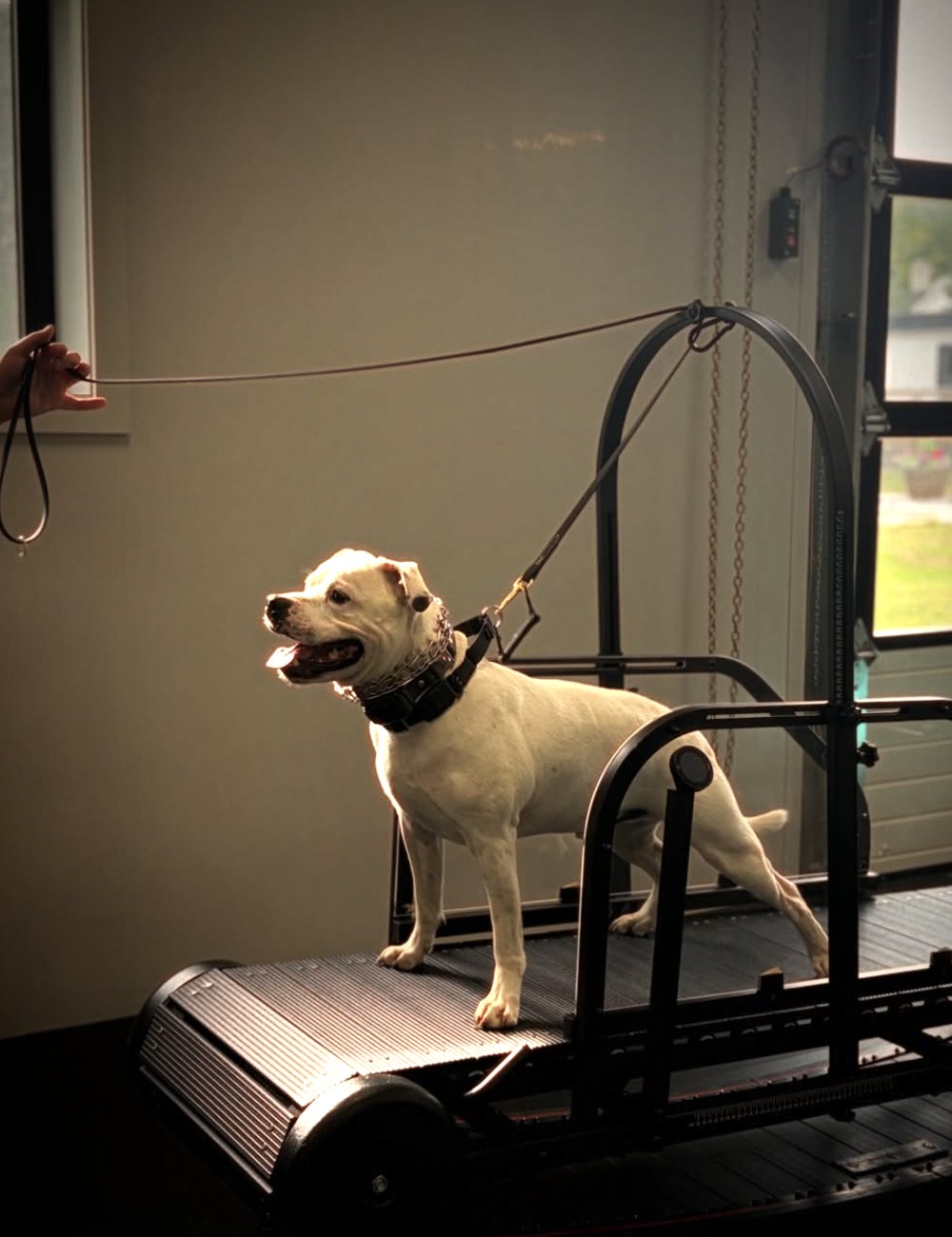
For the great majority of people reading this, the choice is between a motorized dog treadmill and a slatmill, and the deciding question is what the dog is for. If the goal is steady, measured, low-impact walking (weight loss, seniors, rehab, apartment maintenance), you want a motor, because you control the speed and the dog can’t quit early or sprint. If the goal is conditioning a fit dog (building muscle and stamina in a sporting, working or high-drive breed), a slatmill is the better machine, because the dog works harder, moves more naturally, and self-regulates. The Bulldog in the photo above is on a professional conditioning treadmill with an overhead tether point; notice the handler still holds a loose leash by hand. That’s the rule on every type.
How to size a treadmill for your dog
This is where most online purchases go wrong, because people shop by the weight limit on the box and the weight limit is almost never the constraint. Belt length is. A dog needs room to stretch out at a trot without its back feet running off the end or its nose touching the front rail, and a dog that feels cramped shortens its stride, which defeats the purpose and is bad for the joints.
Measure your dog standing square, from the front of the chest to the back of the rump (not nose to tail). The belt should be at least twice that length for walking, and closer to two and a half times for trotting. A 36-inch Lab needs a 72-inch belt minimum, which rules out every human treadmill and most of the cheapest dog models. A 16-inch Frenchie is fine on 40 inches. Width matters less, but the dog should be able to take a slight sideways step without going off the edge: 14 to 16 inches for small dogs, 18 to 20 for medium, 20 plus for large. Then check the weight rating is comfortably above your dog, not just at it, because a trotting dog loads the deck with far more than its standing weight. Finally, look at deck height. A dog stepping up onto a 10-inch platform is fine; a senior or a Dachshund stepping onto one is not, so for those dogs look for a deck under 6 inches or plan on a ramp.
| Dog size | Examples | Minimum belt (walk) | Better belt (trot) | Human treadmill? |
|---|---|---|---|---|
| Small (under 25 lb) | Chihuahua, Frenchie, Dachshund, Yorkie | 35 to 40 in | 45 in | Yes, at a walk, if it goes down to 0.5 mph |
| Medium (25 to 55 lb) | Beagle, Border Collie, Poodle, Pit mix | 50 to 60 in | 65 to 70 in | Maybe, walking only, calm dogs |
| Large (55 to 90 lb) | Lab, Golden, Shepherd, Boxer | 65 to 75 in | 75 to 85 in | No |
| Giant (90 lb plus) | Great Dane, Mastiff, Newfoundland | 80 in plus | 90 in plus | No |
Features that matter (and the ones that don’t)
Minimum speed and increments. The single most important spec. You want a machine that starts at 0.5 mph or lower and moves in 0.1 mph steps. The first sessions of treadmill training happen at speeds a human would call standing still, and a machine that jumps from 0 to 1 mph will frighten a small or nervous dog on day one. Check the spec sheet; this is the number cheap models hide.
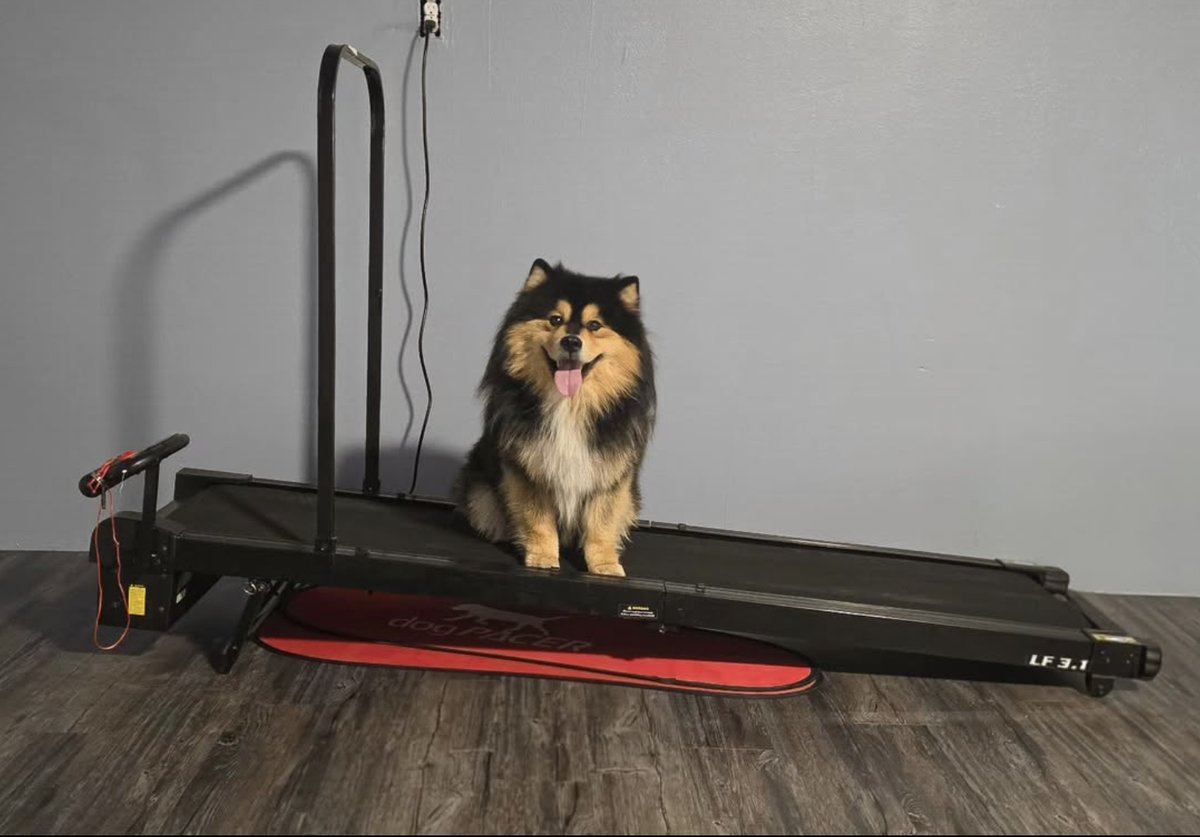
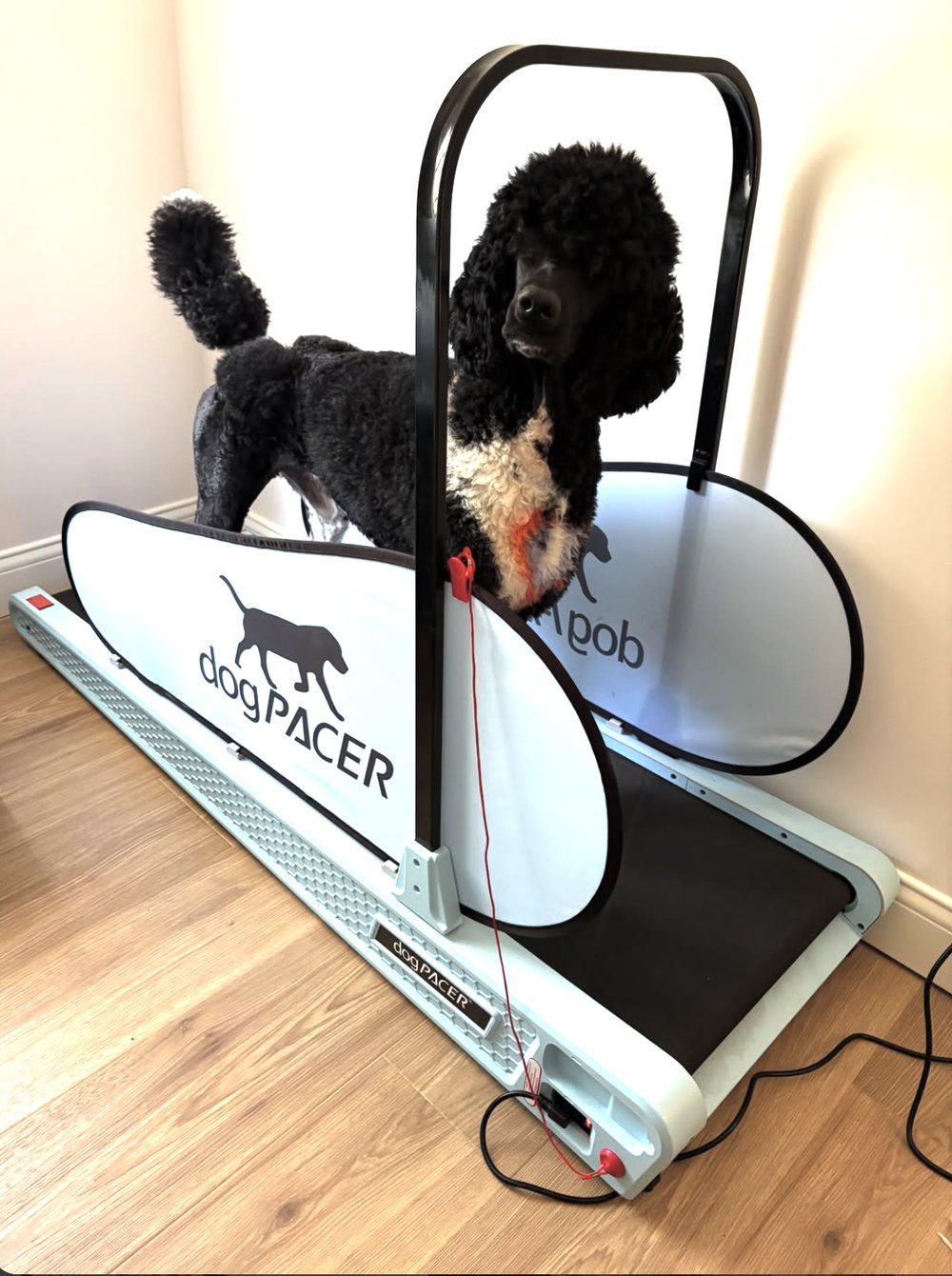
Side panels or rails. Dogs drift sideways when they get distracted. Panels (solid or mesh, like the ones on the Poodle’s treadmill above) keep the dog centered and also block the view of the room, which helps focus. They should be removable for cleaning and for dogs that find them claustrophobic.
Safety key or auto-stop. A clip that attaches to the dog’s harness and kills the motor if the dog falls back or jumps off. Non-negotiable on a motorized machine. Never, ever use it as a tether to hold the dog on; it’s a kill switch, not a leash.
A remote. You should be able to adjust speed and stop the belt from beside the dog, not from a console at the front. On a human treadmill you’re leaning across the dog to reach the buttons, which is one of the reasons they’re a compromise.
Low deck and a quiet motor. Under 6 inches for small or senior dogs. A motor you can hold a conversation over; anything louder makes the first week of training harder than it needs to be.
Incline. Useful, not essential. A gentle 3 to 5 percent incline shifts work to the hind end, which is good for dogs rebuilding rear-leg muscle, and it lets you add intensity without adding speed. If two machines are otherwise equal, take the one with incline.
Things that don’t matter much: app connectivity, preset “programs”, screens, calorie counters (they’re guesses), fancy colors. A folding frame is handy in an apartment but check it doesn’t come at the cost of belt length or stability, because a treadmill that rocks under a trotting dog is a treadmill the dog won’t trust.
What a dog treadmill costs, and the cheaper ways in
Expect to pay roughly $500 to $900 for a compact motorized dog treadmill suited to small and medium dogs, $900 to $2,000 for a full-size motorized one with a belt long enough for large breeds, and $700 to $2,500 for a quality slatmill, with the professional conditioning machines above that. Prices vary by brand, region and sales, so treat those as bands, not quotes, and read the belt-length spec before the price.
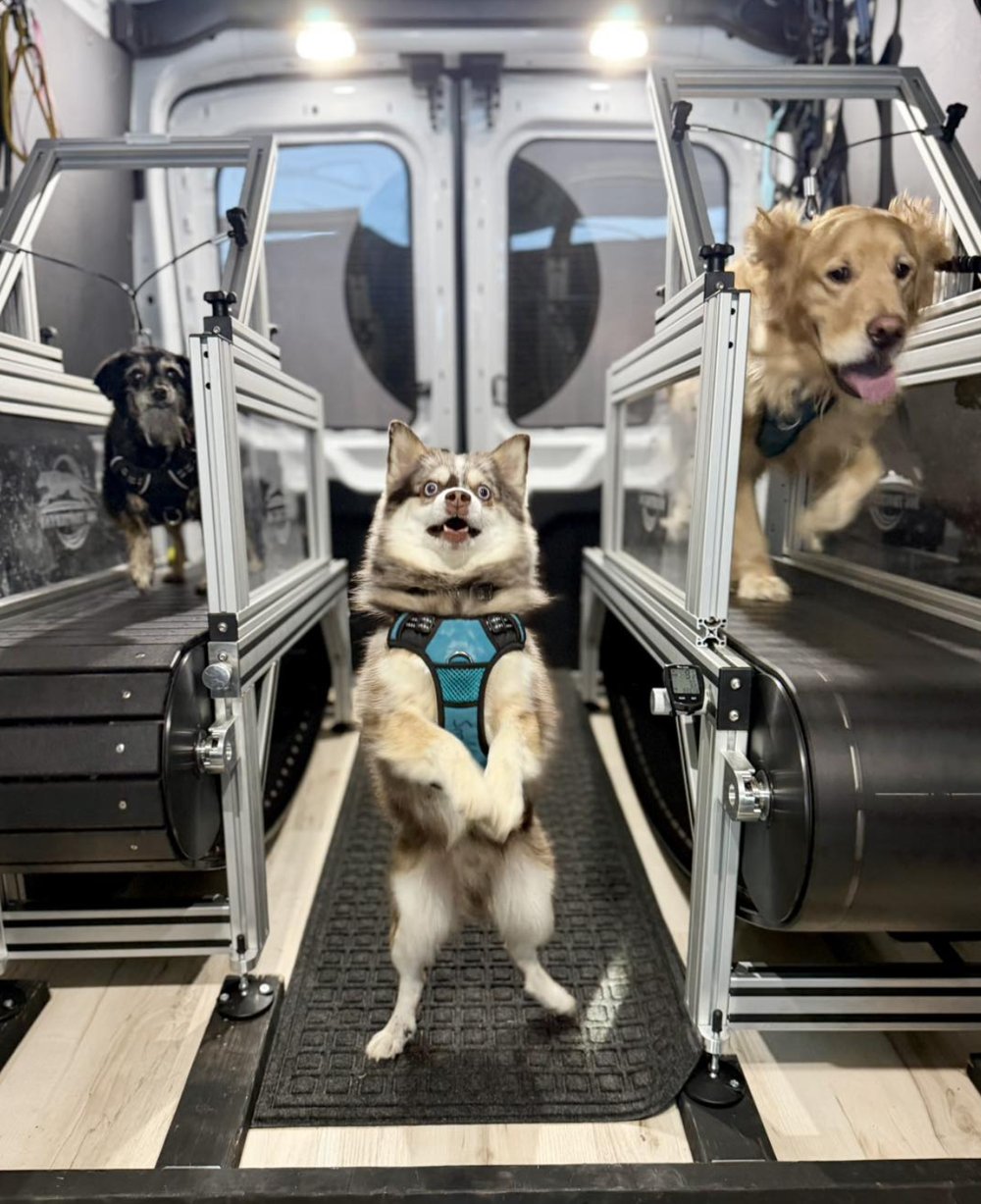
Before you spend any of it, try to put your dog on one somewhere else first. Canine rehab clinics, dog gyms, some daycares and a growing number of mobile dog fitness services (the van in the photo above is one; they bring the treadmills to your driveway) will run a session for $30 to $60. Two or three of those tell you whether your dog takes to it, which type suits him, and how much coaching you’ll need, and the staff will usually give you honest advice about what to buy. Some dogs simply never relax on a moving belt, and finding that out for $90 beats finding it out with a $1,200 machine in the garage. The second-hand market is also strong, because plenty of people buy one, use it for a month and sell it; check the belt tracks straight, the motor runs smoothly at the lowest speed, and the safety stop works.
If budget is the constraint and you have a small or medium dog, the human treadmill you already own, used at a walk with supervision, is a perfectly good starting point. Add a dog treadmill later if the dog takes to it and you want more.
Setting it up at home
Where you put the treadmill matters more than people expect. Give the dog an open view ahead: a treadmill facing a wall 12 inches away makes a dog feel like it’s about to run into it, and dogs slow down or balk. Face it into the room or toward a window, with at least three or four feet of clear space in front and behind, and room for you to stand beside the dog’s shoulder. Put it on a firm, level floor with a mat under it to kill noise and vibration; a treadmill on carpet or a wobbly floor feels unstable to a dog. Keep it away from the dog’s bed and food so the machine doesn’t become the dominant thing in the dog’s safe space, but don’t banish it to a cold garage either; you want sessions to be easy to start.
Then the rules that don’t bend. Never tie the dog to the treadmill. The leash is in your hand, slack, for every session, forever; the safety clip is a kill switch, not a restraint. Never leave the room with the belt moving. Always start from a standing belt, never put the dog onto a moving one. Nails trimmed, harness not collar, water available after, and stop at the first sign of a limp, heavy panting that doesn’t settle, or a dog that keeps trying to get off. For the full introduction method, speeds by size and the four-week plan, go to the treadmill training guide. It’s written to start the day the machine arrives.
Which treadmill for which dog: our recommendations
Overweight dog on a weight-loss plan: a motorized dog treadmill with a low minimum speed and incline. You need exact, repeatable, boring walking, every day, and a motor delivers it. Check the weight rating with margin, because a heavy dog trotting loads the deck hard. Pair it with the weight loss plan and the body condition check; the treadmill handles the movement, the food handles the weight.
Small apartment dog: a compact motorized model, 40 to 50 inch belt, folding if space is tight, with side panels. Or the human treadmill you already have, at a walk. The compact dog machines are quieter, which your neighbors will appreciate.
Large, young, high-drive dog (working lines, sporting breeds, bully breeds): a slatmill. The dog sets the pace, works hard, builds real muscle and stamina, and tends to enjoy it more than a motorized belt. Needs a fit, confident, adult dog and a firm floor.
Senior or arthritic dog: a motorized dog treadmill with a deck under 6 inches, a 0.5 mph minimum and a quiet motor, used flat and slow. Underwater treadmill at a clinic if the dog is very stiff or very heavy, then transition to land. Our arthritis exercise guide covers how it fits with the rest of the routine.
Dog in rehab after surgery or injury: start with the clinic underwater treadmill, because buoyancy protects the repair. Once the vet clears land walking, a motorized dog treadmill at the slowest speeds gives exactly the controlled, symmetrical walking rehab needs, and it’s the easiest place to watch whether the dog is using both back legs evenly. Our injury recovery guide and ACL surgery recovery plan show where treadmill work slots into each phase.
Not sure yet: book two sessions at a rehab clinic or dog gym and decide after.
Mistakes people make buying a dog treadmill
Buying by weight limit instead of belt length, and ending up with a Lab on a belt made for a Beagle. Buying a slatmill for a timid or lazy dog, who stands on it and nothing happens. Buying a cheap motorized model whose lowest speed is 1 mph and whose motor sounds like a leaf blower, then wondering why the dog won’t go near it. Assuming the treadmill replaces walks and raising a fit dog that’s bored out of its mind. Putting it against a wall facing the wall. Tying the dog on. And buying before trying, when a $40 session would have answered every question.
Frequently asked questions
Is a treadmill good for dogs?
Used correctly, yes. It gives controlled, low-impact, weatherproof exercise, and it’s particularly useful for weight loss, seniors, rehab and high-energy dogs in small spaces. It’s a supplement to walks, not a replacement, because dogs need the sniffing and the world as much as the steps.
Can a dog use a regular human treadmill?
Dogs under about 40 pounds can usually walk on one if it goes down to 0.5 to 1 mph and you hold a loose leash beside them the whole time. The belt is too short for large dogs and for trotting, there are no side rails, and it will likely void the warranty.
What size treadmill do I need for my dog?
Measure the dog from the front of the chest to the back of the rump and multiply by two for walking, two and a half for trotting. That’s your minimum belt length. A 36-inch Labrador needs at least a 72-inch belt.
Motorized dog treadmill or slatmill?
Motorized for controlled, measured walking: weight loss, seniors, rehab, beginners, most pet dogs. Slatmill for conditioning a fit, confident adult dog that will drive it: sporting, working and high-drive breeds.
How much does a dog treadmill cost?
Roughly $500 to $900 for a compact motorized model, $900 to $2,000 for a full-size one, $700 to $2,500 for a slatmill. Rehab clinic and dog gym sessions run about $30 to $60, and underwater treadmill sessions $40 to $80.
How long should a dog be on a treadmill?
Beginners: 2 to 5 minutes. Trained dogs: 15 to 30 minutes at a walk or easy trot, once a day, most days. Our training guide has speed and duration by dog size.
Can puppies use a treadmill?
Not for structured sessions until growth plates close, around 12 months for most breeds and later for giants. Repetitive belt work is exactly the kind of load growing joints shouldn’t take. Short, free play and sniff walks are what puppies need.
Are dog treadmills noisy?
Good ones are quiet enough to talk over. Cheap motorized models and human treadmills are not, and noise is one of the main reasons dogs balk in the first week. Put a mat under any treadmill to cut vibration.
Where this fits in your dog’s plan
A treadmill is one tool. What makes it work is the plan around it: the right speed and duration for your dog’s size and condition, the strength and balance work that keeps the joints safe, and, for most of the dogs that need a treadmill in the first place, the food side of the equation. A PetFitness plan puts those together for your dog. If you’d like one built, start your dog’s plan here. If you’d rather start tonight: measure your dog chest to rump, double it, and you already know more than most people who’ve bought one.