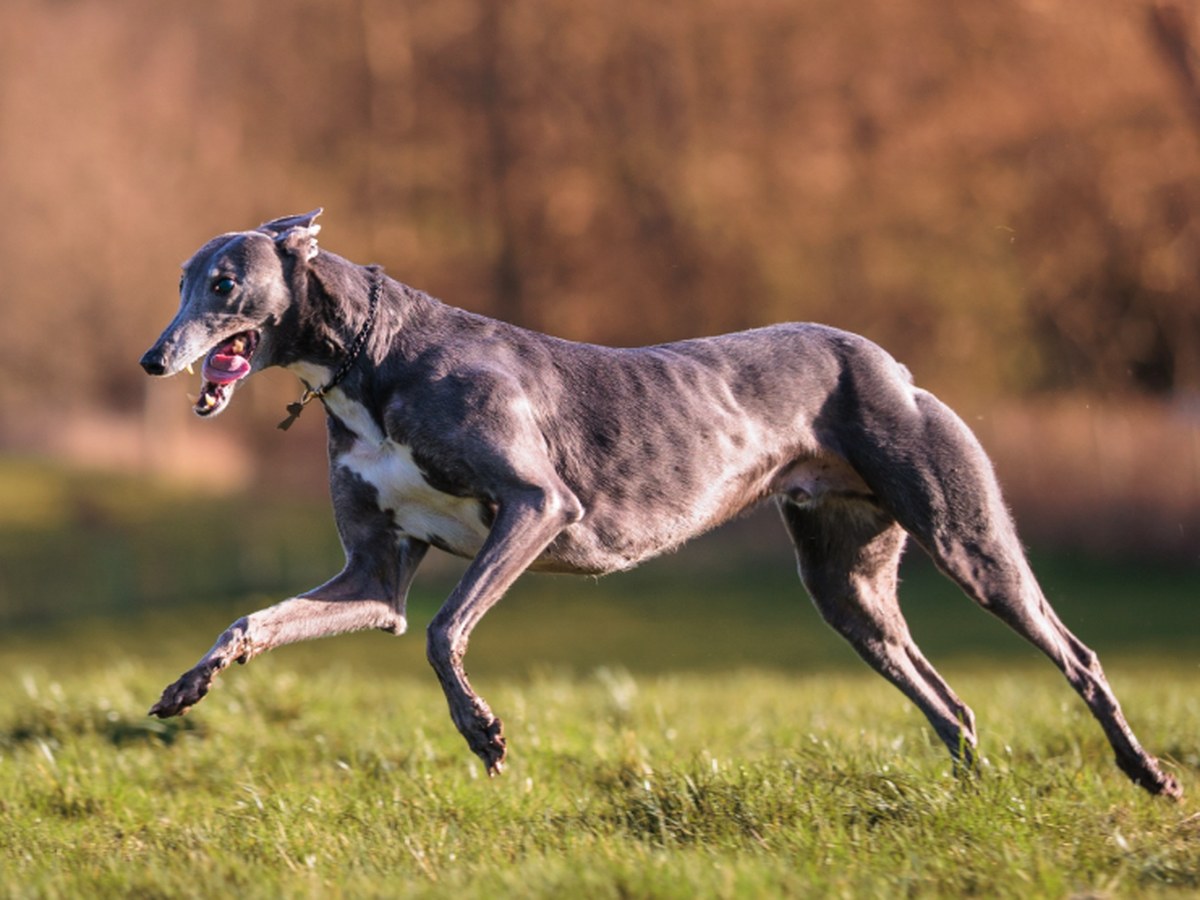
Written by the PetFitness team and reviewed by our Certified Canine Fitness Trainers. Last updated November 11, 2026.
If you’re searching for how to tire out a dog, you’ve probably already tried the obvious answer, which is more walking, and found that it doesn’t work. An hour around the neighborhood and the dog comes home, drinks some water and brings you a toy. So you walk further, and a month later you have the same dog with better stamina. High-energy dogs aren’t tired out by more of the same thing. They’re tired out by the right mix: short bursts of hard effort, work for the nose and brain, and one skill almost nobody teaches, which is how to switch off. This guide is 15 ways to tire out a high-energy dog that work in a normal week with a normal yard, how to combine them, and how to tell when the problem isn’t energy at all.
The short version
- More walking isn’t the answer. Steady walking builds stamina, so the dog needs more every month. Intensity, brain work and variety tire a dog; distance mostly doesn’t.
- Fastest physical options: flirt pole, tug, sprint recalls, swimming and hill work. Ten minutes of any of these beats a 40-minute walk.
- Fastest mental options: scent games, a sniff walk, five minutes of trick training, and meals fed through puzzles instead of a bowl.
- The missing piece: teach an off switch. A dog that has never practiced settling will stay wound up no matter how much exercise it gets.
- A good day: one hard burst (10 to 15 minutes), one walk with sniffing, two short brain sessions, and a settle period. About 60 to 90 minutes total for most high-energy adults.
- Careful with: puppies under a year (no forced running or repetitive jumping), flat-faced breeds in heat, seniors, and endless ball throwing for any dog.
Why your dog isn’t getting tired
There are three usual reasons, and most high-energy dogs have all three going at once.
You’re building an athlete. A dog’s body adapts to steady exercise fast. Walk three miles a day and within a few weeks three miles is a warm-up. Owners of Border Collies, Labs, pointers, Huskies and shepherds fall into this constantly: the dog seems restless, so they add distance, and the dog gets fitter and needs more. You can’t out-walk a working breed. You have to change the kind of work.
The brain hasn’t done anything. These dogs were bred to make decisions for hours: where the sheep are going, where the bird fell, what that scent is. A leash walk on the same route asks nothing of them. A dog can be physically tired and mentally wide awake, and that dog still paces, barks and shreds things. Our guide to mental stimulation for dogs covers this half in depth; the short version is that 15 minutes of nose or brain work often does more than an hour of walking.
Nobody taught the dog to stop. Excitement is a habit. A dog whose whole day is play, fetch, greeting and action gets very good at being excited and has no practice at being calm. More stimulation makes that worse. Calm is a skill, it can be trained, and it’s number 15 on this list for a reason.
If you’re not sure how much exercise is reasonable for your dog’s breed and age to begin with, start with our guide to how much exercise a dog needs per day.
Fast physical burners
These are the high-intensity options: short, hard, done in a yard or a park, and finished in 10 to 15 minutes. Warm up with a few minutes of walking first, work on grass or dirt, and stop while the dog still wants more.
1. Flirt pole
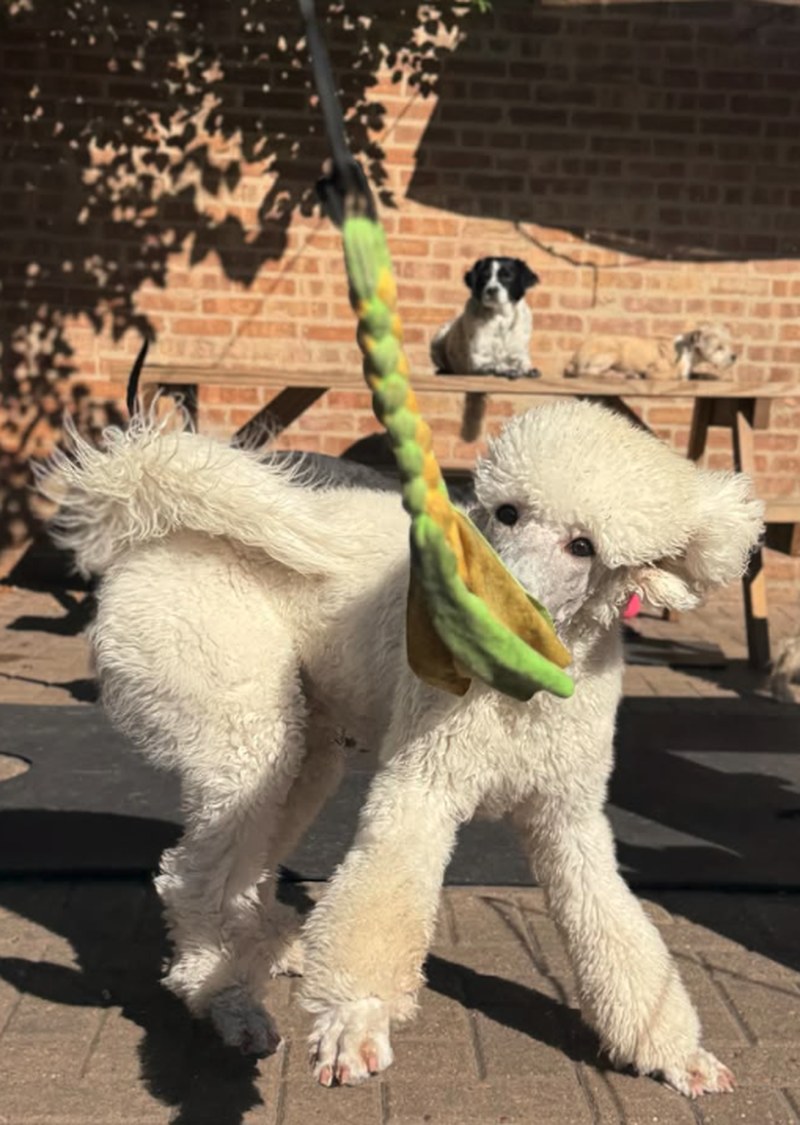
A pole with a rope and a toy on the end, like a giant cat teaser. You swing the toy along the ground in wide arcs and the dog chases, turns, accelerates and grabs. It’s the most efficient dog-tiring tool there is: five to ten minutes of flirt pole will flatten most dogs, and it works in a small yard. Keep the toy low so the dog isn’t leaping and twisting in the air, change direction in wide curves instead of sharp reversals, let the dog catch it often, and build in “drop it” and “wait” between rounds so it doubles as impulse-control training. Buy one for about $25 or make one from a length of PVC, a rope and an old toy. Not for puppies under a year or dogs with joint problems.
2. Tug
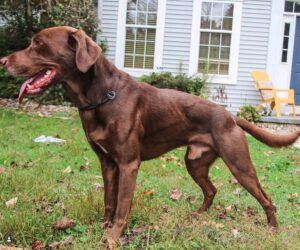
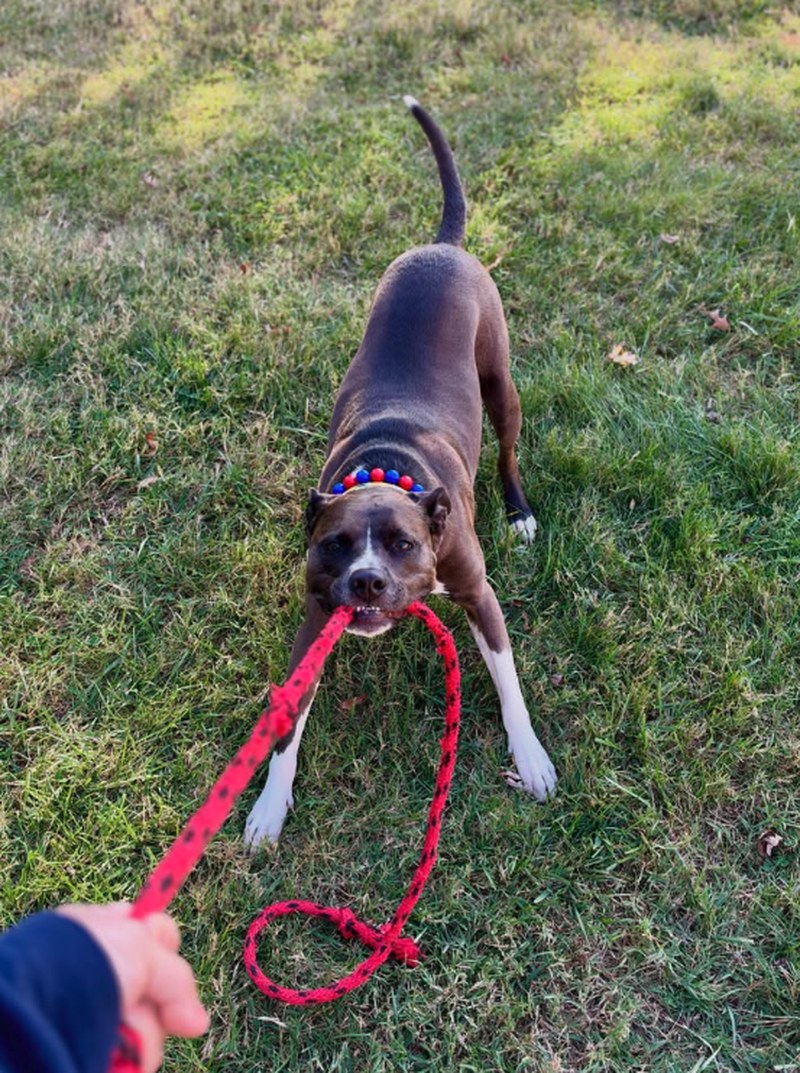
Tug is full-body resistance work and it’s indoors-friendly. A dog that leans back and pulls with its hind legs like the one in the photo is working its legs, core, neck and jaw at once, and most dogs are panting within a couple of minutes. Keep the toy low, pull steadily instead of jerking, play in 20 to 30 second rounds, and end each round with a “drop” and a short sit before the next one starts. Tug doesn’t make dogs aggressive; played with rules, it teaches self-control. A spring pole gives a tug-obsessed dog a way to play on its own.
3. Structured fetch
Fetch tires a dog, but the classic version (a ball launcher, 50 throws, flat-out sprints and skidding stops) is hard on knees and shoulders and creates dogs that are obsessed with the ball. The better version: roll or throw low so the dog isn’t leaping, throw uphill so the run out is hard and the run back is easy, make the dog wait until the ball stops before releasing, and cap it at 10 to 15 throws. Mixing in a “find it” throw into long grass turns half the game into nose work.
4. Sprint recalls
Two people stand 30 to 50 yards apart and take turns calling the dog, with a treat or a toy at each end. The dog sprints back and forth, you get a better recall for free, and ten repetitions is a real workout. On your own, throw a treat one way, let the dog chase it, call it back past you and throw another the other way. Hide-and-seek versions, where one person hides behind a tree before calling, add a search to every sprint.
5. Play with another dog
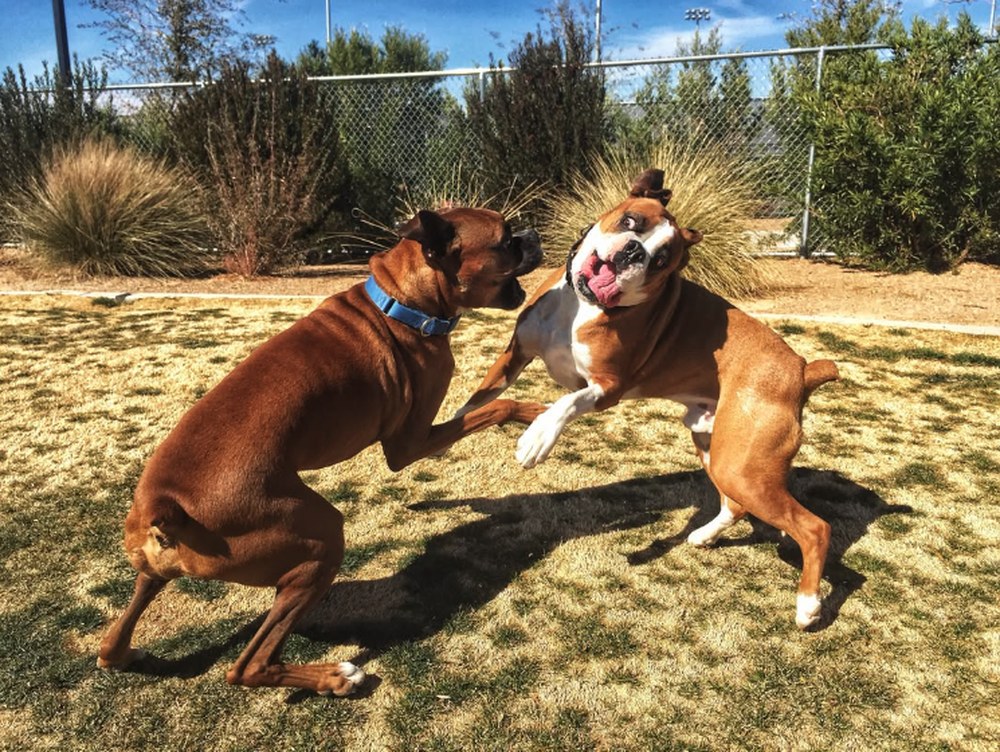
Nothing tires a dog like a well-matched friend. Twenty minutes of wrestling and chase with a dog of similar size and play style covers sprinting, strength, body awareness and social skills in one go. The key words are well-matched: one or two known dogs in a fenced yard is far better than a crowded dog park, where play escalates and not every dog is having fun. Watch for loose, bouncy bodies, role swapping and short pauses; break it up for a minute if one dog keeps trying to leave.
Endurance and strength work
These take longer but build a calmer kind of tired, and several of them add load so that a normal amount of time does more work.
6. Hills and hikes
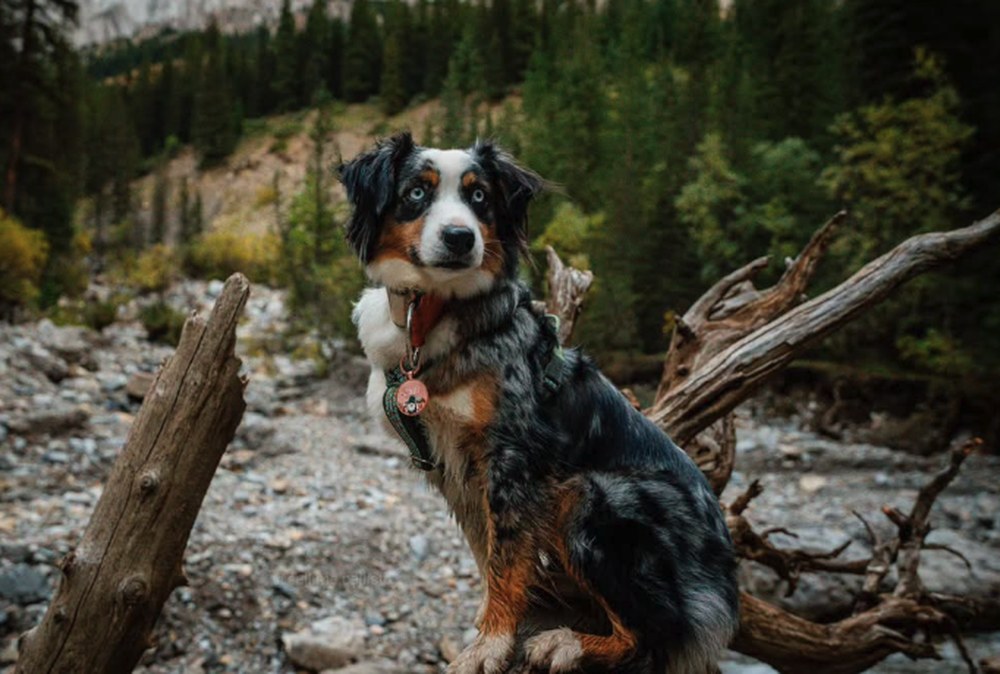
Uneven ground, climbs, logs to step over and a thousand new smells make an hour on a trail worth three on a sidewalk. Hills load the hind end on every step, the footing makes the dog think about where its feet go, and the novelty does the mental work for you. If you can’t get to a trail, find the steepest grass slope nearby and walk up it slowly five to ten times. Our muscle-building guide explains why slow hill walking beats flat running for strength.
7. Swimming
Five minutes of swimming is roughly a 20-minute walk, with no impact on the joints, and it cools the dog while it works, which matters for high-drive dogs in warm weather. Start with short swims and a flotation vest, use a floating toy for short retrieves, and keep it to 10 or 15 minutes. Wading along a shoreline works for dogs that won’t swim. The safety rules are in the home section of our hydrotherapy guide.
8. A backpack or weighted vest
A dog backpack with a water bottle in each side gives a working breed a job and makes a normal walk harder. Start empty, build to no more than 10 percent of body weight, and keep it for healthy adult dogs only. Many dogs walk more calmly with a pack on, because carrying something focuses them. Limits and fitting are in our weight vest guide.
9. Treadmill
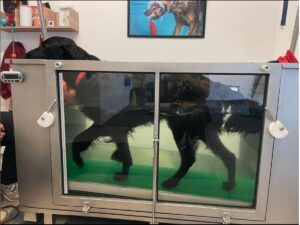
For bad weather, hot summers and apartment life, a treadmill delivers a controlled trot when a walk isn’t possible. Fifteen to twenty minutes at a brisk walk or easy trot, with a slight incline, takes the edge off most dogs, and a slatmill, which the dog powers itself, is a serious workout for a high-drive breed. See how to choose a dog treadmill and the training method. It supplements outdoor time; it doesn’t replace it.
10. Running with you
For a healthy adult dog of a running breed, jogging two or three times a week is good steady work. Build up the way you would for yourself (start with a mile, add slowly), run on trails or grass when you can, avoid the heat of the day, and wait until the dog is fully grown, 12 to 18 months depending on size. Keep in mind the fitness trap: running builds stamina, so use it as one part of the week, not the whole plan. Our guide to building stamina safely has the progression.
Brain work
This is the half that owners of high-energy dogs skip, and it’s the half that makes the difference. Mental work is tiring in a way that leaves a dog calm instead of wired.
11. Sniff walks and scent games
Swap one of the day’s walks for a sniff walk: a long line, a field or a quiet street, and the dog chooses where to go and how long to smell each thing. Twenty minutes of sniffing lowers a dog’s heart rate and leaves it more settled than a brisk walk twice as long. At home, scatter a meal across the lawn, or hide treats around a room and send the dog to “find it.” Scent work is the single best tool for dogs that come home from exercise more excited than they left.
12. Training sessions
Five minutes of learning something new is harder for a dog than 20 minutes of walking. Teach a trick a week (spin, bow, back up, paws up, go to mat), practice “wait” and “leave it” with real temptations, or work on a retrieve by name. Three five-minute sessions a day, with the dog’s kibble as the reward, is a serious amount of mental work. For high-drive breeds this is the job they were built for; our working breed guide has more ideas.
13. Feed through work
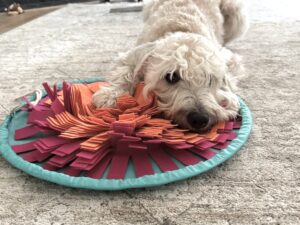
A bowl takes 30 seconds. The same meal in a snuffle mat, a puzzle feeder, a scatter on the lawn or a frozen stuffed Kong takes 15 to 30 minutes of effort and ends with a dog that wants to lie down. It costs no extra time and no extra calories. If your dog eats two meals a day from a bowl, this one change gives you up to an hour of work for free.
14. A backyard obstacle course
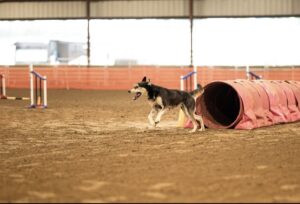
A tunnel, a couple of low jumps, some poles to weave and a platform to pause on combine sprinting with thinking, and running a sequence with you is a team activity that builds focus. Ten minutes is plenty. Our DIY agility guide shows how to build one for under $100 and how to train each piece.
15. Teach an off switch
This is the one that changes the dog. Put a mat or bed down, and every time the dog lies on it and relaxes, calmly drop a treat between its paws. No cue, no excitement. Do it while you watch TV, while you cook, after every exercise session. Over a couple of weeks the dog learns that lying quietly on the mat is something that pays, and you can start asking for it: after the flirt pole, when guests arrive, when the dog is pacing at 8pm. Pair it with a rule that exciting things end with calm things, so every tug game or fetch session finishes with two minutes on the mat and a chew. A high-energy dog with an off switch is a pleasure to live with. One without it is never tired enough.
Putting it together: what a good day looks like
| When | What | Time |
|---|---|---|
| Morning | Breakfast scattered on the lawn or in a puzzle feeder. A 20 to 30 minute walk with at least half of it on a loose leash for sniffing. | 30 to 40 minutes |
| Midday | Five minutes of trick or impulse-control training. A frozen Kong or chew if the dog is alone. | 5 minutes of your time |
| Late afternoon | The hard burst: flirt pole, tug, sprint recalls, a swim or hill repeats. Warm up first, then finish with two minutes of settling on the mat. | 15 to 20 minutes |
| Evening | Dinner in a snuffle mat or as a find-it game. Mat time with a chew while you eat or watch TV. | 15 minutes, then rest |
That’s 60 to 90 minutes, most of it folded into things you’d do anyway, and it’s enough for most high-energy adult dogs. Through the week, rotate the hard burst so the dog isn’t doing the same thing daily: flirt pole Monday, hills Tuesday, a play date Wednesday, swim or treadmill Thursday, agility Friday, a long hike on the weekend and one easy day. Variety is part of what tires them, and it spreads the load across different joints and muscles.
When it isn’t energy
Some dogs that look like they need more exercise need something else, and adding exercise makes them worse.
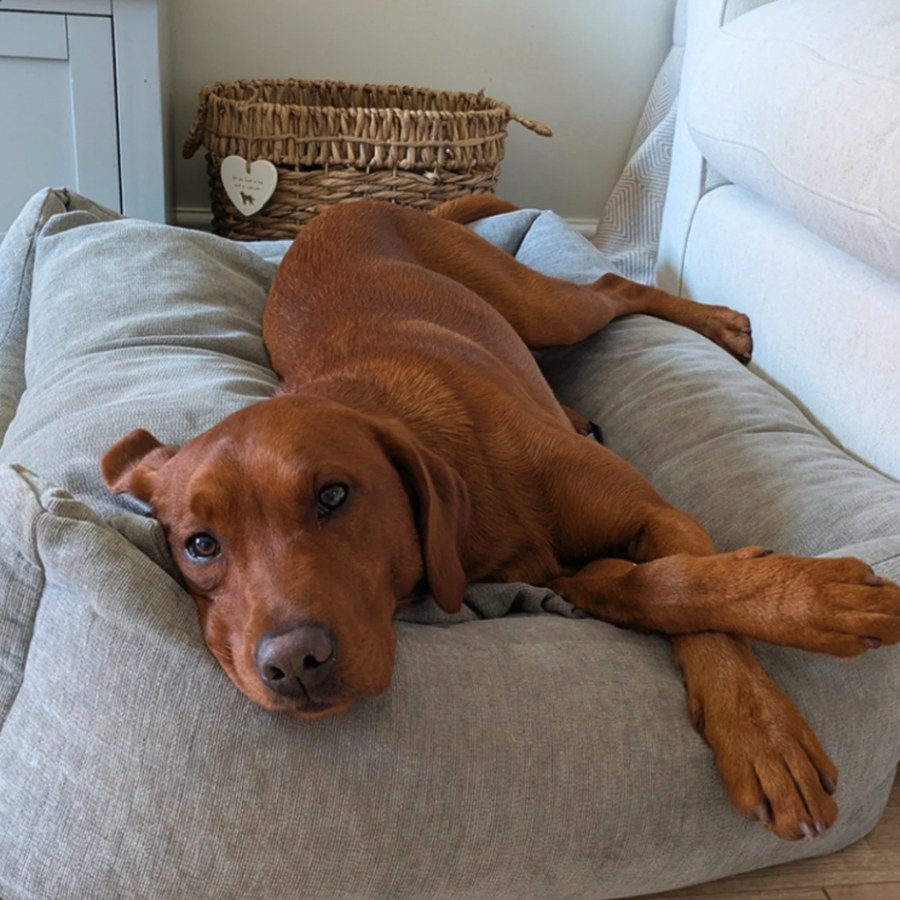
The over-tired dog. Like a toddler, a dog that hasn’t slept enough gets frantic, mouthy and unable to settle. Adult dogs need 12 to 14 hours of sleep a day and adolescents more. If your dog is on the go from morning until night and getting wilder as the day goes on, the fix is enforced naps in a crate or quiet room, not another walk.
The adolescent. Between about 6 and 18 months, dogs have adult energy and no brakes. Most of what looks like endless energy at this age is impulse control that hasn’t developed yet. Keep exercise sensible, lean hard on training and mat work, and it passes.
The anxious dog. Pacing, whining, shadowing you, destroying things only when alone, and being unable to settle even after a big day point to anxiety, not excess energy. Hard exercise raises stress hormones and can make an anxious dog more wound up. Sniffing, licking, chewing and predictable routines help more, and a vet or behaviorist is worth the visit.
The dog that’s sore or itchy. A dog that can’t get comfortable will be restless. Sudden changes in settling, especially in an older dog, deserve a vet check before a new exercise plan.
Who needs a modified version
Puppies under a year. No forced running, no flirt pole, no repetitive jumping and no long hikes while the growth plates are open. Puppies are tired out by short play sessions, sniffing, training in two-minute bursts and food puzzles, and they need a great deal of sleep. See our puppy exercise guide.
Flat-faced breeds. Frenchies, Bulldogs, Pugs and Boxers overheat quickly and can’t cool themselves by panting the way other dogs can. Keep bursts short, work in the cool of the day, and lean on brain work. Details in our guide to exercise for flat-faced dogs.
Seniors and dogs with joint problems. Swap the sprints for swimming, sniff walks, gentle hills and scent games. An old dog with a busy brain still needs a job; it just needs a low-impact one.
Bad weather days. Tug, find-it, trick training, a treadmill, stairs walked slowly, and meals through puzzles will cover a day indoors. Our indoor exercise guide has the full list.
Mistakes that keep dogs wired
Adding distance instead of changing the work. Throwing a ball until the dog drops, which builds obsession and wears out joints. Using a dog park as the only outlet, so the dog learns that other dogs mean chaos. Exercising hard right before you need the dog calm, with no cool-down; a dog needs 20 to 30 minutes to come down after a hard burst. Skipping brain work because it doesn’t look like exercise. Never practicing calm. And ignoring sleep: a dog that never gets a quiet stretch in the day can’t regulate itself in the evening.
Frequently asked questions
What is the fastest way to tire out a dog?
A flirt pole. Five to ten minutes of chasing a toy on a rope tires most dogs more than a long walk. Tug, sprint recalls and swimming are close behind. Follow any of them with a few minutes of settling so the dog comes down properly.
Why is my dog still hyper after a long walk?
Because a steady walk is easy for a fit dog and asks nothing of its brain. Add intensity (hills, a flirt pole, tug), add sniffing and training, and teach the dog to settle afterward. If the dog is frantic and can’t settle at all, it may be over-tired or anxious instead of under-exercised.
How do I tire out my dog indoors?
Tug, find-it games around the house, five-minute training sessions, meals in a snuffle mat or puzzle feeder, a frozen Kong, slow stair climbs, and a treadmill if you have one. Brain work does most of the job indoors.
How do I tire out a high-energy dog before work?
Ten minutes of flirt pole or tug in the yard, breakfast scattered on the lawn while you get ready, and a frozen Kong as you leave. That’s about 15 minutes of your time and covers physical, mental and settle.
Does mental stimulation tire a dog out as much as exercise?
Minute for minute, often more. Fifteen minutes of scent work or training leaves most dogs calmer than 30 minutes of walking. The best results come from doing both.
Can you over-exercise a high-energy dog?
Yes. Signs include limping or stiffness the next day, lagging behind, heavy panting that doesn’t settle within 10 minutes, and a dog that gets more frantic instead of calmer. High-drive dogs won’t stop on their own, so you set the limit, and one easy day a week is part of the plan.
How much exercise does a high-energy dog need?
Most healthy high-energy adults do well on 60 to 90 minutes a day of mixed work: one hard burst, a walk with sniffing, and two or three short brain sessions. Working-line dogs may need up to two hours, with more of it as training and tasks.
Will my dog calm down with age?
Most dogs settle noticeably between two and three years old, working breeds a little later. You don’t have to wait for it, though. A dog that’s taught an off switch at one is calmer at one.
Where this fits in your dog’s plan
Tiring out a high-energy dog is a matter of the right mix in the right amounts, and that mix depends on the dog’s breed, age, fitness and joints. A PetFitness plan sets it out for your dog: how much hard work, how much brain work, what to do on which days, and how to build up safely. If you’d like one built, start your dog’s plan here. If you’d rather start tonight: scatter dinner on the lawn, play five minutes of tug with a drop between rounds, then sit down with a mat beside you and pay your dog for lying on it.