Written by the PetFitness team and reviewed by our Certified Canine Fitness Trainers. Last updated November 13, 2026.
Dog cavaletti are a row of low poles that a dog walks or trots over, one step between each pole. That’s the whole exercise, and it’s one of the most useful things in canine fitness. Rehab therapists use cavaletti to get dogs using a leg again after surgery. Sport handlers use them to lengthen stride and tidy up footwork. Owners of senior dogs use them to keep stiff hips and knees moving through their full range. They cost almost nothing, fit in a hallway, and take five minutes a session. The catch is that the setup matters: poles spaced or raised wrong turn a precise exercise into a row of things to hop over. This guide covers what cavaletti do, how to build a set at home, the spacing and height for your dog’s size, how to teach it, ten variations, and how to adapt them for seniors, rehab and sport dogs.
The short version
- What they are: four to six poles in a row, on or just above the ground, that the dog steps over at a walk or trot with one stride between poles.
- What they do: make the dog lift and place each foot on purpose. That builds body awareness, joint range of motion, core strength, even stride and hind-end muscle, with almost no impact.
- Spacing: for walking, set the poles about one shoulder height apart (your dog’s height at the withers). Adjust until the dog takes one clean step between each.
- Height: start with poles flat on the ground. Raise to wrist height at most for general fitness, never above the hock.
- Pace: slow. A slow walk is harder and more valuable than a trot. If the dog is hopping or rushing, lower the poles and slow down.
- Dose: 4 to 6 passes, three or four times a week. Five minutes is a full session.
- DIY cost: under $20. PVC pipe, broomsticks or pool noodles on cones, bricks or plastic cups.
What cavaletti do for a dog
The word comes from horse training, where riders have used rows of ground poles for a century to improve a horse’s rhythm and balance. The canine version works on the same principle. A dog walking on flat ground can shuffle, drag its toes, shorten the stride on a sore leg and lean on its front end, and most dogs with any stiffness or weakness do exactly that. Put poles in the way and none of those shortcuts work. Each leg has to lift, clear the pole and land in a specific spot, one at a time, in rhythm.
That simple demand does several things at once. It trains proprioception, the dog’s sense of where its feet are, which fades with age, injury and nerve problems and is the first thing rehab tries to restore. It takes the hips, knees, hocks, elbows and wrists through more bend than normal walking does, which keeps joints mobile. It makes the dog shift weight from leg to leg with control, which works the core and the stabilizing muscles around each joint. It evens out a lopsided gait, because a dog can’t favor one leg over a row of poles without clipping them. And it asks the hind legs to step up and under the body, which is the movement that builds a stronger rear end. All of that happens at a walk, with no jumping and almost no impact, which is why the same exercise suits a 13-year-old Labrador and a three-year-old agility dog.
Who should use them
Senior dogs get the most from cavaletti. Toe dragging, stumbling and a shortening stride are signs the dog is losing track of its back feet, and ground poles are the direct fix. They pair well with the routine in our senior exercise guide.
Dogs in rehab after cruciate surgery, a fracture, a spinal problem or a soft-tissue injury use them in the middle phases of recovery to restore normal leg use, once the vet or therapist clears it. Our injury recovery guide and ACL surgery plan show where they fit.
Dogs with arthritis, hip dysplasia or weak back legs benefit from the range-of-motion work, with poles kept flat or very low. See our guides to arthritis, hip dysplasia and weak back legs.
Sport and working dogs use them for stride length, rhythm and footwork, and as a warm-up before agility, flyball or field work.
Puppies can walk over poles lying flat on the ground from about four months as a body-awareness game. No raised poles and no trotting sets until they’re grown; our puppy exercise guide explains why.
Healthy adult pets get a core and coordination session that makes everything else they do safer. Who should hold off: dogs in the first weeks after surgery, dogs with an undiagnosed limp, and dogs in a pain flare. Get the vet’s okay first for any dog with a diagnosed joint or nerve condition.
How to build a set at home
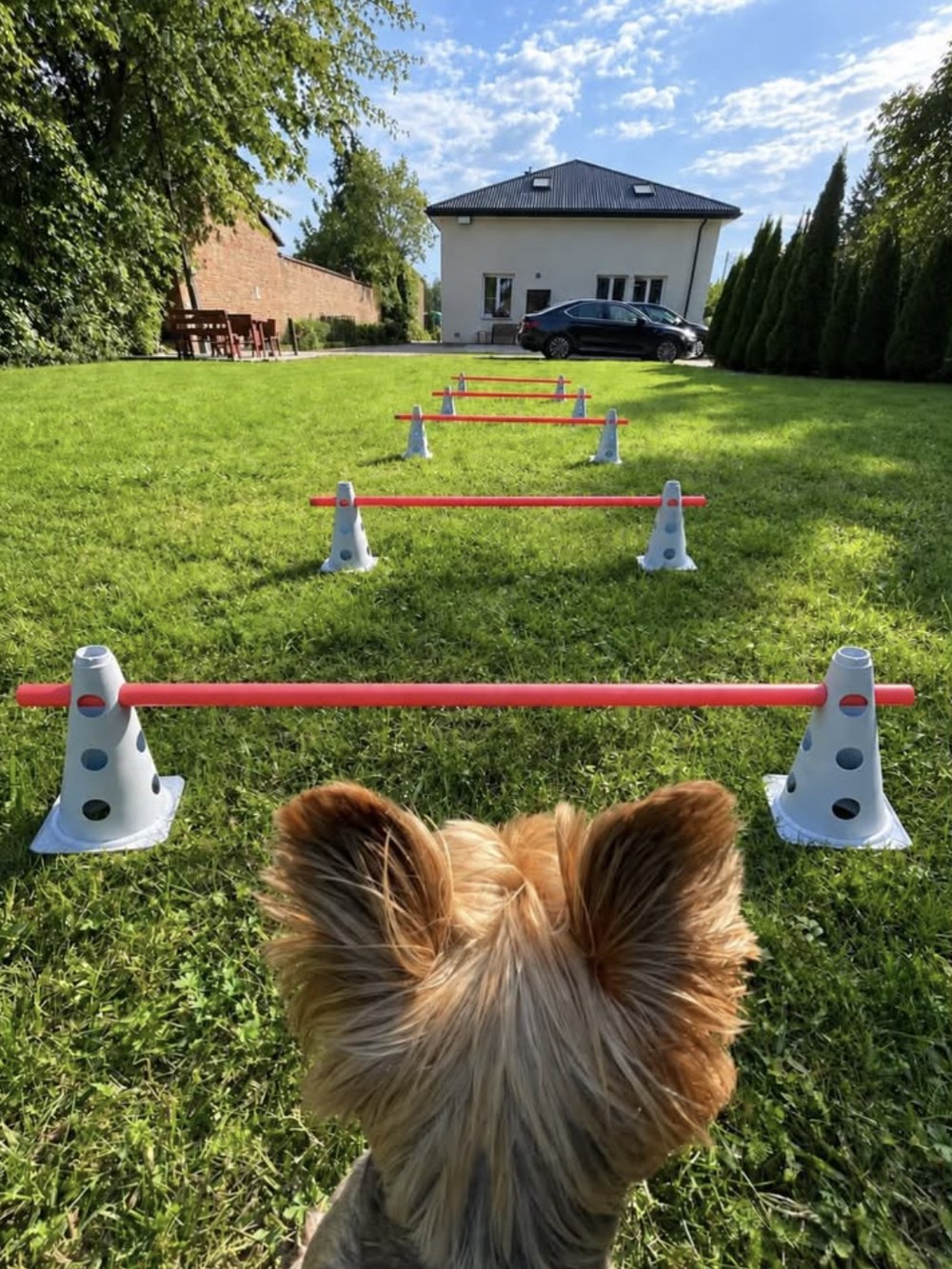
You need poles and something to rest them on. The Yorkie in the photo is looking at a typical home set: five lightweight poles sitting in training cones with holes at several heights, in a straight line on grass.
| Part | Options | Cost |
|---|---|---|
| Poles (4 to 6) | 3/4 or 1 inch PVC pipe cut to 3 or 4 feet, broomsticks, wooden dowels, bamboo garden canes, or pool noodles for nervous or small dogs. Light is good: a pole should roll away if a foot hits it. | $0 to $12 |
| Supports | Training cones with holes (the easiest way to change height), bricks, paving blocks, upturned plastic cups with a notch cut in the rim, shoe boxes, or small buckets. For ground-level work you need nothing; lay the poles on grass. | $0 to $15 |
| Surface | Grass, carpet, rubber matting or a runner rug. Avoid bare tile, hardwood and laminate; lay yoga mats or a rug down the line if that’s what you have. | $0 |
| Ready-made set | Dog cavaletti kits with clip-in poles and adjustable stands. Convenient, tidy, not necessary. | $40 to $120 |
Two rules on construction. Poles must never be fixed in place; if the dog catches one, it should fall or roll. And keep the poles wide enough that the dog walks through the middle without thinking about going around, which for most dogs means 3 feet or more, or set the row along a wall or fence to close one side.
Spacing and height: getting it right for your dog
This is the part that makes cavaletti work. The goal is one clean step between each pair of poles: front foot over, hind foot over, next pole. Too close and the dog shortens up or tries to clear two at once. Too far and the dog adds an extra shuffle step or stretches. Too high and the dog starts to hop, which turns a controlled range-of-motion exercise into jumping.
Spacing for walking: start with the poles one shoulder height apart. Measure your dog from the floor to the top of the shoulder blades (the withers) and use that number as the gap between poles. Then watch the dog go through and adjust by an inch or two until every stride lands in the middle of a gap.
Spacing for trotting: wider, usually one and a quarter to one and a half times shoulder height, because the trot stride is longer. Set it by watching: at the right distance the dog trots through in an even rhythm with one footfall per gap and doesn’t touch a pole.
Height: begin flat on the ground, always. For general fitness, raise the poles over a couple of weeks to somewhere between the top of the paw and the wrist (the carpus, the joint just above the front paw). The usual upper limit is hock height, the point of the back-leg ankle, and that’s for fit dogs doing deliberate slow work. Seniors and rehab dogs often stay at one to three inches for good.
| Dog size (shoulder height) | Walk spacing | Trot spacing | Working height |
|---|---|---|---|
| Small (under 12 in): Yorkie, Dachshund, Frenchie | 8 to 12 in | 12 to 16 in | Ground to 2 in |
| Medium (12 to 20 in): Cocker, Beagle, Border Collie | 12 to 20 in | 18 to 28 in | Ground to 4 in |
| Large (20 to 26 in): Lab, Golden, Shepherd | 20 to 26 in | 28 to 38 in | Ground to 6 in |
| Giant (over 26 in): Great Dane, Mastiff | 26 to 32 in | 36 to 46 in | Ground to 8 in |
Treat the table as a starting point. Leg length, stride and age all shift the numbers, and the dog’s movement is the real measure. If poles are being knocked, feet are landing on poles, or the rhythm is uneven, change the spacing before you change anything else.
How to teach it
- One pole on the ground. Walk the dog over it on leash, at your side, at a slow walk. Reward after the dog has stepped over, not before. Repeat until the dog walks over without looking at it.
- Add poles one at a time until you have four, all flat on the ground, at walk spacing. Walk beside the row, not in front of the dog, so the dog looks ahead and down instead of up at you.
- Keep the head level. A treat held high pulls the head up and hollows the back. Hold the treat low at nose height, or place a target (a lid with a treat on it) on the ground a few feet past the last pole so the dog walks toward it with a level topline.
- Slow it down. If the dog rushes, shorten the leash a little, walk slower yourself, and reward calm passes. Slow is the exercise.
- Check the footfall. Watch from the side or film it. You want one front foot and one hind foot landing in each gap. Adjust spacing until you see it.
- Raise the poles an inch or two only once flat poles are clean and boring, usually after a week.
- Go both directions, and walk on both sides of the dog, so the work is even.
A session is four to six passes, then done. Most dogs learn the basic walk-through in one or two sessions.
Ten cavaletti exercises, easiest to hardest
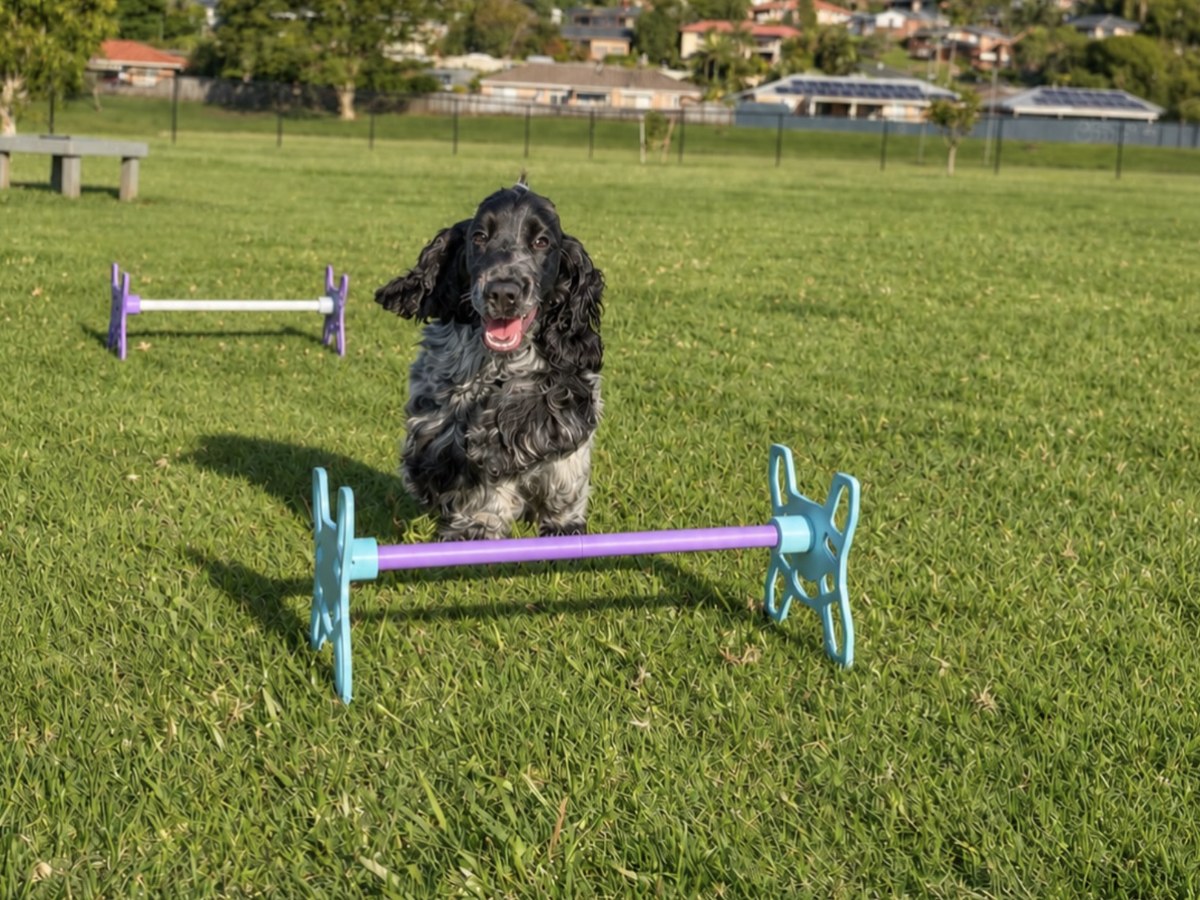
1. Flat walk-through
Four to six poles on the ground, slow walk. The foundation, and for many seniors the only version they need.
2. Raised walk
The same row at paw-to-wrist height. The dog has to bend each joint further and hold its balance for longer on three legs. This is the standard strengthening version.
3. Slow-motion walk
Raised poles, and you walk as slowly as you can. Each leg hangs in the air longer, which multiplies the balance and core demand. Harder than it sounds, and the best version for building control.
4. Stand in the poles
Stop the dog halfway through so it’s standing with poles between its feet, hold five to ten seconds, walk on. Stopping and restarting with the feet placed between poles is strong balance work.
5. Alternating ends
Raise the left end of the first pole, the right end of the second, and so on, so each pole slopes the opposite way. The dog has to lift each side to a different height, which works the body side to side and makes the dog think about every step.
6. The fan (curved poles)
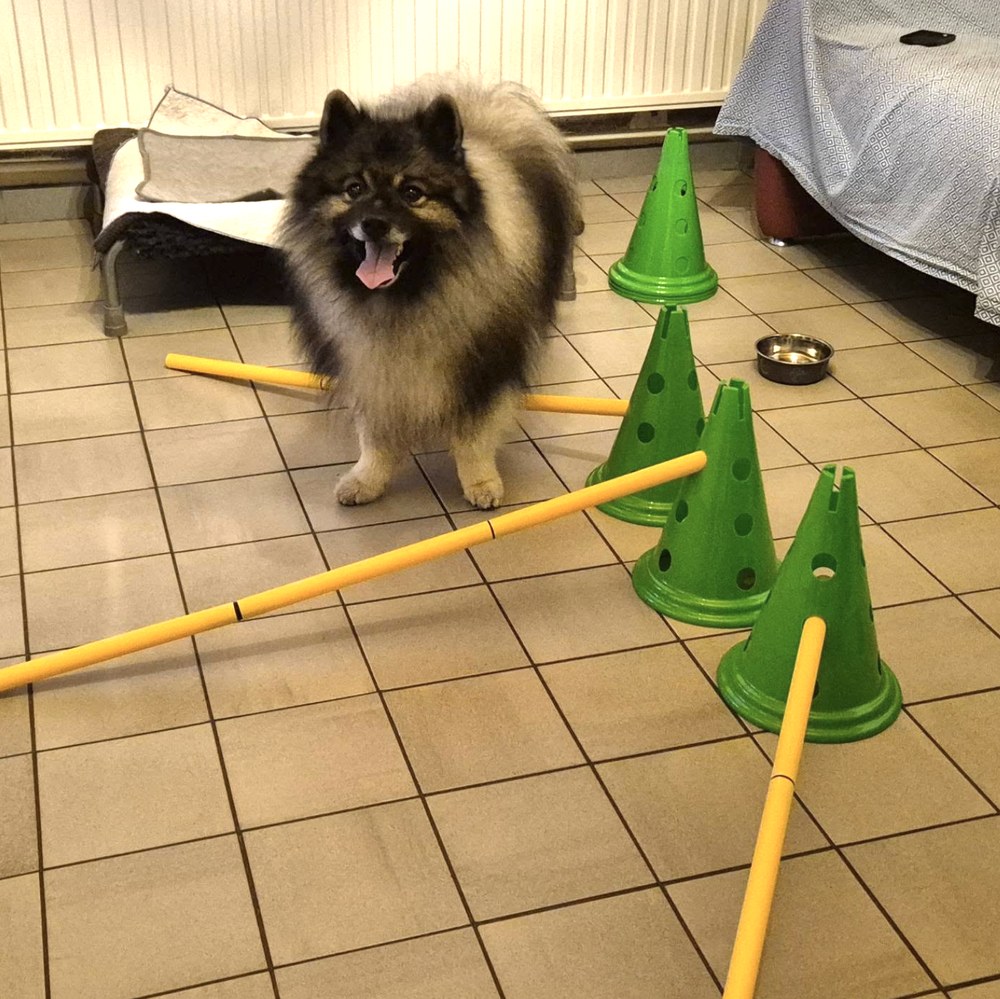
Set the poles like spokes of a wheel, close together at one end and spread at the other, as in the photo above. Walking the curve makes the inside legs take short steps and the outside legs long ones, which bends the spine and loads each side differently. Walk it in both directions. The inner track is harder for small dogs and the outer track suits big ones. If you set it up indoors on tile like this, put a rug or yoga mats underneath so the feet don’t slide.
7. Uneven spacing
Once the dog is good at an even row, vary the gaps slightly, an inch or two more or less. The dog can no longer run on rhythm and has to judge each step. Keep it at a walk.
8. Trot sets
For fit adult dogs. Widen the spacing to trot distance, lower the poles to a couple of inches, and trot the dog through on a loose leash. A good trot set looks smooth and springy with no ticking of poles. This is the version sport handlers use for stride and rhythm.
9. Sidestepping
Stand the dog parallel to a single low pole and ask it to step sideways over it, front feet then back feet. Sideways movement works the muscles on the inside and outside of the hips and shoulders, which forward walking barely touches.
10. Backing over a pole
For dogs that already know how to back up. Ask the dog to walk backward over one pole on the ground. The hind feet have to find and clear something the dog can’t see, which is about the hardest body-awareness task there is. One pole, flat, a few reps.
A four-week starter plan
| Week | What to do | Sessions |
|---|---|---|
| 1 | Four poles flat on the ground at walk spacing. Slow walk, both directions. Find the right spacing. | 3 sessions, 4 passes |
| 2 | Five or six poles. Raise to paw height. Add a stand in the poles on two of the passes. | 3 or 4 sessions, 6 passes |
| 3 | Raise toward wrist height if the dog is clean. Add slow-motion passes and alternating ends. | 3 or 4 sessions, 6 passes |
| 4 | Add the fan in both directions. Fit adult dogs can try a low trot set. Seniors and rehab dogs stay with weeks 2 and 3. | 3 or 4 sessions, 6 to 8 passes |
After that, cavaletti become a five-minute piece of the dog’s weekly routine, alongside the strength work in our muscle-building guide, the core exercises and the balance work. They also make a good warm-up before a backyard agility session, and the poles double as part of the course.
Cavaletti for seniors and rehab
For older dogs and dogs coming back from injury, the rules tighten. Poles stay on the ground or at one to three inches. Spacing can be a little closer than the table, since stiff dogs take shorter steps; set it to the stride the dog has, then widen it gradually as the stride improves, which is one of the ways you’ll see progress. Walk only. Use a harness, and a rear sling for a dog that’s unsteady behind. Work on carpet, a rubber runner or grass, never a slick floor. Four passes is plenty at first.
Watch the feet. A dog that drags a toe over a pole, steps on poles, or swings a leg out to the side to avoid bending it is telling you about a specific joint or a loss of awareness in that limb, and that’s useful information for your vet or therapist. Over a few weeks you should see cleaner clearance and a longer, more even stride. Cavaletti combine well with water work; many rehab clinics use them on land between sessions of hydrotherapy. If a dog is worse after a session, the poles were too high or the session too long.
Mistakes to avoid
Poles too high, so the dog hops instead of steps. Going too fast, which lets momentum do the work. Spacing copied from a chart and never adjusted to the dog. Luring with a treat held high, which lifts the head and drops the back. Slippery floors. Fixed poles that don’t fall when hit. Too many passes; the quality drops after six or eight, and tired dogs clip poles. Working only in one direction or always on the same side of the dog. And treating cavaletti as jumps: if all four feet are leaving the ground at once, lower the poles.
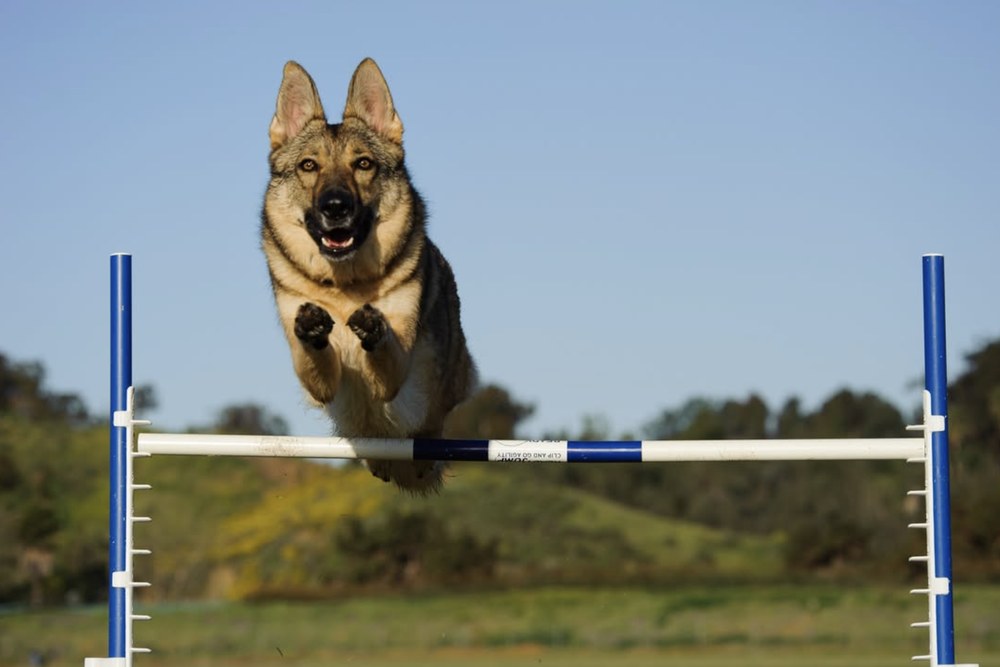
For comparison, the photo above is an agility jump: the bar is high and the dog clears it with all four feet in the air. It’s a great sport for a fit dog, and it’s a different exercise. Cavaletti stay low so the dog steps, one leg at a time.
Frequently asked questions
What are cavaletti for dogs?
A row of low poles the dog steps over at a walk or trot, one stride between poles. They’re used in canine fitness and rehab to improve body awareness, joint range of motion, balance, core strength and gait.
How far apart should dog cavaletti poles be?
For walking, about one shoulder height apart (the dog’s height at the withers). For trotting, one and a quarter to one and a half times that. Adjust until the dog takes one clean step between each pair of poles.
How high should cavaletti be for dogs?
Start flat on the ground. For general fitness, work up to between paw and wrist height. Hock height is the usual maximum, for fit dogs doing slow controlled work. Seniors and rehab dogs often stay at one to three inches.
How many cavaletti poles do I need?
Four to six. Fewer than four doesn’t give the dog a rhythm; more than six adds little. One pole is enough for sidestepping and backing exercises.
How often should my dog do cavaletti?
Three or four times a week, four to six passes a session. It’s a quality exercise, so short and often beats long and occasional.
Are cavaletti good for older dogs?
They’re one of the best exercises for them. Ground-level poles at a slow walk help with toe dragging, stumbling and a shortening stride, and keep the hips and knees moving through their range with almost no impact.
Can puppies do cavaletti?
Poles flat on the ground at a walk, yes, from about four months, as a body-awareness game. No raised poles or trotting sets until the growth plates close, around 12 to 18 months depending on breed size.
What’s the difference between cavaletti and agility jumps?
Height and purpose. Cavaletti are low and stepped over one leg at a time to train movement quality. Jumps are cleared with all four feet off the ground. If your dog is jumping your cavaletti, they’re too high or too close.
Where this fits in your dog’s plan
Cavaletti are a small exercise that pays off in everything else a dog does, from getting up off the floor to running a course. A PetFitness plan sets the spacing, height and progression for your dog and puts the poles alongside the right strength, balance and conditioning work for its age and condition. If you’d like one built, start your dog’s plan here. If you’d rather start tonight: lay four broomsticks on the lawn a shoulder height apart, and walk your dog over them slowly, four times.