Written by the PetFitness team and reviewed by our Certified Canine Fitness Trainers. Last updated September 16, 2026.
A treadmill is the most useful piece of dog fitness equipment nobody teaches you how to use. Done right, it gives a dog a controlled walk or trot in any weather, in any apartment, at exactly the speed and duration you choose. Done wrong, it teaches the dog that the belt is something to fear, and you never get a second chance at a first session. This guide is the full method: which treadmill to use, how to introduce it over the first two weeks, what speed and how long by dog size, a four-week plan, and the safety rules we don’t bend on.
The short version
- Timeline: most dogs are walking calmly on a moving belt within 7 to 14 days of short daily sessions. Rushing it is the number one reason dogs refuse the treadmill for good.
- Speed: a walk, not a run. Roughly 1 to 2 mph for small dogs, 2 to 3 mph for large dogs. Trotting (3 to 4.5 mph) only after a month of clean walking.
- Duration: 1 to 3 minutes in week one, building to 15 to 20 minutes by week four. Cap sessions at 30 minutes.
- Human treadmill: works for dogs under about 40 lb at walking speeds. Large dogs need a belt 1.5 to 2 times their body length, which most home treadmills don’t have.
- Never tie the leash to the treadmill, never leave the room, and never use it for a dog that is limping, recovering from surgery, or afraid of it.
What treadmill training does for a dog (and what it doesn’t)
A treadmill does one thing very well: it delivers a measured amount of steady-state cardio with none of the variables of a real walk. No stopping to sniff, no pulling, no ice, no 95-degree pavement, no other dogs. For a working breed that needs 60 to 90 minutes of movement a day and lives with someone who can give it 30, that’s the difference between a dog that is settled at night and one that isn’t. It’s also the easiest way to add controlled exercise to a weight loss plan, because you can set the exact speed and time and repeat it tomorrow.
What it doesn’t do is replace walks. Dogs need to sniff, and a walk where the dog reads the neighborhood does more for its brain than any treadmill session. Our rule in the PetFitness program: the treadmill supplements outdoor exercise, it never replaces it entirely. If your dog’s only movement is on a belt, something is missing. See how much exercise your dog actually needs before deciding how much of it the treadmill should cover.
Which treadmill: human, motorized dog treadmill, or slatmill
The type of treadmill you use changes the training, so settle this first. There are four options that matter.
| Type | How it works | Best for | Typical price |
|---|---|---|---|
| Human treadmill | Motor drives the belt. You set the speed. Belt is usually 20 x 55 in with no side rails. | Dogs under about 40 lb, walking pace only. You probably already own one. | $0 if you have it |
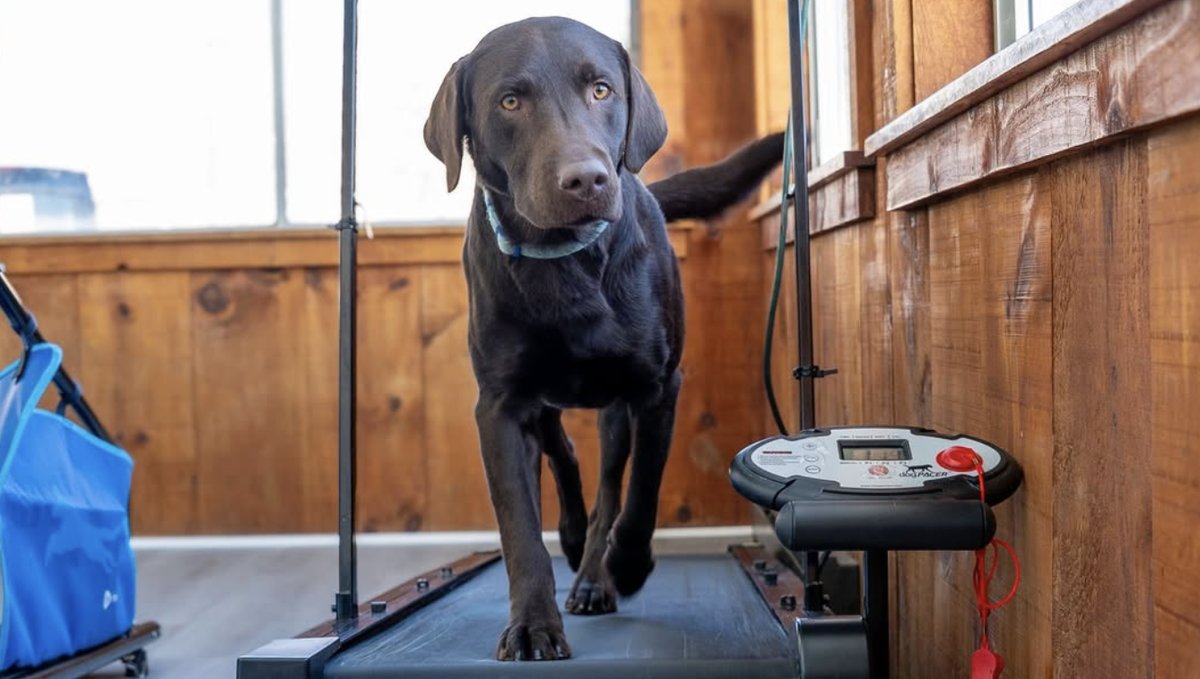
| Motorized dog treadmill | Same idea, built for dogs: longer belt, low deck, side rails, slower minimum speed, quieter motor. | Most pet dogs. The safest option for beginners and for large breeds. | $500 to $2,000 |
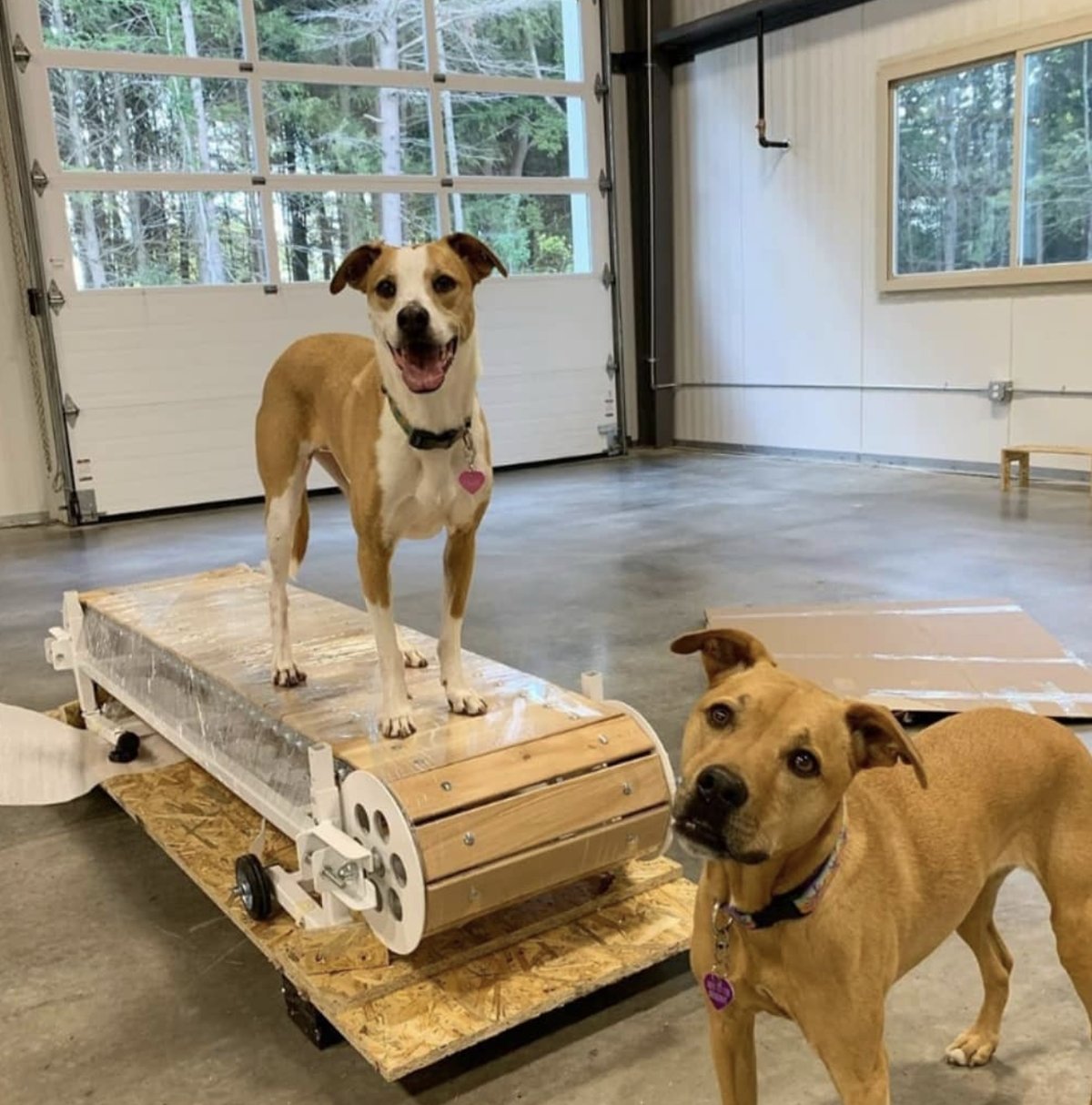
| Slatmill (non-motorized) | Free-spinning slats. The dog powers it and sets its own pace. Stops when the dog stops. | Fit adult dogs, sport and working dogs, conditioning for muscle and stamina. | $700 to $2,500 |
| Underwater treadmill | Belt inside a water tank at a rehab clinic. Buoyancy takes weight off the joints. | Post-surgery rehab, arthritis, obese dogs that can’t tolerate land work yet. | $30 to $70 per session |
The belt length rule. The belt should be 1.5 to 2 times your dog’s body length (nose to base of tail) so the dog can take a full stride without its back feet hanging off the end. A 55-inch human belt is fine for a Beagle and marginal for a Lab. This is the main reason large dogs belong on a dog-specific treadmill.
Human treadmill cautions. If you’re using yours: the motor housing at the front is a tripping hazard and gets warm, the minimum speed on some models (1.0 mph or more) is too fast for a tiny dog’s first sessions, and there are no rails, so a dog can drift sideways off the belt. It’s workable for a small or medium dog with you standing right there. It’s a bad idea for a giant breed or a dog that has never been on one.
Slatmill note. Because the dog drives it, a slatmill can’t force pace, which makes it the safest type in one sense and the hardest to learn in another. Dogs have to figure out that walking makes the slats move. Expect an extra week of introduction. The payoff is that a fit dog on a slatmill can self-regulate into a trot and build real muscle, which is why sport dog people use them. If your goal is stamina rather than just steps, see our guide to building dog stamina safely.
Who should not treadmill train
- Puppies under 12 months (large breeds, under 18 months). Growth plates are still open. Puppies get different exercises.
- Any dog that is currently limping, sore, or within a vet’s post-surgery restriction window. Underwater treadmills at a rehab clinic are a different story and are often prescribed for exactly these dogs.
- Flat-faced breeds (Bulldogs, Pugs, Frenchies) in warm rooms or at any speed above a slow walk. They overheat before they get tired.
- Dogs with diagnosed heart conditions, unless the vet has cleared steady-state exercise.
- Any dog that panics on the belt after a proper two-week introduction. Some dogs never take to it, and forcing the issue makes it worse. Use other indoor exercise instead.
How to train your dog to walk on a treadmill: the 8-step method
The whole method comes down to one idea: the dog should never experience anything on the treadmill it wasn’t already comfortable with the day before. Each step lasts as many days as it needs. Most dogs move through steps 1 to 5 in a week and are walking cleanly by day 10 to 14. Nervous dogs take three weeks. That’s fine.
Before you start: fit a well-padded harness (not a collar) and clip a leash to it. You’ll hold the leash throughout. Have small, soft, high-value treats in a pouch. Put the treadmill somewhere with a wall on one side if possible, so there’s only one way off.
Step 1. Treadmill off, treat on the belt (day 1 to 2)
Treadmill unplugged. Toss treats onto the belt and let the dog step on to get them, then step off. Two or three minutes, twice a day. Say nothing, ask nothing. You want the dog to decide the treadmill is where good things happen. Feed dinner on the belt if the dog is hesitant.
Step 2. Standing on it, facing forward (day 2 to 3)
Lure the dog onto the belt facing the front. Reward it for standing there for 5, then 10, then 20 seconds. Step off, repeat. Use the harness and leash but keep the leash slack. If the dog jumps off, no correction, just start over. Done when the dog will stand calmly for 30 seconds while you stand beside it.
Step 3. Motor on, belt not moving (day 3 to 4)
Turn the treadmill on with speed at zero (or the lowest it goes with the dog off, then stop it) so the dog hears the motor and feels the hum. Repeat step 2 with the noise present. Skip this on a slatmill; there is no motor.
Step 4. First movement (day 4 to 6)
Dog on the belt, you beside it holding the leash in one hand and a treat in front of its nose with the other. Start the belt at the slowest possible speed (0.5 to 0.8 mph on a dog treadmill, the minimum on a human one). Most dogs will take a few surprised steps and want off. Let them off after 5 to 10 seconds, reward, and repeat. Three to five short reps per session. On a slatmill, lure the dog one step forward with the treat so it learns that walking moves the slats, and reward every step at first.
Step 5. Thirty seconds of walking (day 6 to 8)
Same speed, longer. Feed a treat every few seconds while the dog walks, keeping the treat at nose height at the front of the belt so the dog stays centered. Build to 30 seconds, then a minute. Stop the belt while the dog is still calm, not after it starts trying to leave. Ending on a good note is the entire game.
Step 6. Find the dog’s walking speed (day 8 to 10)
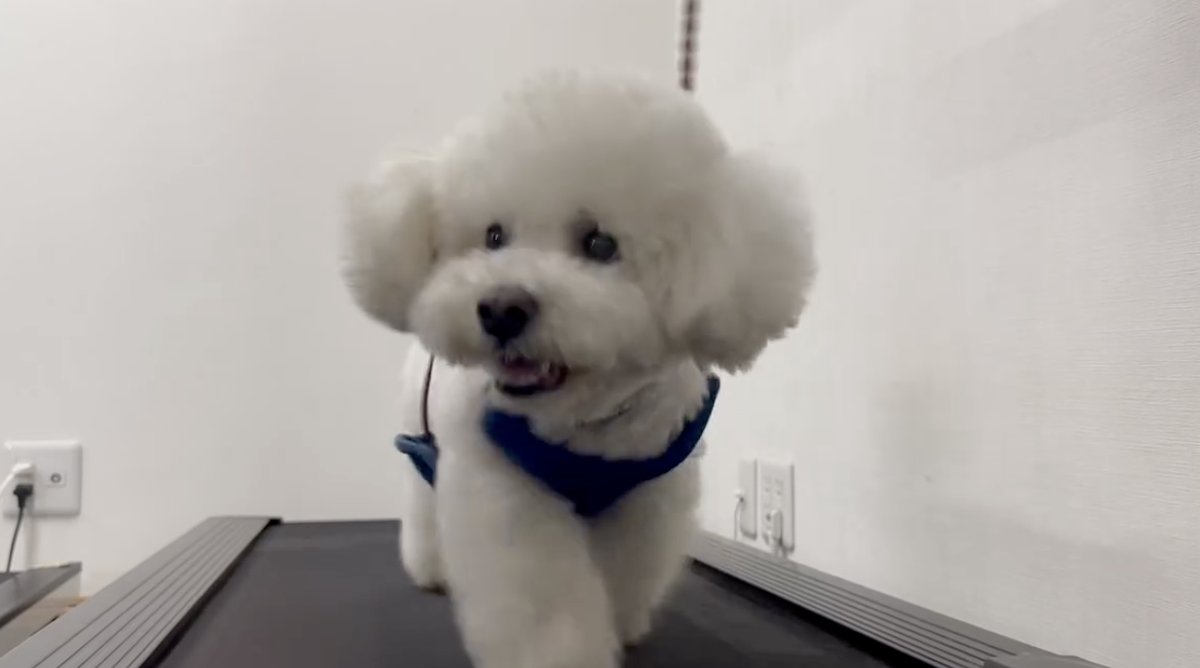
Raise speed in 0.2 to 0.3 mph increments until the dog is walking with a natural, relaxed gait: head level, tail neutral, feet landing in the middle of the belt. Too slow and the dog shuffles or tries to sniff the belt. Too fast and it breaks into a trot or drifts back. Note the speed. That’s your baseline for the next month.
Step 7. Fade the treats and the lure (day 10 to 14)
Move from a treat every few seconds to one every 30 seconds, then one at the end. Keep talking to the dog and stay beside it. Build to 5 minutes. Most dogs are here by the end of week two.
Step 8. Build duration, not speed (week 3 onward)
Add 2 to 3 minutes per session every few days until you reach your target, usually 15 to 20 minutes. Speed stays the same. Only once the dog has done a month of clean 15-minute walks do you consider adding trotting intervals, and then only for dogs that are physically ready for it.
Speed and duration by dog size
These are the ranges we use in PetFitness plans for healthy adult dogs. Your dog’s ideal walking speed is whatever produces the relaxed gait described in step 6; the table tells you where to look for it.
| Dog size | Walking speed | Trot (advanced only) | Target session | Sessions per week |
|---|---|---|---|---|
| Small (under 20 lb) | 1.0 to 2.0 mph | 2.5 to 3.5 mph | 10 to 15 min | 3 to 5 |
| Medium (20 to 50 lb) | 1.5 to 2.5 mph | 3.0 to 4.0 mph | 15 to 20 min | 3 to 5 |
| Large (50 to 90 lb) | 2.0 to 3.0 mph | 3.5 to 4.5 mph | 20 to 30 min | 3 to 5 |
| Giant (90 lb and up) | 2.0 to 3.0 mph | Usually skip trotting | 15 to 20 min | 3 to 4 |
A few things the table can’t tell you. Fit sporting dogs will happily walk at the top of their range and beyond; overweight and senior dogs belong at the bottom. Incline, if your treadmill has it, is a better way to make a session harder than speed: 3 to 5 percent incline at walking pace works the rear end hard with no impact. Don’t use the treadmill on the same day as a weighted vest session or a long hike; it’s one of the day’s workouts, not an add-on. And never run a dog on a motorized treadmill at a gallop. A gallop is a bounding gait that doesn’t suit a fixed-speed belt, and if the dog stumbles at 8 mph it’s on the belt before you can hit stop.
The four-week starter plan
This assumes a healthy adult dog and a motorized treadmill. On a slatmill, add a week to phase one.
| Week | Goal | Session | Frequency |
|---|---|---|---|
| 1 | Comfort on the machine (steps 1 to 5) | 3 to 5 min total, belt moving for 1 to 2 min of it | Daily, twice if short |
| 2 | Find walking speed, fade treats (steps 6 to 7) | 3 to 5 min continuous walking | Daily |
| 3 | Build duration | 8 to 12 min at baseline speed | 4 to 5 days |
| 4 | Reach target | 15 to 20 min, optional 3 percent incline for the last 5 | 3 to 5 days |
After week four, the treadmill becomes a regular tool: three to five sessions a week at target duration, with outdoor walks on the other days or the same day. Once a dog has two months of clean walking, we start adding 30 to 60 second trot intervals for dogs whose plan calls for cardio, and pair it with core work and balance training on off days for a complete program.
Safety rules we don’t bend on
- You are in the room, beside the dog, every second the belt is moving. Not on your phone in the next room. Treadmill injuries happen when a dog stumbles and nobody stops the belt.
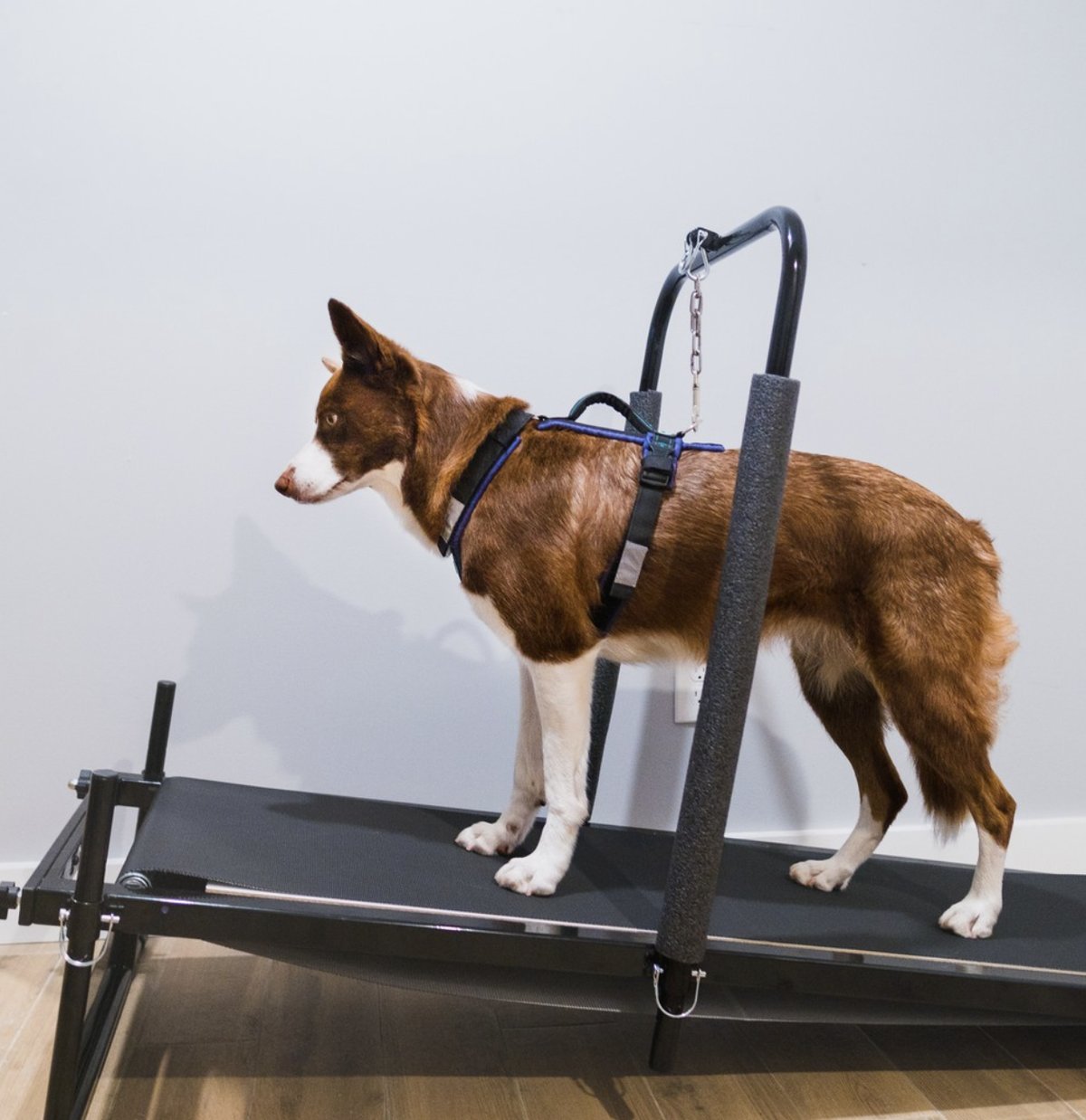
- Never tie the leash to the treadmill. Not to the rail, not to the console, not to a hook on the wall. The support bar on a dog treadmill is for you to hold the leash over, or for a loose clip that gives the dog a foot of slack, never to restrain a dog that wants off. A dog that falls while tied on can be dragged.
- Harness, not collar. A collar on a treadmill puts pressure on the throat the moment the dog drifts back.
- Warm up and cool down. Two minutes at the slowest speed at each end of the session. Then do the post-workout stretches once the dog is off.
- Water before, not during. A bowl next to the treadmill after the session. Skip sessions within an hour of a meal for deep-chested breeds.
- Nails short, pads checked. Long nails catch on belts. Rough belts and hot motors can abrade pads; check them after the first few sessions.
- Cool room. Treadmill work indoors with no airflow overheats dogs faster than the same walk outside. A fan pointed at the dog is worth it.
- Stop at the first sign of trouble. Drifting to the back of the belt, tail tucked, whale eye, repeated attempts to jump off, limping, or open-mouth panting that doesn’t settle within a minute of stopping. End the session, go back a step tomorrow.
Adapting it for seniors, overweight dogs, and rehab
Senior dogs. The treadmill is one of the best tools there is for an old dog that’s losing muscle in the hind end, because you control the speed precisely and there’s nothing to trip on. Keep speed at the bottom of the range, sessions at 5 to 10 minutes, and watch the rear feet: if they start dragging or crossing, stop. Pair it with the low-impact exercises for senior dogs and get a vet to check for arthritis first.
Overweight dogs. The treadmill is the single most controllable calorie burner in a weight loss program, and the one an out-of-shape dog can build up gradually with no joint impact beyond a walk. Start at 5 minutes and the slowest walking speed, build by two minutes a week, and accept that it will take longer than the four-week plan above. Combine it with diet; exercise alone rarely takes weight off a dog. Our body condition guide shows you how to measure progress in something more useful than the scale.
Rehab. Land treadmill work is prescribed by rehab vets for dogs recovering from cruciate surgery, hip dysplasia management, and neurological conditions, because the belt forces a symmetrical gait and stops the dog from favoring a leg. But the protocols are specific to the injury and the stage of recovery. Don’t improvise it. If your dog has a diagnosed condition, get the plan from the rehab vet and see our guides on exercise after ACL surgery and hip dysplasia exercises for what usually surrounds it.
Troubleshooting
The dog jumps off the back. Speed is too fast, or you’re standing behind the dog instead of beside it. Slow the belt and stand at the dog’s shoulder with a treat at the front.
The dog sniffs the belt or walks with its head down. Speed is too slow. Bump it 0.2 mph.
The dog freezes and won’t move on a slatmill. Normal. Lure one step at a time with a treat, reward every step for the first few sessions. Some trainers gently push the slats forward under the dog’s feet by hand to show it what happens.
The dog was fine, then started refusing. Something happened: a stumble, a loud noise, a session that ran too long. Go back to step 2 for two days and rebuild. Don’t try to push through.
The dog is fine on the treadmill but bored. Add a 3 percent incline, vary the session length, or move the treadmill to face a window. Boredom is real and a dog that dreads the treadmill will start refusing.
Frequently asked questions
Can dogs use a human treadmill?
Small and medium dogs, yes, at walking speeds with you right there. The belt on most home treadmills is about 55 inches, which gives a 40 lb dog room to stride and a 90 lb dog none. There are also no side rails, so the dog can drift off the edge. If you have a large breed or are buying new anyway, a dog-specific treadmill is the better tool.
Are dog treadmills safe?
Yes, when the dog has been introduced properly, the leash is never tied to the machine, and a person is beside the dog the whole time. Nearly every treadmill injury we hear about comes from one of those three rules being broken.
How long should a dog be on a treadmill?
One to three minutes of belt time in the first week, 15 to 20 minutes at a walk once trained, and never more than 30 minutes in a session. A fit large dog can do 30 minutes at a walk or 20 with trot intervals. Small dogs and seniors usually top out at 10 to 15.
How fast should a dog walk on a treadmill?
Whatever speed gives a relaxed, natural walk with the dog centered on the belt. For most dogs that’s between 1.5 and 3 mph depending on size. If the dog is trotting, it’s too fast for the early weeks.
Can I run my dog on a treadmill?
A trot (3 to 4.5 mph), yes, once the dog has a month of clean walking behind it and is fit enough for it. A full gallop, no. On a slatmill the dog sets its own pace and can safely trot or canter because the belt stops when the dog does. On a motorized belt, the belt doesn’t stop for a stumble.
How much does a dog treadmill cost?
Motorized dog treadmills run about $500 to $2,000 depending on size. Slatmills are $700 to $2,500. Underwater treadmill sessions at a rehab clinic are typically $30 to $70 each. If you already own a human treadmill and have a dog under 40 lb, start there before spending anything. Our dog fitness equipment guide covers what else is worth buying.
Will a treadmill tire my dog out?
Physically, yes. Mentally, less than a walk. A 20-minute treadmill session burns energy but doesn’t give the dog anything to think about. High-drive dogs need both. If you want the treadmill to settle a hyperactive dog, pair it with ten minutes of training or scent work afterward.
Is a treadmill good for a dog with weak back legs?
Often, and it’s a common rehab prescription, because the belt makes the dog use both hind legs evenly at a speed you control. Slow speed, short sessions, and a vet’s okay first. Our weak back legs guide covers the rest of the program.
Where this fits in your dog’s plan
In a PetFitness conditioning plan the treadmill covers the stamina component for dogs whose owners can’t get them enough outdoor mileage, and the plan sets the speed, duration, and progression based on your dog’s breed, age, weight, and starting fitness. If you want the full program with the treadmill protocol built in alongside strength, balance, and flexibility work, build your dog’s plan here. If you’d rather start on your own, unplug the treadmill tonight and toss a few treats on the belt. That’s step one.
About the author. Richie Allen is the founder of PetFitness. Every protocol in the PetFitness program is tested on real dogs before it goes into a plan.
Reviewed by the PetFitness training team. Our Certified Canine Fitness Trainers checked the introduction steps, the speed and duration ranges, and the senior and rehab guidance on this page against the standards used in the PetFitness program.
Related guides: Dog conditioning: the complete guide · Indoor exercise for dogs · Weighted vests for dogs · How to build your dog’s stamina