Written by the PetFitness team and reviewed by our Certified Canine Fitness Trainers. Last updated September 30, 2026.
Roughly six in ten dogs in the US are overweight, and most of their owners would tell you their dog is fine. That gap is the whole problem. A dog that’s 15 percent over ideal weight doesn’t look fat to the person who sees it every day; it looks normal, because it is normal now. This page gives you the same check vets use, the 9-point body condition score, with what to look for, what to feel for, and photos of dogs at both ends of the scale so you can compare. It takes about two minutes and you don’t need a scale.
The short version
- The rib test: run your flat hand along your dog’s side with light pressure. You should feel each rib easily, like the bones on the back of your hand. If you have to press, the dog is overweight.
- From above: a healthy dog has a visible waist behind the ribs, an hourglass. Straight sides or a bulge means extra weight.
- From the side: the belly should slope up from the chest toward the hind legs. Flat or sagging means extra weight.
- The score: vets rate dogs 1 to 9. A 4 or 5 is ideal. Each point above 5 is roughly 10 to 15 percent over ideal weight, so a 7 is carrying 20 to 30 percent extra.
- Breed charts don’t work. Weight ranges for a breed are too wide to tell you anything about your dog. Body shape does.
Why you can’t tell by looking
Owners misjudge their dogs’ weight in a predictable direction. Surveys by the Association for Pet Obesity Prevention have found that well over half of US dogs are overweight or obese, while the large majority of the people who own those dogs describe them as a normal weight. Vets see the same thing in the exam room: the dog that’s clearly a 7 out of 9 belongs to someone who is surprised to hear it.
Three things cause this. Weight goes on slowly, a pound or two a year, so there’s never a day the dog looks different from the day before. Most of the dogs in the park, on the street, and on Instagram are also overweight, so the eye recalibrates to a heavier baseline. And coat hides a lot; a fluffy dog can carry an extra 20 percent under fur that looks the same at any weight. So the check below is hands first, eyes second, and it works on any breed, any coat, any size.
The three-part check
Do all three. Each one catches something the others miss, and together they take under two minutes. Have the dog standing on level ground, ideally after a walk when it’s relaxed.
1. Feel the ribs
Stand beside the dog and lay your hand flat on its side, just behind the front leg, fingers pointing toward the tail. Slide your hand back along the ribcage with light pressure, about what you’d use to stroke the dog. Now compare it to the back of your other hand: hold it flat and run a finger across the knuckles. A dog at a healthy weight feels like that. You can count individual ribs under a thin, even layer, without pushing.
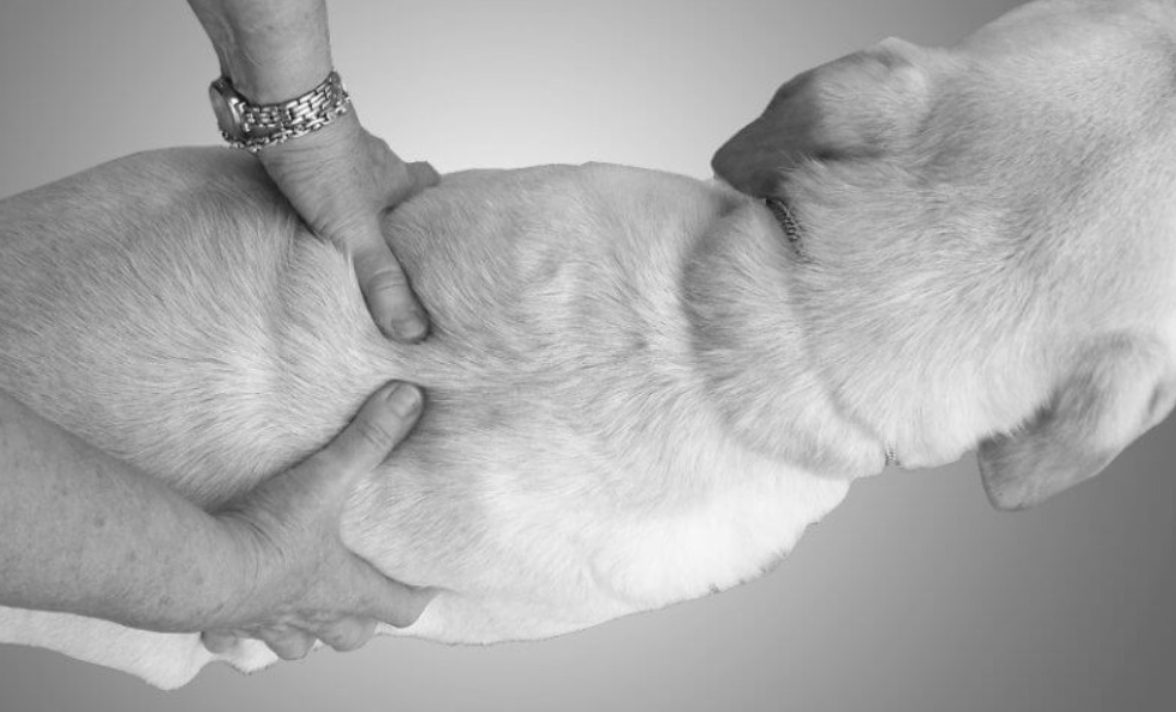
If you have to press to find ribs, there’s a layer of fat over them and the dog is overweight. If you can press and still can’t find ribs at all, the dog is obese. If the ribs are sharp and there’s nothing over them, like running a finger over your knuckles with the hand clenched, the dog is underweight. This is the single most reliable part of the check because coat doesn’t affect it. The photo above shows the hand position: one hand over the ribs behind the front leg, the other at the waist. On this dog you can see the inward curve at the waist under the lower hand, which is what a healthy weight looks like from above.
2. Look from above
Stand directly over the dog and look straight down at its back. A healthy dog narrows behind the ribs, before the hips: an hourglass, or at least a clear inward curve. That’s the waist. An overweight dog has straight sides from ribs to hips, like a loaf. An obese dog bulges outward there, wider at the belly than at the ribs.
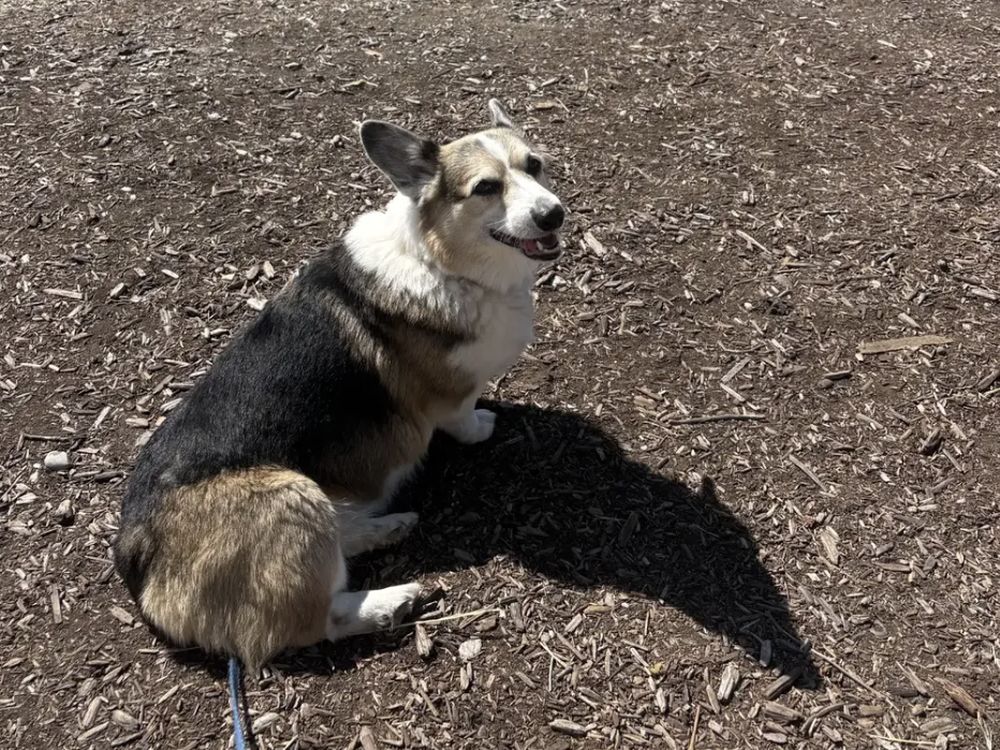
The corgi above is what “no waist” looks like. The sides run straight from the ribcage back to the hips with no inward curve. On a long-coated dog, wet the coat down or press it flat with your hands to see the real outline. On a very short dog like this one, the view from above is easier to judge than the side.
3. Look from the side
Crouch so you’re level with the dog and look at the line of its belly from the chest back to the hind legs. On a healthy dog that line slopes upward, so the belly is higher than the chest. That’s the abdominal tuck. On an overweight dog the line runs flat. On an obese dog it sags below the chest line and may sway when the dog walks.
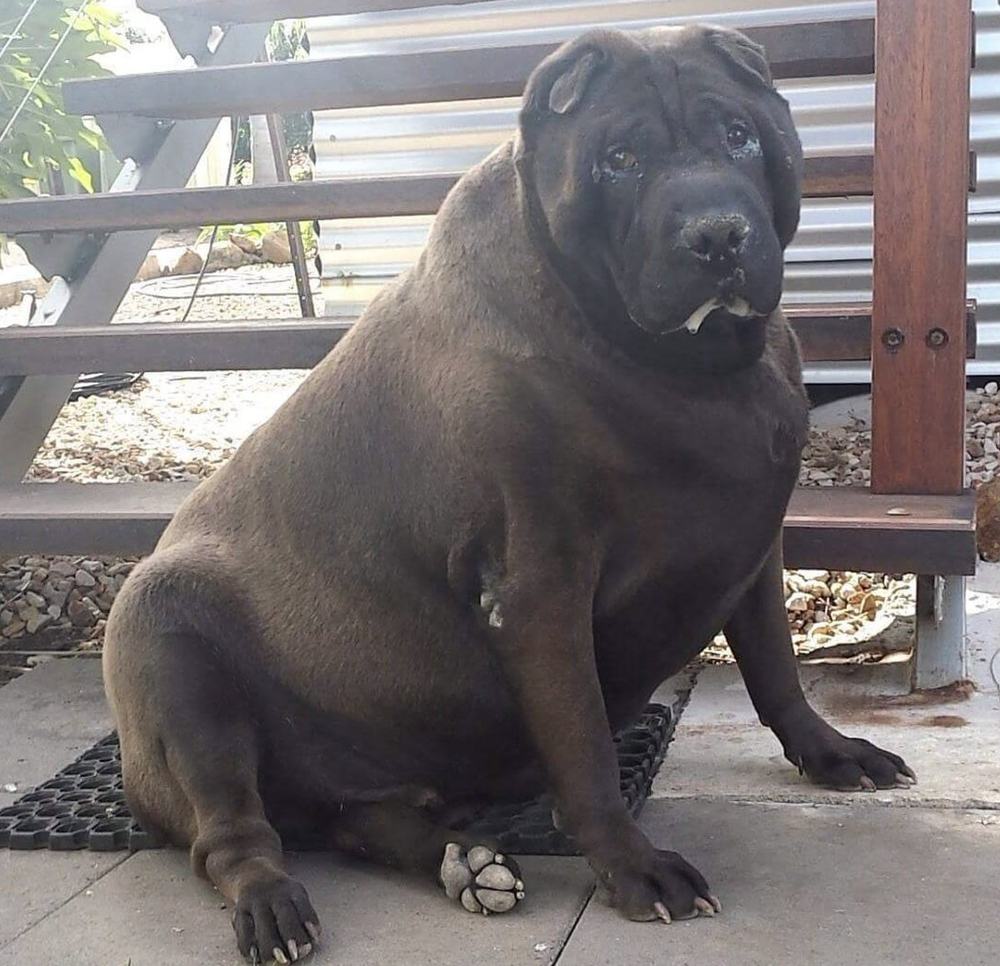
The Shar-Pei above is at the top of the scale: no neck, no waist, a belly that rounds out in every direction. Most overweight dogs are nowhere near this and are much harder to spot, which is why the rib test comes first.
Body condition score: the 1 to 9 scale
Vets score body condition on a 9-point scale developed and validated in the 1990s. It’s what’s written in your dog’s chart as “BCS 6/9” or similar. It exists because weight on a scale doesn’t tell you whether a dog is fat; a 70-pound Lab might be lean and a 70-pound Lab might be obese. The score describes what the dog’s body actually looks and feels like. Here’s the whole scale.
| Score | Category | Ribs | From above | From the side | Vs ideal weight |
|---|---|---|---|---|---|
| 1 | Emaciated | Ribs, spine, and hip bones visible from a distance; no body fat, obvious muscle loss | Severe hourglass | Extreme tuck | More than 20% under |
| 2 | Very thin | Ribs, spine, and hips easily visible; no fat felt; some muscle loss | Pronounced hourglass | Pronounced tuck | 15 to 20% under |
| 3 | Thin | Ribs easily felt and may be visible; top of spine visible; minimal fat | Obvious waist | Obvious tuck | 10 to 15% under |
| 4 | Ideal (lean) | Ribs easily felt with minimal fat covering | Clear waist | Clear tuck | Ideal |
| 5 | Ideal | Ribs easily felt under a slight fat covering, not visible | Waist visible behind ribs | Belly tucked up | Ideal |
| 6 | Slightly overweight | Ribs felt with slight pressure, under a noticeable fat layer | Waist visible but not prominent | Slight tuck | 10 to 15% over |
| 7 | Overweight | Ribs hard to feel under a heavy fat layer; fat deposits over lower back and tail base | Waist barely visible or absent | Little or no tuck | 20 to 30% over |
| 8 | Obese | Ribs can’t be felt without firm pressure; heavy fat over back and tail base | No waist; back may be broadened | No tuck; belly may sag | 30 to 45% over |
| 9 | Severely obese | Ribs can’t be felt at all; heavy fat over chest, spine, tail base, neck, and legs | Sides bulge outward | Belly sags and sways | More than 45% over |
The last column is the useful one for planning. If your dog is a 7, it’s carrying about 20 to 30 percent more than it should, so an 80-pound dog scored 7 has an ideal weight somewhere around 62 to 67 pounds. That’s the number a weight loss plan is built from. Ask your vet to score the dog and set the target with you; it takes 30 seconds and it’s free at most clinics.
What a 4 or 5 looks like
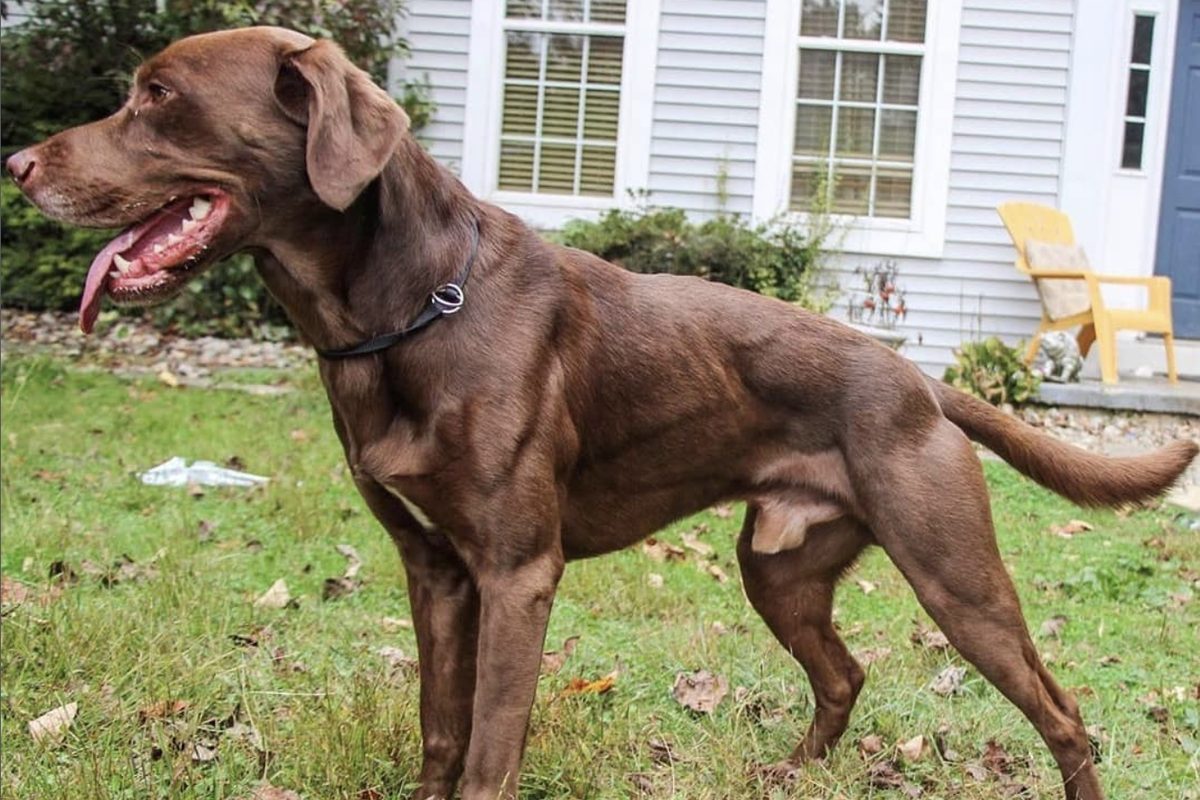
The Lab above is the picture to compare against. From the side, the belly slopes up sharply from the chest to the hind legs. You can see the outline of the last rib but not the ribs themselves. The muscles of the shoulder and thigh are visible under the coat, which means the dog is fit as well as lean. Most owners who see a dog in this condition think it looks a little thin. It isn’t; this is what the breed is supposed to look like, and it’s the shape that the long-term data says lives longest.
What a 7 or 8 looks like
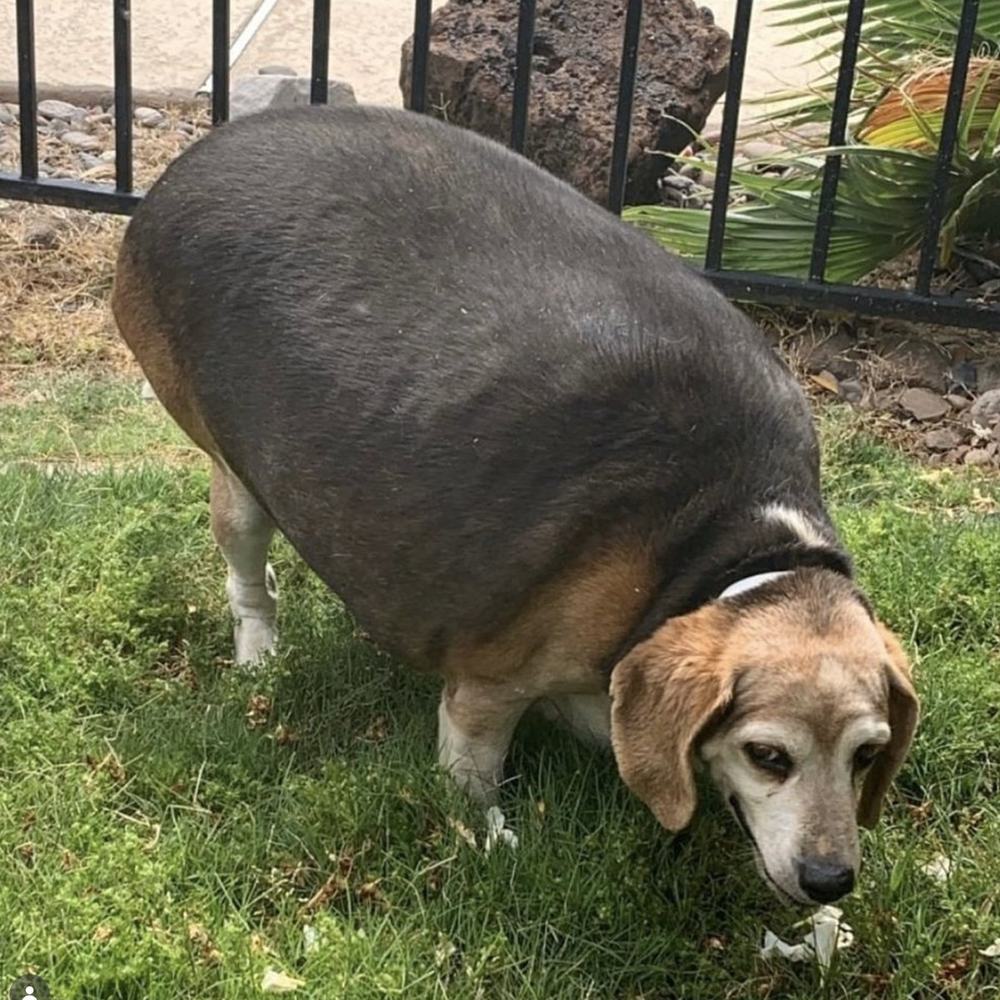
The beagle above is a typical 7 to 8. No waist from any angle, a belly that runs flat and low, a thick neck that blends into the shoulders, and a coat that lies smooth over a layer of fat where you’d expect to see the ribcage. Beagles, Labs, Dachshunds, Cocker Spaniels, Cavaliers, Pugs, Bulldogs, and Golden Retrievers gain weight more easily than most breeds and show up in the 7 and 8 range more often than others.
Other signs your dog is overweight
These don’t replace the hands-on check, but they’re the things owners notice first, and any of them is a reason to do the check today.
Fat pads. Soft, movable lumps of fat at the base of the tail, over the hips, or on the chest between the front legs. On a lean dog those spots are bony.
No neck. From the side, the head seems to sit directly on the shoulders with no visible narrowing. On a lean dog you can see where the neck ends and the chest begins.
Panting and slowing down. A dog that pants after a short walk in mild weather, lags behind on walks it used to lead, or lies down partway through a game of fetch. Owners often put this down to age. Weight is more common, and it’s fixable.
Trouble with stairs, jumping, or getting up. Hesitating before jumping onto the couch or into the car, taking stairs one at a time, or needing a couple of tries to stand up from lying down. Extra weight makes all of these harder, and in older dogs it makes arthritis pain worse.
The collar or harness got tighter. The simplest one. If you’ve let the collar out a notch in the last year and the dog isn’t a puppy, that’s weight.
Grooming and scooting. A dog that can’t reach around to groom its back end, or that scoots because it can’t clean itself, has usually put on enough weight to lose the flexibility.
If you’ve noticed a sudden change in weight or energy rather than a slow one, or the dog is gaining while eating the same amount, that’s a different question. Thyroid and adrenal problems cause weight gain that diet won’t fix, and our guide to why dogs gain weight covers when to get the dog tested.
Why breed weight charts don’t help
The first thing most people do is search “how much should a Labrador weigh” and find a range like 55 to 80 pounds. That range is useless for your dog. A small-framed female Lab is lean at 55 and obese at 80; a big male is lean at 80. Breed standards are written for show dogs and describe a range of frames, not a target for any individual. Mixed breeds don’t have a chart at all. And the same problem applies to your vet’s scale on its own: the number tells you what the dog weighs, not what it should weigh. That’s why body condition is scored by shape and feel, and why the last column in the table above is a percentage rather than a number in pounds. Weigh the dog to track change over time; use the body check to decide whether the current weight is right.
Why it matters
The best evidence here is a 14-year Purina study that followed 48 Labrador Retrievers from puppyhood, half fed to a lean body condition and half fed 25 percent more. The lean dogs lived a median of 1.8 years longer, and the heavier dogs developed osteoarthritis and other chronic conditions years earlier. Being overweight is also a known risk factor in dogs for diabetes, pancreatitis, breathing problems in flat-faced breeds, heat intolerance, some cancers, and complications under anesthesia. And it makes every joint problem worse: for a dog with hip dysplasia or arthritis, weight loss is the single most effective thing an owner can do, ahead of any supplement or medication.
The other side is that it’s reversible, and the changes come fast. Owners who put a dog on a proper plan usually report more energy within a month, before the scale moves much, and most dogs that need to lose 15 to 20 percent get there in about 12 weeks.
What to do if your dog scores 6 or above
Score 6. The easy one. Cut treats to 10 percent of daily calories, measure the food with a kitchen scale instead of a scoop, and add 15 minutes to the daily walk. Recheck in a month. Most 6s become 5s without any other change.
Score 7. The dog needs to lose 20 to 30 percent of its body weight, which takes a real plan: a calorie target set from ideal weight, weighed portions, a gradual exercise build, and weekly weigh-ins. Our 12-week dog weight loss plan has the calorie tables and the exercise ramp. Plan on about three months to reach target for most dogs.
Score 8 or 9. Start with a vet visit. Dogs this heavy should be checked for thyroid and other causes before the diet starts, usually do better on a prescription weight loss diet that stays nutritionally complete at a big calorie deficit, and need exercise kept very low impact (walking, swimming) at first because their joints are under real load. The plan is the same as for a 7, run more slowly, over five or six months.
Score 3 or below. Underweight dogs are less common but the check works in both directions. A dog with visible ribs and spine and no fat covering should see a vet before you add food, since weight loss in an adult dog that’s eating normally usually has a medical cause.
How to check a dog you can’t see well
Long or thick coats (Goldens, Huskies, Newfoundlands, Poodles, doodles). Skip the visual checks and rely on the rib test. Press the coat flat with both hands and feel the outline of the ribcage and waist underneath. Bath time, when the coat is wet and flat, is the easiest moment to see the real shape.
Deep-chested breeds (Greyhounds, Whippets, Dobermans, Vizslas, Weimaraners). These dogs have a naturally dramatic tuck and visible last ribs even at a healthy weight, so what looks thin on a Lab is normal on a Greyhound. Judge by the rib test and the waist from above, not the side view.
Barrel-chested and short-legged breeds (Bulldogs, Pugs, Dachshunds, Corgis, Bassets). The side view is hard to read because the belly is close to the ground anyway. Use the view from above and the rib test. These breeds also gain weight easily, so check them more often.
Puppies. Puppies should look a little rounder than adults and shouldn’t be put on a weight loss diet without a vet. A puppy that has no waist and a sagging belly is usually being free-fed; measure meals and cut treats rather than restricting below the food’s guide.
Senior dogs. Older dogs lose muscle, which can make the spine and hips feel bonier while the belly stays round, so a senior can score “overweight” and “thin” in different places at once. Score by the ribs and belly. Loss of muscle in an older dog is a reason to add strength work and protein, not to add fat; our guide to low impact exercise for senior dogs covers what’s safe.
How often to check
Do the full three-part check once a month, and weigh the dog at the same time if you can (a vet’s walk-on scale is free to use at most clinics, or weigh yourself holding a small dog and subtract). Write both down. A dog that gains two pounds a year looks the same year over year and is obese by age six; a monthly note catches it at the first pound. Take a photo from above and from the side once every few months too. Photos don’t recalibrate the way your eye does, and comparing this month’s to last year’s is often what convinces an owner that something changed.
Frequently asked questions
How do I know if my dog is overweight?
Feel for the ribs with light pressure; you should find them easily. Look from above for a waist behind the ribs, and from the side for a belly that slopes up toward the hind legs. If you have to press to find ribs and there’s no waist, the dog is overweight.
What is a healthy body condition score for a dog?
4 or 5 on the 9-point scale. Ribs easily felt under a thin layer, a visible waist from above, and a tucked-up belly from the side. Many owners think a 5 looks slightly thin, because so many dogs around them are 6s and 7s.
How much overweight is a dog with a BCS of 7?
About 20 to 30 percent over ideal weight. Each point above 5 is roughly 10 to 15 percent. A 60-pound dog scored 7 has an ideal weight of roughly 46 to 50 pounds.
Is my dog fat or just fluffy?
The coat can’t hide the rib test. Press the coat flat and feel for ribs with light pressure. If they’re easy to find, it’s fluff. If you have to push, it’s fat. Wet the coat at bath time to see the real outline.
Should I be able to see my dog’s ribs?
On most breeds, no. You should feel them easily but see only a hint of the last rib or two, if that. Greyhounds, Whippets, and other sighthounds are the exception and normally show a few ribs at a healthy weight.
Can a dog be overweight and still be active?
Yes, especially young dogs. Activity doesn’t mean the dog is at a healthy weight, and the joint damage from carrying extra weight builds up whether or not the dog seems bothered. Score by the body check, not by energy.
What breeds get overweight most easily?
Labradors, Golden Retrievers, Beagles, Dachshunds, Cocker Spaniels, Cavalier King Charles Spaniels, Pugs, Bulldogs, Basset Hounds, and Corgis show up in the overweight range more than other breeds. Spayed and neutered dogs of any breed need about 20 to 30 percent fewer calories than intact dogs, and that’s the point where many dogs start gaining.
How fast should an overweight dog lose weight?
One to two percent of body weight per week. Faster than that risks losing muscle. The weight loss plan has the weekly targets.
Where this fits in your dog’s plan
Body condition is the first thing a PetFitness plan asks for, because it sets the target the rest of the plan is built toward. A dog scored 7 gets a weight loss plan with calories set from ideal weight and an exercise ramp that starts low impact. A dog scored 5 gets a fitness plan that builds strength and stamina without changing the food. If you’d like the plan built for your dog, build your dog’s plan here. If you’d rather start on your own: do the three-part check tonight, write down the score, and if it’s 6 or above, start with the treats and the kitchen scale tomorrow.
About the author. Richie Allen is the founder of PetFitness. Every exercise in the PetFitness program is tested on real dogs before it goes into a plan.
Reviewed by the PetFitness training team. Our Certified Canine Fitness Trainers checked the body condition scale, the three-part check, and the breed and age adjustments on this page against the standards used in the PetFitness program. A body condition score is an assessment, not a diagnosis; your vet should confirm the score and rule out medical causes before any weight loss plan for a dog scored 8 or above.
Related guides: Dog weight loss plan · Why is my dog gaining weight · Dog calories per day · Low calorie dog treats · How much exercise does a dog need · Exercises for dogs with arthritis · Dog conditioning guide