Your dog’s core muscles play an important role in balance, stability, posture, and movement. Just like in people, a stronger core helps support the rest of the body. Safe core exercises may help dogs improve coordination, mobility, and overall fitness.
If your dog is already working on balance, read Best Balance Exercises for Dogs.
What Is Your Dog’s Core?
Your dog’s core includes the muscles around the abdomen, back, hips, and pelvis. These muscles help stabilize the body during everyday movements like walking, climbing stairs, turning, and standing.
A strong core may help improve:
- balance
- coordination
- posture
- mobility
- overall body control
1. Sit-to-Stand Exercises
Moving from sitting to standing is one of the simplest ways to activate the core and hind leg muscles.
- Ask your dog to sit.
- Use a treat to encourage standing.
- Repeat several slow, controlled repetitions.
Focus on smooth movement rather than speed.
2. Balance Cushion Exercises
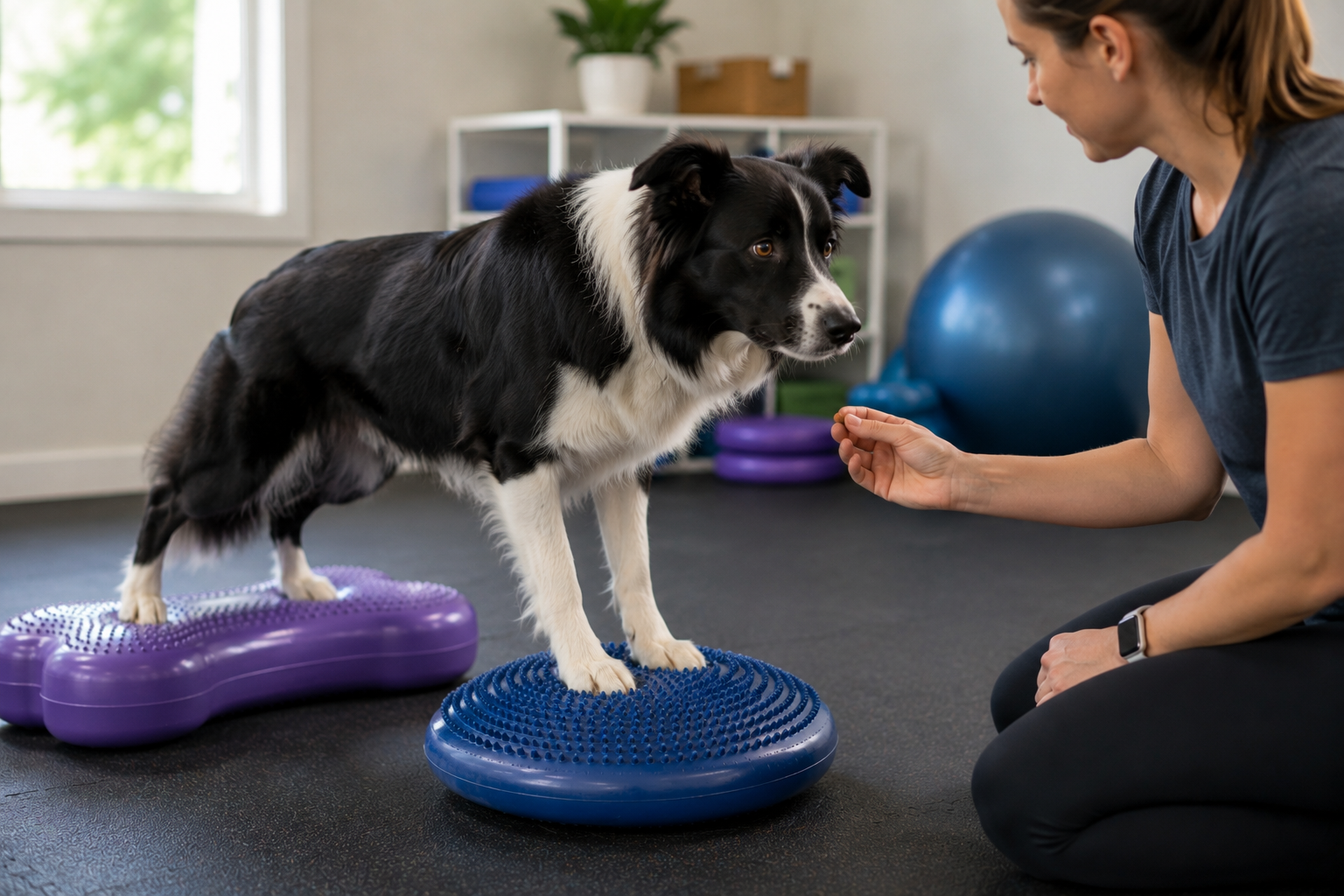
Standing on a balance cushion or foam pad encourages your dog to engage stabilizing muscles throughout the body.
Keep sessions brief and always supervise your dog.
If your dog is new to balance work, start with only a few seconds at a time.
3. Weight-Shifting Exercises
While your dog is standing comfortably, slowly move a treat from side to side so your dog follows it with their head.
This encourages gentle weight transfer and activates core muscles responsible for stability.
4. Cavaletti Pole Walking
Walking slowly over low poles helps improve:
- coordination
- body awareness
- balance
- core engagement
Keep poles low and allow your dog to move at a comfortable pace.
5. Controlled Figure-Eight Walking
Walking in slow figure-eight patterns encourages controlled turning while activating muscles throughout the body.
Wide turns are generally more comfortable than tight circles.
Who May Benefit From Core Exercises?
Core exercises may be helpful for:
- senior dogs
- dogs recovering from injury
- dogs with weak back legs
- dogs with balance issues
- sporting and working dogs
Always consult your veterinarian before beginning rehabilitation exercises.
Exercise Safely
Core training should always be introduced gradually.
Remember to:
- use non-slip flooring
- keep sessions short
- allow plenty of rest
- watch for signs of fatigue
Quality of movement is more important than the number of repetitions.
Related Articles
- Best Balance Exercises for Dogs
- How to Help a Dog With Weak Back Legs
- Exercises for Dogs With Arthritis
- Can Senior Dogs Build Muscle Through Exercise?
- How to Keep a Senior Dog Active Safely
Final Thoughts
Core strength supports nearly every movement your dog makes. Simple, low-impact exercises performed consistently may help improve stability, coordination, mobility, and overall physical function throughout your dog’s life.
Want a Personalized Plan for Your Dog?
PetFitness creates structured exercise plans based on your dog’s breed, age, mobility, and conditioning level.