Written by the PetFitness team and reviewed by our Certified Canine Fitness Trainers. Last updated September 9, 2026.
Balance training is the part of dog fitness that most owners skip and most rehab vets start with. It builds the small stabilizing muscles around the hips, shoulders, and spine, teaches the dog where its feet are, and protects joints better than any amount of extra walking. It also needs almost no space, no weather, and about ten minutes. This guide is the full program: what to use, ten exercises in order from easiest to hardest, a four-week plan, and how to adapt it for seniors and dogs coming back from injury.
The short version
- What it does: strengthens the stabilizer muscles and core, improves body awareness (proprioception), and lowers injury risk, especially cruciate tears and back strain.
- Who it’s for: every dog. Puppies, seniors, athletes, and dogs in rehab all do some version of it; only the surface and the duration change.
- How often: 5 to 10 minutes, 3 to 4 times a week. Balance work is skill, not cardio. Short and frequent beats long and rare.
- What you need: a couch cushion to start. A balance disc or pad ($25 to $60) once the dog has the idea.
- First rule: the dog steps on, never jumps on. Non-slip floor underneath, and you next to the dog, every session.
Why balance work matters more than it looks
A dog walking on flat ground uses its big muscles: quads, hamstrings, glutes, shoulders. It barely uses the deep stabilizers that hold each joint steady when a foot lands wrong. Those muscles only work when the surface is unpredictable. That’s the whole trick of balance training: put the dog on something that moves slightly, and the body has to recruit everything at once to stay upright.
Three things come out of that. First, joint protection. Most cruciate ligament tears in dogs happen on a sudden turn or an awkward landing, and the muscles that prevent that are the ones balance work trains. Second, core strength, which shows up as a straighter back, less sway in the hind end, and easier stairs in older dogs. Third, body awareness. A dog that has spent time on a wobble board knows where its back feet are, and dogs that know where their back feet are trip less, slip less, and recover faster when they do.
It’s also mentally tiring in the way a long walk isn’t. Ten minutes of concentration on a balance disc settles a high-energy dog more reliably than thirty minutes of fetch, which is why we put it in nearly every PetFitness conditioning plan regardless of the dog’s goal.
Equipment: what to buy and what to use from around the house
You can run the first two weeks with things you already own. After that, one piece of purpose-built equipment makes the progression much easier to control.
| Equipment | What it’s for | Household stand-in | Rough cost |
|---|---|---|---|
| Balance pad (dense foam block) | The starting point. Soft enough to challenge, stable enough that nothing tips. | Couch cushion, folded thick blanket, yoga mat rolled double | $25 to $40 |
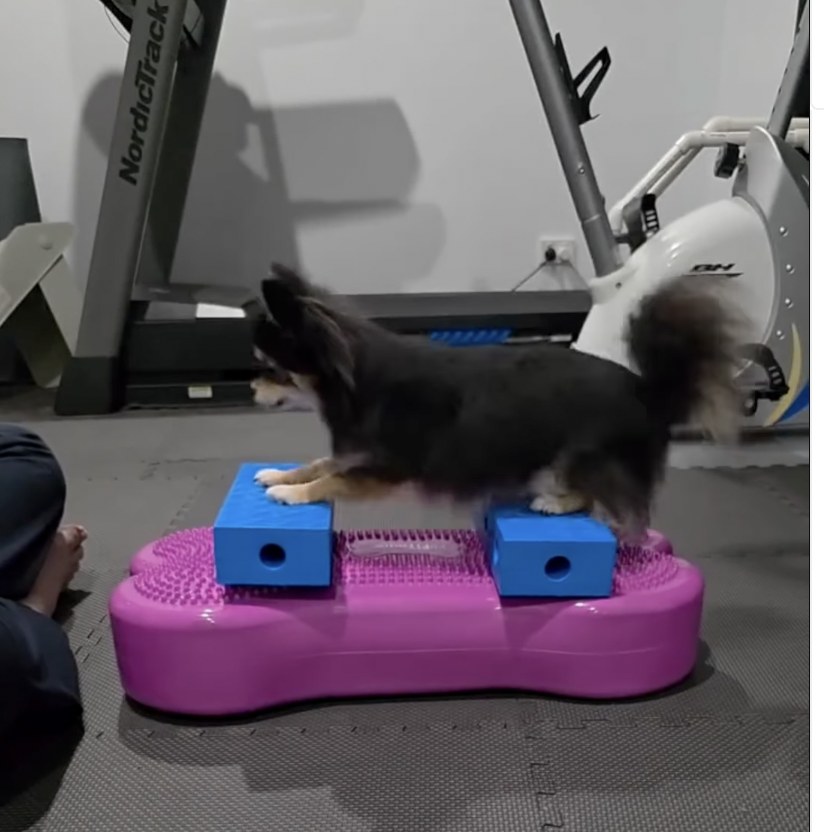
| Balance disc (inflatable, 13 to 22 in) | The workhorse. Adjust the air to make it easier or harder. Front feet, rear feet, or all four. | Partially deflated air mattress or pool float, weighted down | $20 to $40 |
| Paw pods / targets | Teach the dog to place each foot deliberately. Great for hind-end awareness. | Upturned bowls, small books, painter’s tape squares on the floor | $20 to $35 for a set |
| Wobble board | Tilts in every direction. Intermediate to advanced. | A sturdy board over a tennis ball (with you holding it) for the idea only | $40 to $90 |
| Peanut or donut (large inflatable) | Advanced whole-body work. Needs a spotter every time. | None safe. Skip until you own one. | $40 to $80 |
| Non-slip mat | Under everything. A dog that slips once on a hard floor stops trusting the equipment. | Yoga mat, rubber gym tiles, a rug that doesn’t slide | $15 to $30 |
If you buy one thing, buy the balance disc. It covers exercises 3 through 8 below and it’s the item people search for most. FitPaws makes the ones you’ll see in every rehab clinic; the cheaper generic discs work the same and last nearly as long. For the rest of the gear worth owning, see our dog fitness equipment guide.
Five rules before the first session
- Step on, never jump on. Lure the dog with a treat held low so the feet go up one at a time. Jumping onto unstable equipment is how dogs get hurt and how they learn to hate it.
- Non-slip under everything. Equipment on tile or hardwood slides. One slip and you’ve lost two weeks of trust.
- You stay within arm’s reach. On the disc and pad you’re the spotter. On the peanut you’re holding it.
- Short. Thirty seconds of standing is a set. Three to five sets is a session. Muscles the dog has never used fatigue in minutes, and a tired dog on a wobble board gets sloppy.
- Warm up first. Two or three minutes of walking and a few slow figure-eights. Cold stabilizers strain easily. Our dog stretching guide has a warm-up that fits.
The ten exercises, easiest to hardest
Work through them in order. Don’t move to the next until the dog holds the current one calmly for 30 seconds, three times, on two separate days. That rule is what keeps this safe.
1. Cushion stand
Setup: a couch cushion or balance pad on a non-slip floor.
Do: lure the dog so all four feet are on the cushion. Reward for standing still. Build to 30 seconds.
Works: every stabilizer at once, at the lowest difficulty. This is where puppies and seniors start and, for some seniors, where they stay.
Harder: two cushions stacked. Softer cushion.
2. Front paws up
Setup: a low step, a firm cushion, or a balance pad about 4 to 6 inches high.
Do: front feet on the platform, rear feet on the floor. Hold for 15 to 30 seconds. Then walk the rear feet slowly left and right in a half circle while the front feet stay put (the “pivot”).
Works: hind-end awareness. Most dogs have no idea where their back feet are; this fixes it.
Harder: raise the platform. Then swap: rear feet up, front feet down.
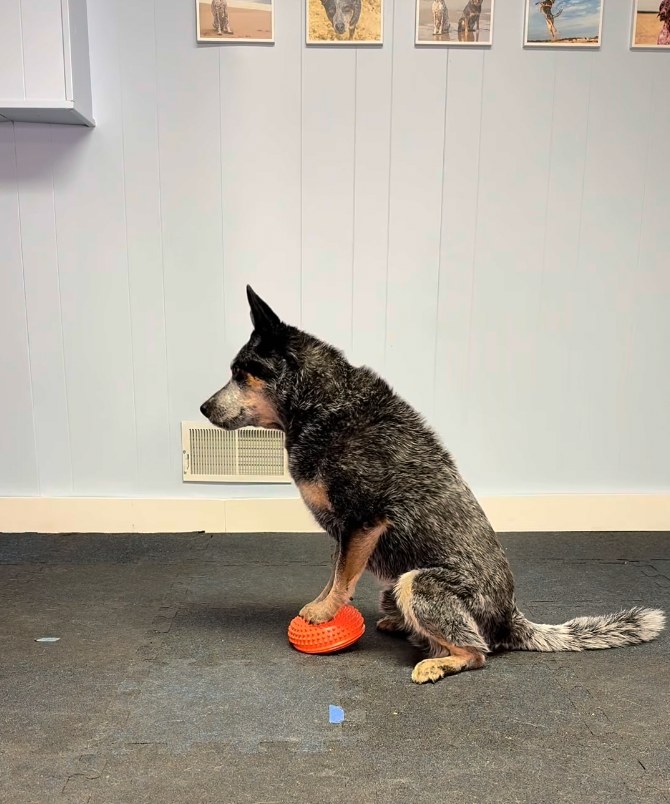
3. Single paw target
Setup: one paw pod, a small balance half-ball, or an upturned bowl.
Do: from a sit or a stand, ask for one front paw on the target and hold. Switch paws. Later, ask for a rear paw, which is much harder.
Works: single-limb loading, which is exactly what a dog does when it turns fast or lands from a jump.
Harder: unstable target. Longer holds. Rear paws.
4. Balance disc, front feet
Setup: balance disc inflated firm, on a non-slip mat.
Do: front feet on the disc, rear on the floor. Hold. You’ll see the shoulders and the muscles along the top of the back working to keep the disc level.
Works: shoulders, chest, and the front half of the core.
Harder: let a little air out. Softer disc, more wobble.
5. Balance disc, rear feet
Setup: same disc.
Do: back the dog onto the disc, or lure it forward so the rear feet end up on it. Front feet on the floor. Hold 15 to 30 seconds.
Works: hips, hamstrings, glutes, and the low back. This is the single most useful exercise on this page for dogs with weak back legs.
Harder: softer disc. Add a slow weight shift by moving the treat side to side.
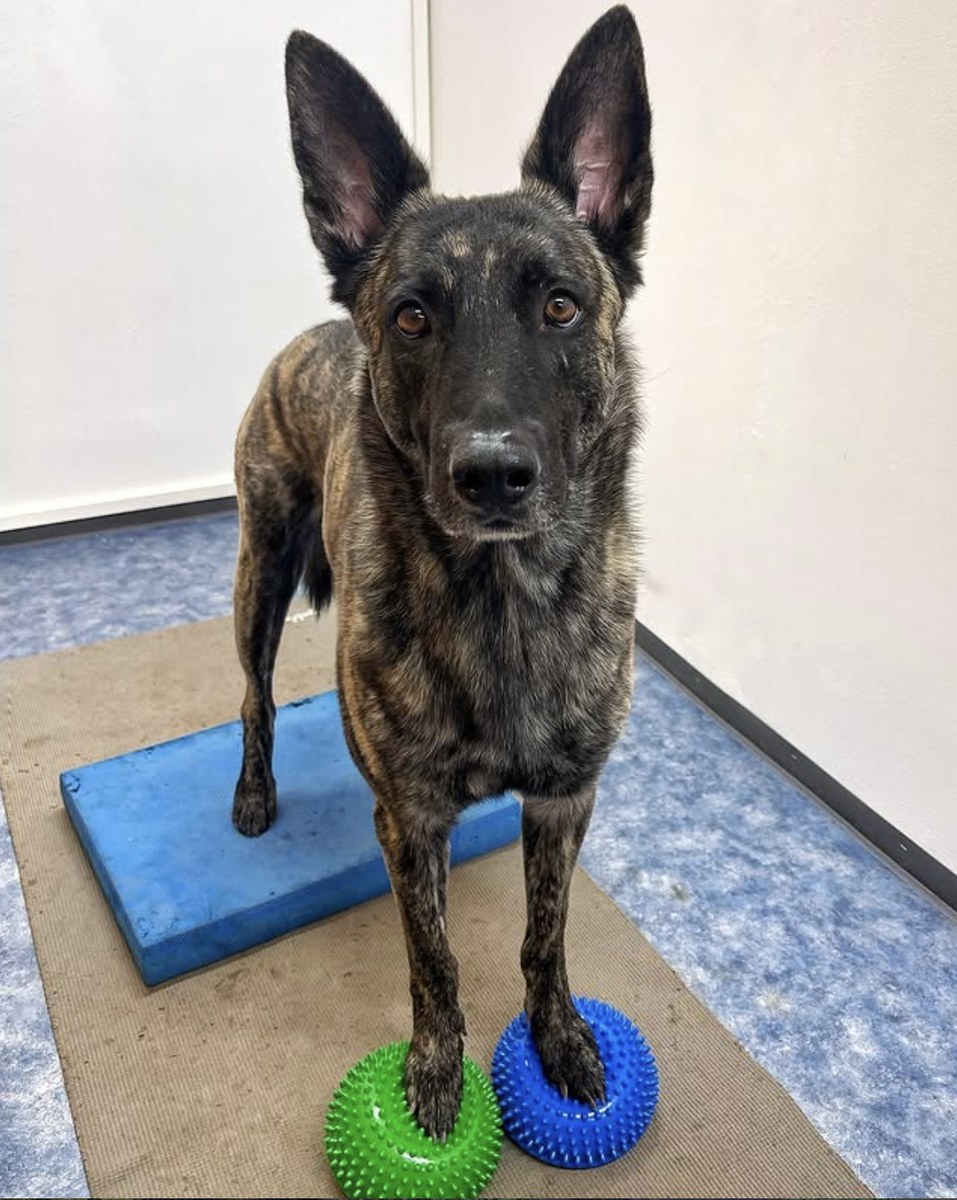
6. Paw pods, all four
Setup: four pods, targets, or tape squares set at the dog’s natural stance width.
Do: one foot on each target, standing square. Hold. Then move the rear pods an inch closer together and repeat.
Works: stance awareness and symmetrical loading. Dogs that favor one leg show it here.
Harder: unstable pods. Narrow the stance. Ask for a sit-to-stand while all four stay on the targets.
7. Sit-to-stand on a pad
Setup: balance pad or firm cushion large enough for all four feet.
Do: with all four feet on the pad, cue a sit, then a stand, then a sit. Slow. 5 to 8 reps.
Works: quads and glutes under instability. This is a squat for dogs. It pairs well with our core strength exercises.
Harder: do it on the balance disc. Then add a down in the sequence.
8. Weight shifts on the disc
Setup: all four feet on a large disc or on two discs (front and rear).
Do: hold a treat at the dog’s nose and move it slowly toward one hip, then the other, then toward the chest and toward the tail. The dog shifts its weight to follow without moving its feet.
Works: every stabilizer, in every direction, and the spine’s small rotators.
Harder: softer discs. Slower movements. Bigger reach.
9. Wobble board
Setup: wobble board on a non-slip mat, you holding one edge for the first sessions.
Do: front feet on, then all four. Let the board tilt a little and let the dog correct it. Hold 15 to 30 seconds.
Works: reaction speed. The board moves before the dog does, so the correction has to be fast.
Harder: let go of the edge. Ask for a sit on the board.
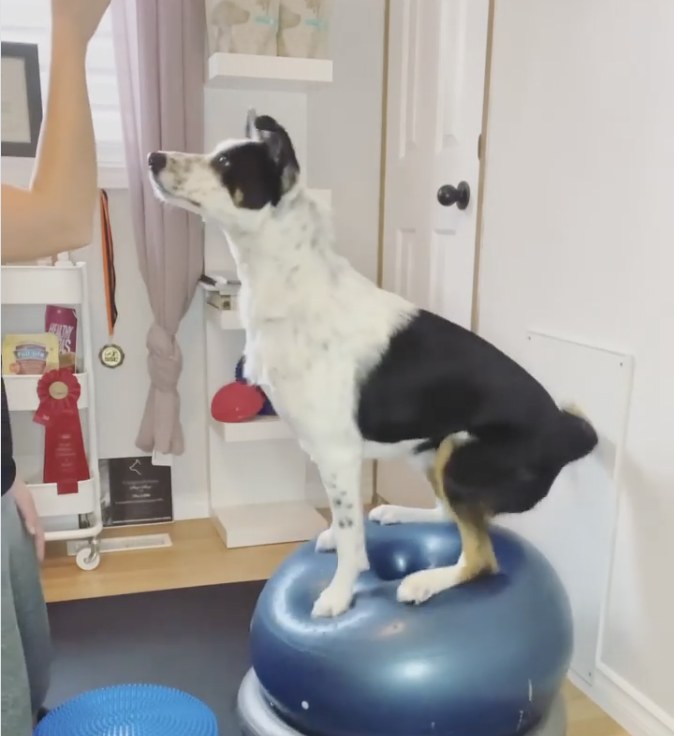
10. Peanut stand
Setup: inflatable peanut or donut, braced so it can’t roll (a wall, two cushions, or a purpose-made holder), you holding it.
Do: front feet up first, hold, then all four. 10 to 20 seconds is plenty.
Works: the whole body, and confidence. Dogs that can stand on a peanut can handle any surface they’ll meet outdoors.
Harder: it’s already hard. Add sit-to-stands only when the stand is boring.
A 4-week starter plan
Three sessions a week, 5 to 10 minutes each, after a short warm-up. The numbers are sets of 30-second holds unless the exercise says reps.
| Week | Exercises | Volume | Move on when |
|---|---|---|---|
| 1 | 1 (cushion stand), 2 (front paws up) | 3 sets each | Dog steps up calmly and holds 30 s without shifting |
| 2 | 2 with pivot, 3 (single paw), 4 (disc front feet) | 3 sets each | Front feet stay planted through the pivot; disc stand is steady |
| 3 | 4, 5 (disc rear feet), 6 (paw pods) | 3 to 4 sets each | Rear-feet stand holds 30 s; dog places all four feet on targets without help |
| 4 | 5, 7 (sit-to-stand on pad), 8 (weight shifts) | 3 sets, 5 to 8 reps for #7 | Sit-to-stands are slow and even; weight shifts happen without a foot moving |
After week 4, keep two or three of these in rotation for the rest of the dog’s life, twice a week. Add the wobble board and peanut only if you want a project; the first eight exercises give a pet dog everything it needs. Balance work slots in alongside the walking and stamina work in our daily exercise guide; it doesn’t replace it.
Balance training for senior dogs
Older dogs benefit most and need the gentlest version. Weak hind ends, stiff backs, and the shuffle-and-slip on hard floors that owners notice around age nine or ten all respond to balance work, because the muscles that atrophy first in an aging dog are the stabilizers. Start with exercise 1 on a firm cushion, keep every hold under 15 seconds, and use a pad rather than a disc for the first month. Rear-feet-up (exercise 5) on a low, firm pad is the single best senior exercise here, done three times a week. Skip the wobble board and the peanut entirely. Our low-impact exercise guide for senior dogs has the full routine these fit into.
Balance work in rehab
If your dog is coming back from cruciate surgery, a hip dysplasia diagnosis, or a soft-tissue injury, balance training is probably already on the rehab plan your vet or physio gave you, and their sequence overrides ours. The general shape is the same: stable surface first, short holds, add instability slowly, and never add height and instability in the same week. See our pages on exercise after ACL surgery, hip dysplasia exercises, and exercise for dogs recovering from injury for where balance work fits in each.
Puppies
Balance training is one of the few strength-type exercises that’s fine for puppies, because there’s no impact and no load beyond body weight. Keep it to exercises 1, 2, and 6 on low, firm surfaces, keep sessions to a few minutes, and treat it as a body-awareness game rather than a workout. It pays off later: puppies that learn where their feet are become adults that are hard to injure. The rest of the puppy routine is on our puppy exercise page.
Mistakes we see most
- Too much air in the disc, too soon. A rock-hard disc barely moves. A half-inflated one is much harder. Start firm, deflate gradually.
- Luring the head too high. A treat held up makes the dog rock back onto its hind end. Hold it at nose level so the dog stays square.
- Long sessions. If the dog starts stepping off or shifting, you’re past the useful point. Stop a set before that.
- Slippery floors. Covered above. It’s the number one reason dogs refuse equipment.
- Skipping the rear end. Front-feet-up is easy and dogs like it, so people stay there. The rear-feet exercises are where the joint protection comes from.
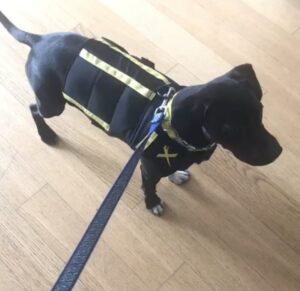
- Combining with a weighted vest. Don’t. Instability and load together is how strains happen. The vest has its own rules.
Frequently asked questions
How often should I do balance exercises with my dog?
Three to four short sessions a week, 5 to 10 minutes each. Daily is fine if sessions stay short. Once a week isn’t enough to build anything.
Do I need to buy a balance disc?
Not for the first two weeks. A couch cushion and a step get you through exercises 1 and 2. After that, yes, a disc is worth the $25 to $40. It’s the piece that makes exercises 4 through 8 possible and the one you’ll still be using in five years.
Is FitPaws worth the money?
Their equipment is what most rehab clinics use and it’s well made. It’s also two to three times the price of generic equivalents that do the same job for a pet dog. If you’ll use it several times a week for years, buy FitPaws. If you’re not sure your dog will take to it, start generic.
Can balance training help a dog with weak back legs?
Yes, and it’s usually the first thing a rehab vet prescribes for it. Rear-feet-up on a pad, then on a disc, builds the hip and thigh muscles that weak hind ends are missing. Go slowly and get a vet to rule out anything structural first. Our weak back legs guide covers the full picture.
How long until I see a difference?
Steadier stands within two weeks. Visible changes in how the dog moves (straighter back, cleaner turns, fewer slips) in six to eight weeks of three sessions a week.
Can puppies do balance exercises?
Yes, on low firm surfaces and in short sessions. No wobble boards, no peanuts, no height. It’s one of the safest ways to build a puppy’s body without loading its joints.
My dog is scared of the equipment. What now?
Put the disc flat on the floor and feed the dog on it, off it, next to it, for a few days without asking for anything. Then ask for one paw. Most dogs come around within a week if you never rush the step-up.
Where this fits in your dog’s plan
Balance work is one of five components in a PetFitness conditioning plan, alongside walking, strength, flexibility, and stamina, and the plan sets how much of each your dog needs based on breed, age, weight, and where it’s starting from. If you want the full program with video for every exercise on this page, build your dog’s plan here. If you’d rather start on your own, exercises 1 and 2 with a couch cushion tonight is a fine beginning.
About the author. Richie Allen is the founder of PetFitness. Every exercise in the PetFitness program is tested on real dogs before it goes into a plan.
Reviewed by the PetFitness training team. Our Certified Canine Fitness Trainers checked the exercise progression, the hold times, and the senior and rehab guidance on this page against the standards used in the PetFitness program.
Related guides: Core strength exercises for dogs · Dog conditioning: the complete guide · Dog fitness equipment worth buying · Indoor exercise for dogs