Written by the PetFitness team and reviewed by our Certified Canine Fitness Trainers. Last updated October 15, 2026.
Old dogs don’t need less exercise. They need different exercise. The instinct when a dog slows down is to let it rest, and that’s the fastest way to turn a slow dog into a dog that can’t get up. Muscle is what holds an old dog’s joints together, and muscle disappears fast when it isn’t used. The right senior dog exercises keep that muscle, keep the joints moving, keep the weight off, and keep the brain working, without the pounding that an old body can’t take anymore. This page covers when a dog counts as a senior, how much exercise an older dog actually needs, the eight exercises we use most with senior dogs in the PetFitness program, what to stop doing, and a weekly plan for three levels of senior dog, from the one who still wants to hike to the one who struggles to stand.
The short version
- Keep going: a senior dog that stops exercising loses muscle in weeks, and muscle is what keeps it mobile. Little and often, every day, beats a long weekend walk.
- Change what, not whether: swap fetch, jumping and long hikes for slow sniff walks, swimming, sit-to-stands, low step-overs, balance work and gentle hills.
- How much: most seniors do well on 30 to 60 minutes a day split into two or three sessions. Frail dogs can do 10 minutes three times a day and still benefit.
- The test: how the dog gets up the next morning. Same or better, keep going. Stiffer than usual, cut the next session in half.
- Weight matters more than ever: every extra pound on an old joint hurts. Check with the body condition check.
- Vet first: a senior check-up before you change the routine, and a pain plan if the dog is stiff. Exercise works alongside treatment, not instead of it.
When is a dog considered a senior?
There’s no single birthday. Dogs age at different speeds depending on size, and the bigger the dog, the sooner it gets there. The usual rule vets use is that a dog becomes a senior in the last quarter of its expected lifespan, which works out roughly like this:
| Size | Examples | Senior from about |
|---|---|---|
| Small (under 20 lb) | Chihuahua, Dachshund, Yorkie, Shih Tzu | 10 to 11 years |
| Medium (20 to 50 lb) | Beagle, Border Collie, Cocker Spaniel, Bulldog | 8 to 10 years |
| Large (50 to 90 lb) | Labrador, Golden Retriever, German Shepherd, Boxer | 7 to 8 years |
| Giant (over 90 lb) | Great Dane, Mastiff, Saint Bernard, Newfoundland | 5 to 6 years |
Those are starting points, not switches. A lean, active eight-year-old Labrador that still pulls on the leash is a senior on paper and not in practice. A heavy, stiff six-year-old with bad hips is a senior early. What matters for exercise is how the dog moves, not the number. The signs that a dog has crossed into senior territory: slower to get up in the morning, stiff for the first few minutes of a walk, less interest in play, more sleep, a greying muzzle, and the back end looking thinner than it used to. That last one is the important one, and it’s the reason to keep reading.
Why exercise matters more for a senior dog, not less
Old dogs lose muscle. It has a name, sarcopenia, and it happens to every ageing mammal, but in dogs it compounds fast because of how it interacts with the joints. The muscles of the hind end, the gluteals, hamstrings and quads, are what stabilize the hips and knees. When they shrink, the joints take more load, the joints hurt more, the dog moves less, and the muscles shrink faster.
Exercise is the only thing that interrupts that cycle. Not supplements, not a softer bed, not a better diet, though all of those help around the edges. Loaded movement tells muscle to stay. The dogs we see hold up best into their teens are not the ones that were rested the most. They’re the ones that kept walking every day, kept doing a few sit-to-stands, and kept swimming in summer. The same goes for the brain: senior dogs that keep exploring, sniffing and solving small problems stay sharper for longer than dogs parked on the couch, and cognitive decline shows up as behaviour problems that are easy to mistake for stubbornness.
There’s good evidence behind this. The best-known study followed a group of Labradors for their whole lives and found that the dogs kept lean lived almost two years longer on average and developed arthritis years later than their heavier littermates. Weight and movement are the two levers you control. Everything on this page is about pulling both of them without hurting the dog.
How much exercise does a senior dog need?
Less than a young adult, but more than most seniors get. The general guidance in our daily exercise guide is 30 minutes to two hours for an adult dog depending on breed. For a senior, the sensible range is 30 to 60 minutes a day for a dog that’s still moving well, and 20 to 30 minutes for a dog that’s stiff or frail, with two changes to how it’s delivered.
Split it. Two or three shorter sessions beat one long one. An old dog that walks for 45 minutes once a day spends the first ten minutes stiff and the last ten tired, and both of those are when injuries happen. Three 15-minute walks keep the dog warm, keep the joints lubricated, and never push into fatigue.
Every day. The senior dog that rests all week and hikes on Saturday is the one that can’t get up on Sunday. Consistency is the whole game. A boring 15-minute walk every single day does more for an old dog than anything you can do on a weekend.
If you’re not sure whether your dog is getting enough or too much, the next-morning test settles it. Watch how the dog gets up the day after a session. If it rises the same as usual or better, the amount was right or could go up a little. If it’s noticeably stiffer, slower, or reluctant, yesterday was too much. Adjust from there. No chart beats that test.
The rules before any senior dog exercise
Senior check-up first. Before changing an older dog’s routine, get a vet exam that includes the joints, the heart and basic bloodwork. Stiffness in an old dog is usually arthritis, but it can be a cruciate tear, a spinal problem, or something unrelated to the joints at all, and the plan is different for each. If the dog is in pain, ask for a pain management plan. A dog that hurts won’t use the leg, and a leg that isn’t used doesn’t build muscle no matter what exercise you do. Our guide to exercises for dogs with arthritis goes deeper on that side.
Warm up, always. Five minutes of slow walking before anything else, and a few minutes of easy walking to finish. Cold old joints are stiff joints, and the dog’s own stretching when it gets up is part of the warm-up, not a sign of a problem.
Surfaces. Grass, dirt, packed trails, carpet, rubber mats. Not wet tile, polished wood, ice, or loose gravel. A slip is the single most common way a senior dog goes from “a bit stiff” to “can’t stand up.” Put runners down on slick floors at home; it’s the cheapest thing on this page and it prevents more injuries than anything else.
Heat. Old dogs overheat faster and cool down slower. Walk early or late in summer, carry water, and watch for heavy panting that doesn’t settle within a few minutes of stopping.
Let the dog set the pace. A senior that wants to stop usually has a reason. Sniffing is not stalling; for an old dog it’s half the point of the walk.
The 8 best low-impact exercises for senior dogs
1. Slow leash walks
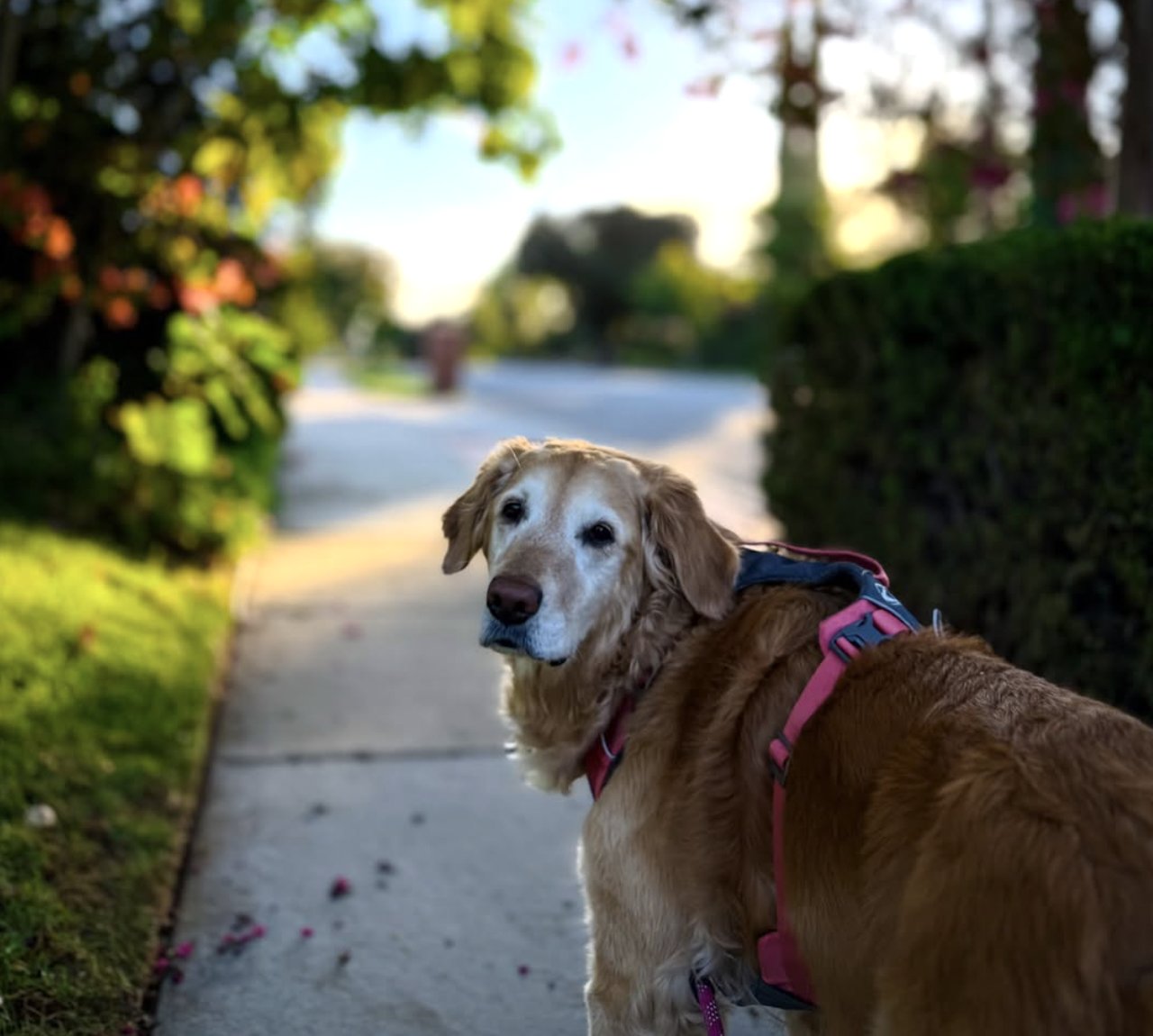
The foundation of everything. A daily walk keeps every joint moving through its range, keeps the hind end muscles working, keeps weight down, and gives the dog’s brain the smells and sights it needs. The change for a senior is the pace. Walk at the dog’s speed, not yours, and let it sniff. A slow 20-minute walk where the dog stops ten times to investigate a hedge is better exercise for an old dog than a brisk 20 minutes where it’s dragged along, because the stop-start pattern loads the legs more evenly and the sniffing works the brain. Start with 10 to 15 minutes two or three times a day. Build by a few minutes a week if the next-morning test allows it. Use a harness rather than a collar; old necks don’t need the pressure, and a harness with a handle on top lets you steady the dog on steps or curbs.
2. Swimming and water walking
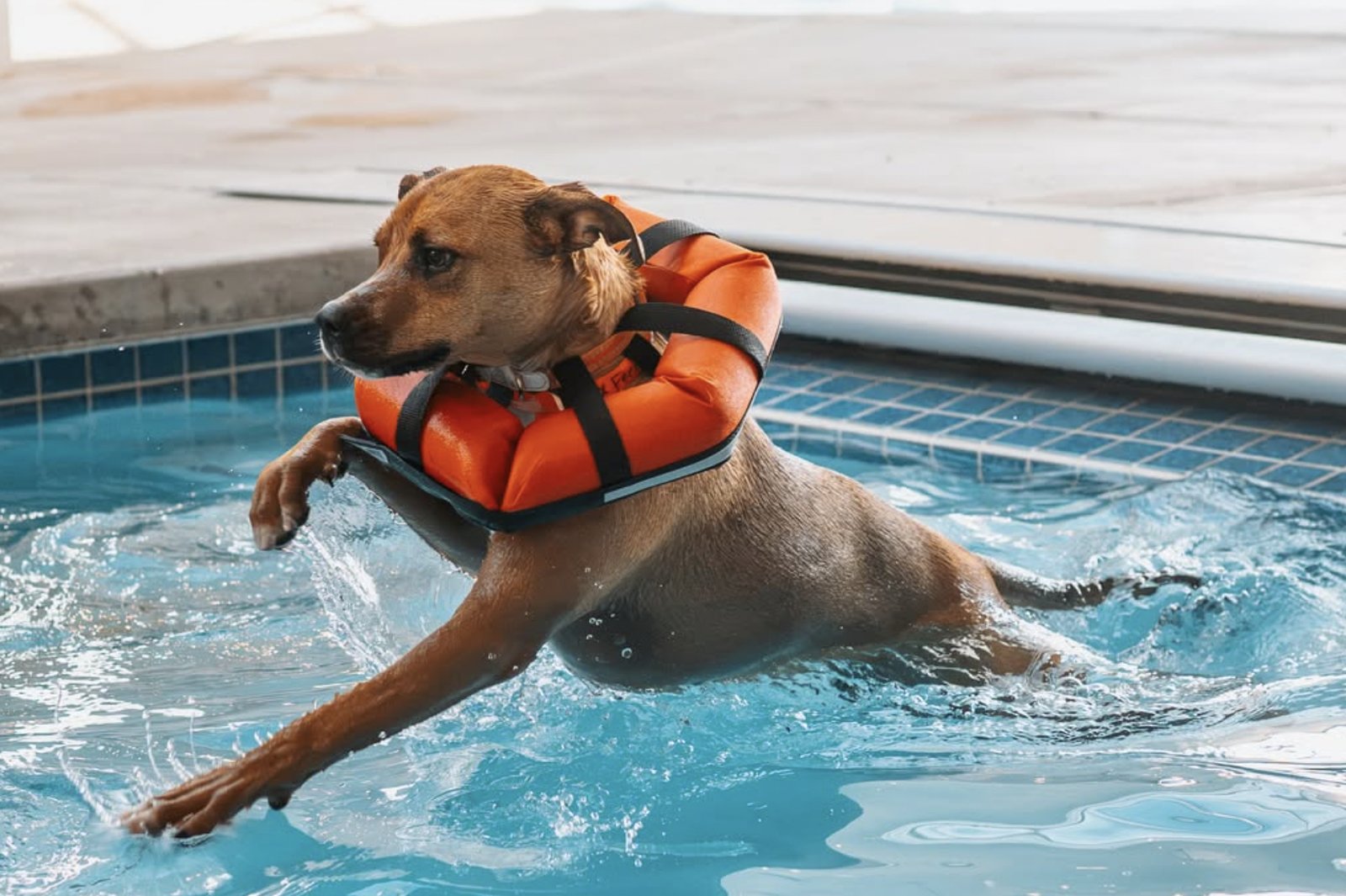
The best exercise there is for an old dog that can tolerate water. Buoyancy takes most of the weight off the joints while the resistance works the muscles harder than walking does. Dogs that limp on land often swim without any sign of pain, and the hind end gets a workout it can’t get any other way. Start with 2 to 5 minutes of actual swimming, build toward 10 to 15 over a few weeks, and use a dog life jacket every time. Old dogs tire fast, their back ends sink, and a jacket keeps them level and gives you a handle. Warm water beats cold; a heated pool or a canine hydrotherapy centre is ideal, and a lake in July works. Walk the dog in on a ramp or shallow steps, never a jump from the side, and dry the ears afterwards. If your dog has never swum, our guide to whether dogs are natural swimmers covers how to introduce it safely. For dogs that won’t swim, walking in water up to the elbows gives much of the same benefit.
3. Sit-to-stand
The single best strength exercise for a senior dog, and you can do it in the kitchen. Ask for a sit, then a stand, then a sit. That’s one rep. Every rep works the quads, hamstrings and glutes, the exact muscles an old dog loses first. Do it on a rug or rubber mat, never a slick floor, and watch for a square sit: both hind legs tucked evenly, not flopped to one side. If the dog sits crooked or slides a leg out, it’s protecting something and you should mention it to the vet. Start with 3 to 5 reps once a day. Build toward 8 to 10 reps twice a day over a month. Use a treat held at nose height to get the stand, so the dog pushes up with the back legs instead of pulling forward with the front.
4. Low cavaletti (step-overs)
Lay four to six poles on the ground in a line, a dog’s body length apart, and walk the dog slowly over them. Broom handles, pool noodles, or rolled towels all work. Stepping over something makes the dog lift each leg deliberately, which stretches the joints through a bigger range than flat walking and makes the dog think about where its feet are. For seniors, the poles stay on the ground or no higher than the dog’s wrist. Walk, never trot. Three or four passes through the line, once or twice a day, is plenty.
5. Balance work
Have the dog stand with all four feet on a folded blanket, a sofa cushion, or a foam mat, and hold still for 15 to 30 seconds. That’s it. The unstable surface makes every small stabilizing muscle around the hips, knees and shoulders fire to keep the dog upright, and those are the muscles that prevent falls. You can add gentle weight shifts: press lightly on one hip so the dog shifts weight to the other side, then release. Three holds of 30 seconds, once a day. Keep a hand near the dog’s harness the first few times. Our full guide to improving a dog’s balance has more progressions, but for a senior the cushion stand is enough for months.
6. Backing up
Stand in front of the dog and walk toward it slowly so it steps backward, or lure it backward with a treat at chest height. Five to ten steps, twice a day. Walking backward works the hind end in a way forward walking doesn’t, and it forces the dog to shift weight onto the back legs, which is exactly what a senior dog has been avoiding. Do it in a hallway so the dog goes straight, and on carpet.
7. Gentle hills
Walking slowly up a gentle slope loads the hind end more than flat ground and strengthens the muscles that push the dog forward. Walking slowly down it works the front end and the muscles that control descent, which is what a dog uses on stairs and getting out of the car. Find a grassy slope you’d describe as a gentle rise, not a hill, and walk up and down it three or four times in the middle of a normal walk. Slow is the whole point. A senior dog trotting downhill is a knee injury waiting to happen.
8. Slow treadmill walking
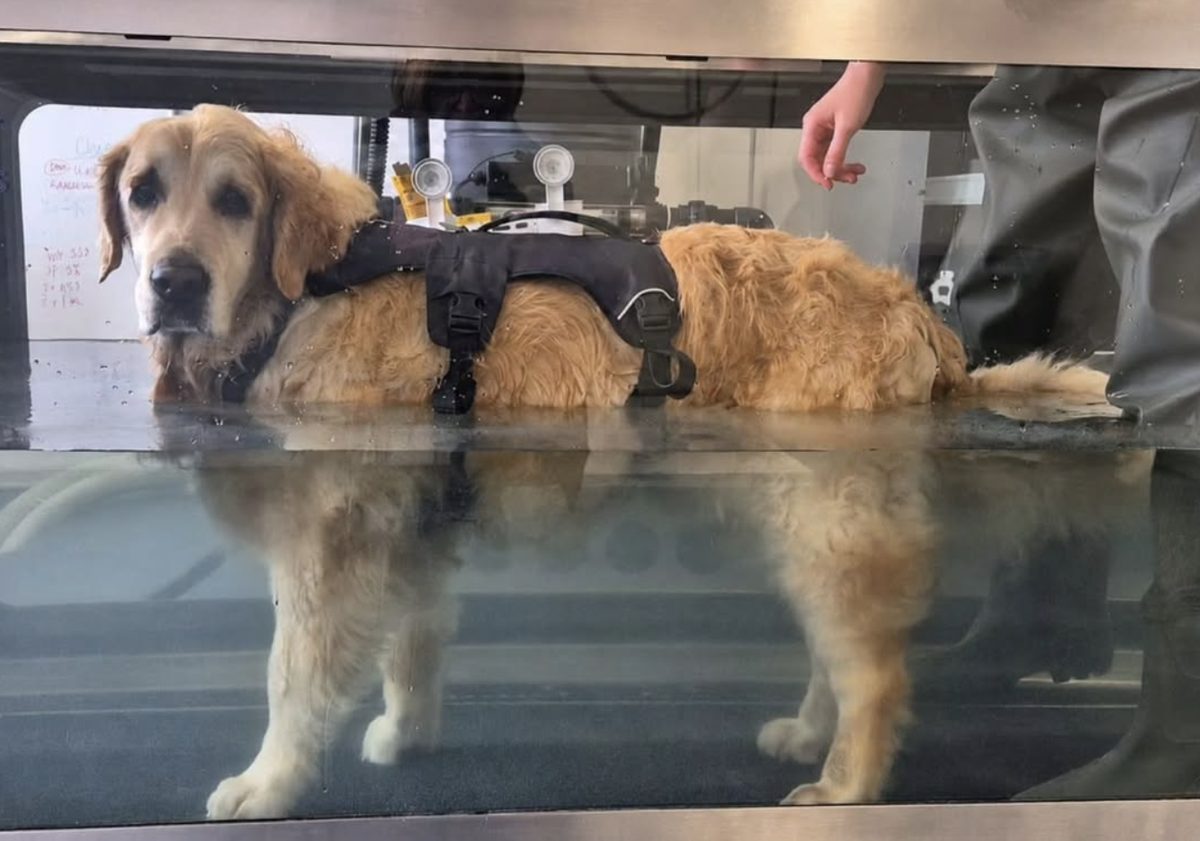
A treadmill lets you control the one thing that’s hard to control on a walk: the pace. Set to a slow walk, it keeps an old dog moving evenly for 10 to 15 minutes with no stops, no pulling and no slippery surfaces, which is useful in bad weather or for a dog whose walks have become mostly standing still. An underwater treadmill at a rehab clinic adds buoyancy and resistance on top, and for a stiff senior it’s often the single best session of the week. On a home treadmill, start at the slowest setting with the dog on a harness and you beside it, 3 to 5 minutes, and build slowly. Never tie the dog on and walk away. Our guide to getting a dog comfortable on a treadmill covers the introduction step by step.
Mental exercise counts
An old dog’s brain needs work as much as its legs do, and on days when the body can’t do much, the brain can carry the load. Scatter a handful of kibble in the grass and let the dog find it. Hide a treat under one of three cups. Use a snuffle mat or a slow feeder for meals. Teach a new, easy trick; old dogs learn fine, they just learn slower. Ten minutes of nose work tires a senior dog out as thoroughly as a walk, with zero impact on the joints, and it slows the kind of cognitive decline that shows up as pacing at night, staring at walls and forgetting house training. On a frail dog’s rest days, this is the exercise.
What to stop doing
Fetch. The sprint, the skid, the twist to catch, the sudden stop. Every part of fetch is hard on old joints, and the dogs that love it most are the ones that won’t stop when they should. If the dog lives for it, roll the ball along the ground a short distance so the dog walks to it, or switch to a game of find-it.
Jumping. On and off furniture, in and out of the car, over anything. Ramps and steps for all of it; see below.
Rough play with young dogs. A senior dog body-slammed by a two-year-old Labrador at the park can be out for weeks. Supervise, and step in early.
Long weekend hikes after a quiet week. Covered above, but it’s the most common mistake we see. Consistency over heroics.
Stairs at speed. Walking stairs slowly is fine and even useful. Charging up and down them is not. A baby gate at the top of the stairs is a reasonable thing to own for an old dog.
Anything on a slippery floor. No sit-to-stands on tile, no play on hardwood, no greeting visitors at the door on a slick entryway. Rugs and runners everywhere the dog moves.
A weekly plan by condition
Where your dog starts depends on how it moves now, not its age. Pick the row that sounds like your dog. Move up a row when the dog has handled the current one for two or three weeks with no next-morning stiffness. Drop a row any time the dog has a bad week.
| Dog | Who it’s for | Every day | 2 to 3 days a week | Total per day |
|---|---|---|---|---|
| Active senior | Moves well, still keen, maybe a little slow to rise in the morning | Two 20 to 30 minute sniff walks with a gentle hill in one of them. Sit-to-stand 8 to 10 reps. Balance hold 3 x 30 seconds. | Swimming 10 to 15 minutes, or cavaletti passes and backing up added to a walk | 45 to 60 min |
| Stiff senior | Stiff for the first minutes of a walk, slower on stairs, thinner through the back end, on or considering pain medication | Three 10 to 15 minute slow walks on flat grass. Sit-to-stand 5 to 8 reps. Backing up 5 steps. Balance hold 2 x 20 seconds. Ten minutes of nose work. | Water walking or swimming 5 to 10 minutes, or underwater treadmill with a therapist | 30 to 45 min |
| Frail senior | Struggles to stand, wobbly behind, needs help on steps, tires within minutes | Three 5 to 10 minute walks, part of them just standing and sniffing. Sit-to-stand 3 reps with you steadying the harness. Standing on a cushion 2 x 15 seconds. Nose work at every meal. | Underwater treadmill or assisted water walking with a therapist, if available | 20 to 30 min |
The active senior plan is close to a normal adult routine with the impact removed. The frail senior plan looks like almost nothing, and it still works: a dog that does three 5-minute walks and three sit-to-stands a day keeps muscle that a dog resting on its bed loses. If your dog is already past the frail stage, has lost the use of its back legs, or is recovering from surgery, our guide on helping a dog with weak back legs picks up where this one stops.
Set the house up for an old dog
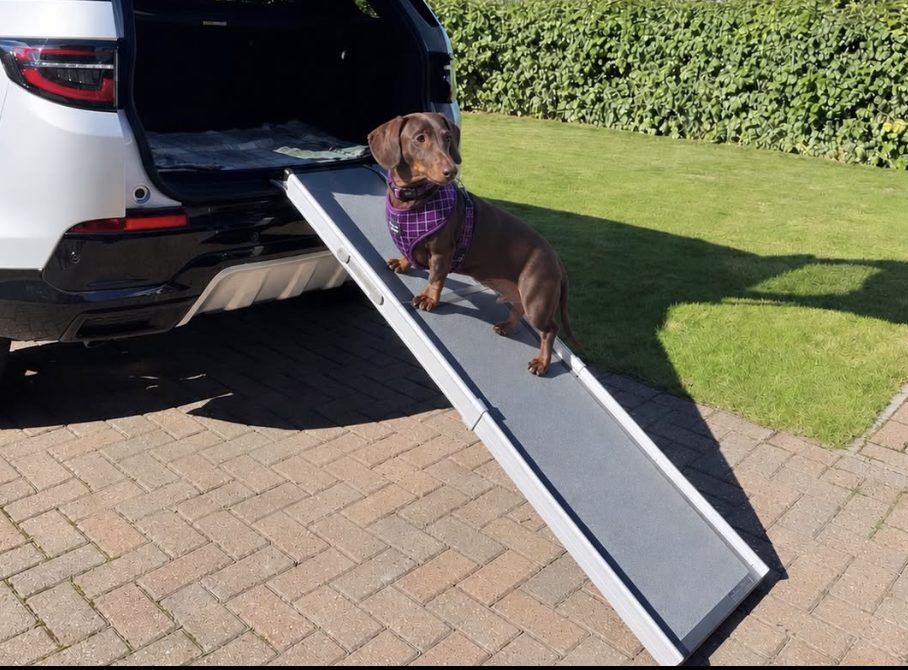
Half of what wears out an old dog isn’t exercise, it’s the dozen small jumps and slips of an ordinary day. Fixing those is free exercise in reverse: it removes the load that hurts without removing the movement that helps.
Ramps or steps for the car, the bed and the sofa, if the dog is allowed on them. The car is the big one; a 70 lb dog jumping down from an SUV lands with several times its weight on the front legs.
Rugs and runners on every hard floor the dog uses, especially where it eats, where it sleeps, and the route between the two.
A supportive bed that’s easy to get on and off, low to the ground, with a firm foam base rather than a soft pillow the dog has to climb out of.
Raised bowls for a large or giant senior, so the dog doesn’t have to brace through stiff shoulders and neck to eat.
A harness with a handle so you can steady the dog on steps, curbs and slippery patches without hauling on its neck. For the full list of what’s worth buying and what isn’t, see our guide to dog fitness equipment.
Signs you’re doing too much
A tired senior dog and an overworked one look different, and the difference shows up the next day, not during the session. Signs the plan is too much: stiffer than usual getting up the morning after; limping that wasn’t there before; reluctance to go out for the next walk; licking at one joint; sleeping much more than normal for a day or two; or a dog that lies down mid-walk and doesn’t want to continue. Any one of those means cut the next two or three sessions in half, then build back more slowly. If limping or stiffness lasts more than two days, it’s a vet visit, not a rest day.
Signs the plan is working: the dog gets up more easily in the morning, the first minutes of the walk are less stiff, it asks to go out, and over a couple of months the back end starts to look fuller from behind. That last one takes time. Give it eight weeks before you judge.
Weight: the part most owners skip
Every pound of extra body weight is a pound more load on joints that are already worn, on every single step. For a senior dog, getting lean is more effective for mobility than any supplement, any bed and most medications, and it makes every exercise on this page work better. Most older dogs are carrying extra weight because they’re eating the same amount they ate at three while moving half as much. Run the 9-point body check. If the dog is overweight, the 12-week weight loss plan is built to run alongside a senior exercise routine, and the exercise side of it is this page.
Frequently asked questions
Is it OK to stop exercising an old dog?
No, unless a vet has told you to for a specific reason. Rest feels kind, but an old dog that stops moving loses muscle within weeks and becomes less mobile, not more comfortable. Reduce the intensity, split the sessions, change the exercises, but keep the dog moving every day.
How far should a senior dog walk?
Measure in minutes, not distance, and let the dog set the pace. Two or three walks of 10 to 30 minutes each, depending on the row in the table above. A senior dog’s walk often covers less ground than it used to because of all the sniffing, and that’s fine. The sniffing is doing something too.
My old dog limps after walks. Should I stop walking it?
Shorten the walks, warm the dog up for five minutes first, stay on grass, and see the vet about pain control. Limping after exercise usually means arthritis that needs managing, not that walking is wrong. Once pain is controlled, most dogs can walk comfortably again with the right routine.
Is swimming safe for a senior dog?
For most, it’s the safest exercise there is. Use a life jacket, keep sessions short, use warm water where you can, and get in and out by a ramp or shallow steps. Dogs with heart conditions, ear problems or certain skin conditions should be cleared by a vet first.
What if my senior dog has hip dysplasia or arthritis as well?
The exercises on this page are the same ones used for both conditions, with the same rules: low impact, little and often, surfaces that grip. The difference is pace and pain management, which your vet sets. Our guides to hip dysplasia exercises and arthritis exercises cover the specifics.
Where this fits in your dog’s plan
A PetFitness plan for a senior dog starts from how the dog moves today, not its birthday, sets the walks and strength work at a pace the dog can hold every day, adds water work where it’s available, and runs the weight side alongside if the dog needs it. If you’d like the plan built for your dog, build your dog’s plan here. If you’d rather start on your own: pick your dog’s row in the table, do three sit-to-stands on the rug tonight, put runners on the slippery floors this week, and find out where the nearest warm water is.