Written by the PetFitness team and reviewed by our Certified Canine Fitness Trainers. Last updated September 19, 2026.
Dogs stretch themselves a dozen times a day. Stretching a dog on purpose, the way a rehab vet or a sport dog handler does, is a different thing, and it’s the part of a fitness program most owners have never been shown. Done right, it keeps the hips and shoulders moving through their full range as the dog ages, speeds up recovery after hard exercise, and gives you a weekly hands-on check of every joint. Done wrong, it can hurt a dog. This guide covers the ten stretches we use in PetFitness plans, split into the ones the dog does itself and the ones you do for it, with hold times, a five-minute post-walk routine, and the rules that keep it safe.
The short version
- Two kinds: active stretches the dog does itself (play bow, cookie stretches) and passive stretches where you move the limb. Start with active. Add passive once the dog is relaxed being handled.
- When: after exercise, on a warm dog. Never cold, never first thing in the morning, never before a workout.
- How long: passive stretches 15 to 30 seconds, 2 to 3 times per side. Active stretches 3 to 5 reps. The whole routine takes five minutes.
- The line you don’t cross: stretch to the point of gentle resistance, never past it. If the dog pulls the leg away, tenses, or looks at your hand, you’ve gone too far.
- Who needs a vet first: any dog with a diagnosed joint condition, recent surgery, or a limp. Stretching those dogs is rehab, and the protocol comes from the vet.
What stretching does for a dog, and what it doesn’t
The honest version: the research on stretching in dogs is thinner than the research on stretching in people, and the research in people says stretching doesn’t prevent injuries the way everyone assumed. What it does do, in both species, is maintain range of motion. A joint that gets moved through its full range regularly keeps that range; a joint that doesn’t, loses it, slowly, starting in middle age. That’s the main reason to stretch a dog: so a ten-year-old Lab can still reach forward with its shoulders and push off with its hips the way it did at four.
There are three side benefits. Stretching after exercise is a cool-down, and dogs that cool down properly are less stiff the next morning. Passive stretching is a weekly hands-on inspection: you’ll feel a warm joint, a tight muscle, or a flinch weeks before it shows up as a limp. And a dog that has been handled this way from young is calmer at the vet and easier to treat if it’s ever injured.
What stretching won’t do: build muscle, fix a structural problem, or replace the strength and balance work that keeps joints stable. In a PetFitness plan, stretching is the last five minutes of every session, not a session by itself.
Active vs passive stretches
Active stretches are ones the dog performs under its own control, usually because you lured it with a treat or asked for a trained behavior. The play bow, the cookie stretch, and a front-feet-up stand are all active. The dog decides how far to go, which makes them nearly impossible to overdo. Every dog can start these today.
Passive stretches are ones where you move the limb while the dog stays relaxed. The trainer in the photos below is doing passive stretches: a hind leg drawn back, a front leg drawn forward. These reach a fuller range than active stretches and are what rehab vets prescribe, but they depend on you feeling the end of the joint’s range and stopping there. They also depend on the dog trusting your hands. Build up to them over two or three weeks of active stretching and gentle handling first.
Rules before you stretch a dog
- Warm first. Five to ten minutes of walking minimum. Stretching a cold muscle is how you strain it. The ideal moment is the end of a walk or a treadmill session.
- Relaxed dog, relaxed you. Quiet room, non-slip surface, no other dogs. For passive stretches the dog is lying on its side or standing square; for active ones, standing.
- Support the joint. One hand above the joint you’re moving, one below. Never hold a leg by the paw and pull. The leg moves in the plane it naturally moves in (forward and back), never sideways or twisted.
- Move slowly to the first resistance, then stop. That’s the stretch. It should look like nothing is happening. If the dog’s muscles tense, the leg pulls back, the head turns toward your hand, the ears go back, or the dog licks its lips or yawns, back off immediately.
- Hold, don’t bounce. 15 to 30 seconds for passive stretches. Bouncing triggers the muscle to contract, which is the opposite of what you want.
- Both sides, every time. Asymmetry is information. If one hip moves less than the other, that’s worth a vet’s opinion.
- Skip it if the dog is sore, limping, or within a vet’s restriction after surgery. Those dogs get a prescribed protocol, not this one. See exercises for dogs recovering from injury.
The 10 stretches
| Stretch | Type | What it targets | Dose |
|---|---|---|---|
| 1. Play bow | Active | Chest, shoulders, spine, hip flexors | 5 to 10 s hold, 3 to 5 reps |
| 2. Cookie stretch to the hip | Active | Neck, side of the spine (lateral flexion) | 3 to 5 s hold, 3 reps per side |
| 3. Cookie stretch to the chest | Active | Back of the neck, upper spine | 3 to 5 s hold, 3 reps |
| 4. Cookie stretch up | Active | Front of the neck, chest | 3 to 5 s hold, 3 reps |
| 5. Front feet up | Active | Hip extension, abdominals, lower back | 10 to 15 s hold, 3 reps |
| 6. Hip flexor stretch (hind leg back) | Passive | Hip flexors, front of the thigh | 15 to 30 s, 2 to 3 reps per side |
| 7. Hamstring stretch (hind leg forward) | Passive | Hamstrings, glutes, lower back | 15 to 30 s, 2 to 3 reps per side |
| 8. Shoulder extension (front leg forward) | Passive | Shoulder, chest, biceps | 15 to 30 s, 2 to 3 reps per side |
| 9. Shoulder flexion (front leg back) | Passive | Front of the shoulder, triceps | 15 to 30 s, 2 to 3 reps per side |
| 10. Wrist and hock range of motion | Passive | Lower joints, tendons of the lower leg | 10 slow flex-and-extend cycles per leg |
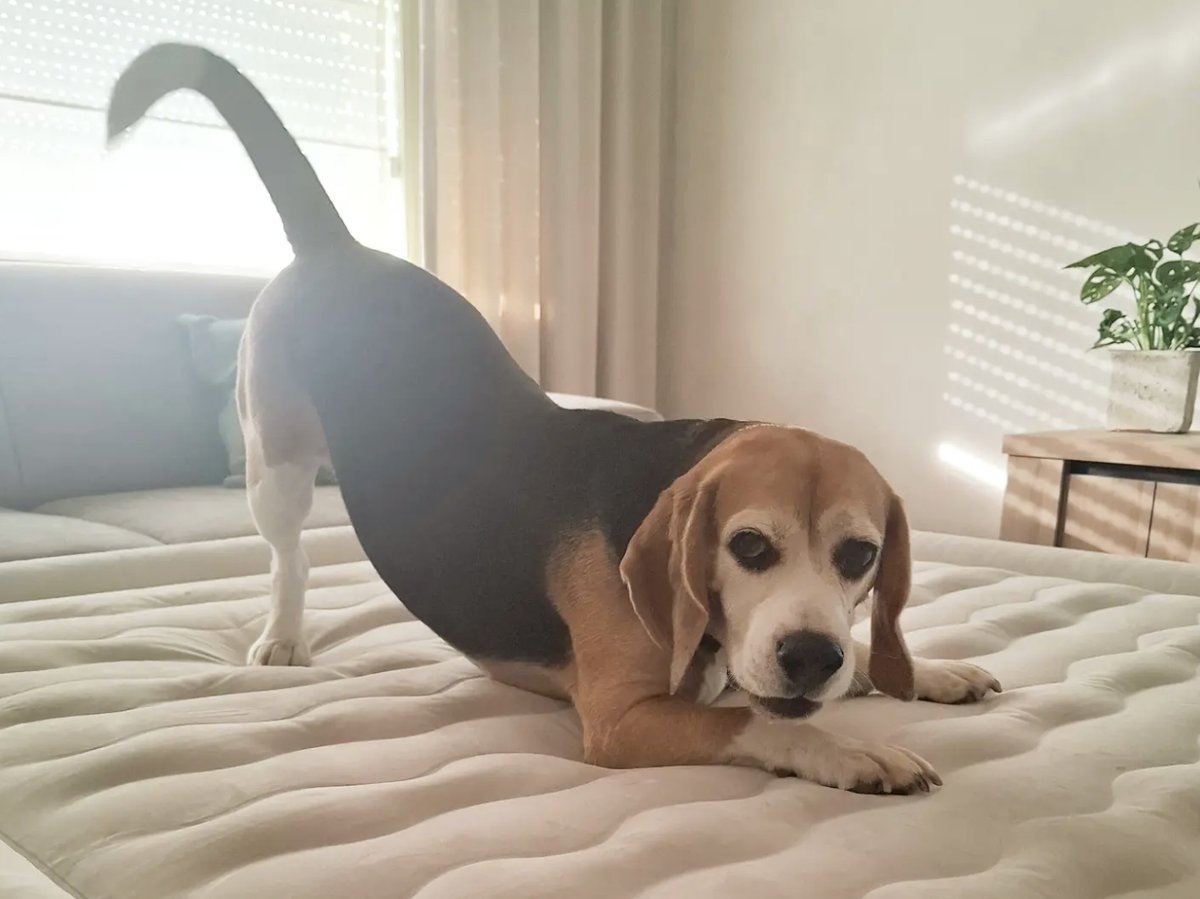
1. Play bow
The stretch dogs invented. Chest to the floor, hips high, front legs out in front. It opens the shoulders and chest, extends the spine, and stretches the hip flexors, all at once. Most dogs offer it in play; to get it on cue, lure the nose down and slightly back between the front feet while the rear stays up, and reward the moment the elbows touch. Hold for 5 to 10 seconds by keeping the treat in place. Three to five reps. If the dog drops into a full down instead, lure lower and more slowly. Puppies and seniors can both do this one every day.
2. Cookie stretch to the hip
Dog standing square. Hold a treat at the dog’s nose and draw it slowly around toward the hip on the same side, so the dog bends its neck and spine sideways to follow. Stop where the dog stops. Hold 3 to 5 seconds, release, and do the other side. Three reps each way. A fit dog can touch its nose to its hip; a stiff or overweight one gets halfway. Don’t let the dog step around to reach the treat; if the feet move, you went too far or too fast. This one and the next two are the ones we ask for after every session, because they take thirty seconds and cover the whole spine.
3. Cookie stretch to the chest
Same start. Draw the treat from the nose straight down and back between the front legs, so the dog tucks its chin toward its chest. Hold 3 to 5 seconds. Three reps. Stretches the back of the neck and the muscles along the top of the spine that tighten in dogs that pull on leash.
4. Cookie stretch up
Treat straight up above the nose, so the dog lifts its head and looks at the ceiling without sitting or lifting its front feet. Hold 3 to 5 seconds. Three reps. Opens the front of the neck and the chest. Keep it gentle in flat-faced breeds and any dog with a history of neck problems.
5. Front feet up
Front feet on a step, a low box, or the edge of a couch, rear feet on the floor, standing tall. This puts the hips into extension and stretches the abdominals and the muscles along the lower back. Hold 10 to 15 seconds, 3 reps. Raise the surface over a few weeks for a bigger stretch, but never above the dog’s elbow height. It’s also a strength exercise, which is why it’s in the core strength program too.
Setting up for passive stretches
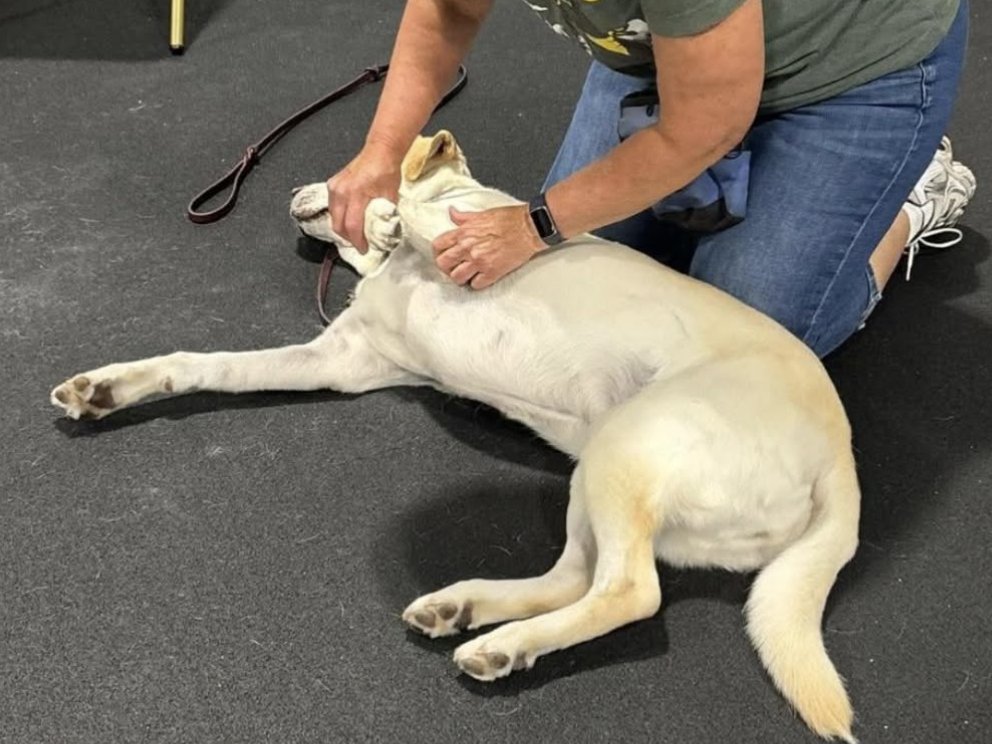
For stretches 6 to 10 the dog lies on its side on a mat, the way the Lab is here, with you kneeling behind its back. Standing works for the hip flexor stretch and is often easier with a big dog, but lying down is more relaxed and gives you better control. Spend a few sessions just getting the dog to lie there while you run your hands down each leg before you stretch anything. A dog that fights the position won’t relax into a stretch, and a stretch on a tense muscle does nothing.
6. Hip flexor stretch (hind leg back)
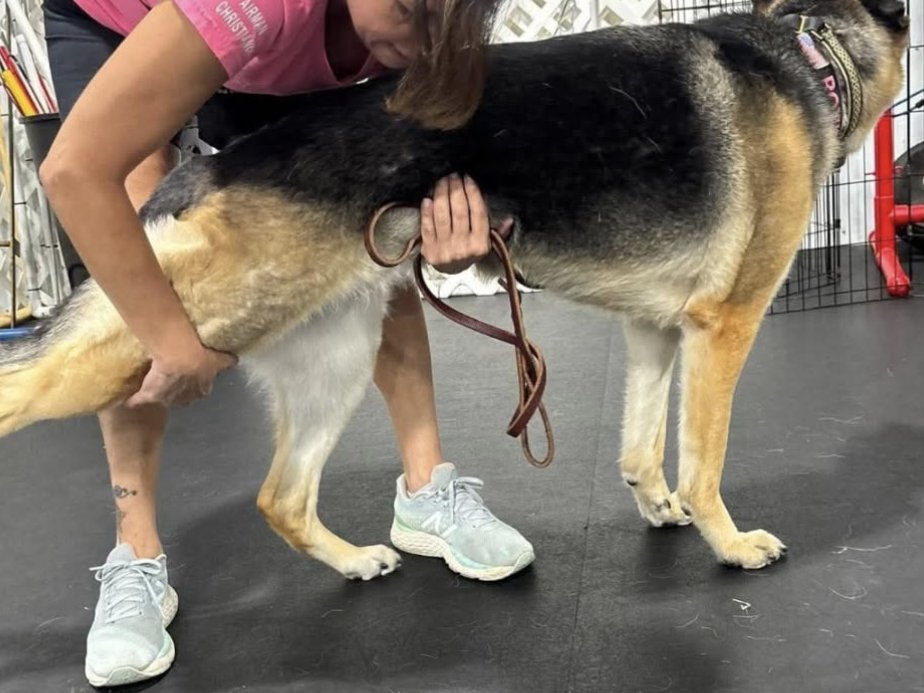
The most useful passive stretch there is, because hip flexors shorten in every dog that sits a lot, and short hip flexors shorten the stride. Dog lying on its side or standing. One hand steadies the pelvis, the other holds the thigh just above the knee (not the paw, not the hock). Draw the leg slowly straight back, keeping it in line with the body, until you feel the first resistance. Hold 15 to 30 seconds. Release slowly. Two to three reps, then the other leg. The leg should move back a little farther on the second rep than the first; that’s the stretch working.
7. Hamstring stretch (hind leg forward)
Same position. Hand behind the thigh, draw the leg forward toward the dog’s chest with the knee bent, until resistance. Hold 15 to 30 seconds. Two to three reps per side. This is the one that helps dogs that seem stiff getting up from a down. Go especially slowly with dogs that have had a cruciate injury and only after the vet has cleared it.
8. Shoulder extension (front leg forward)
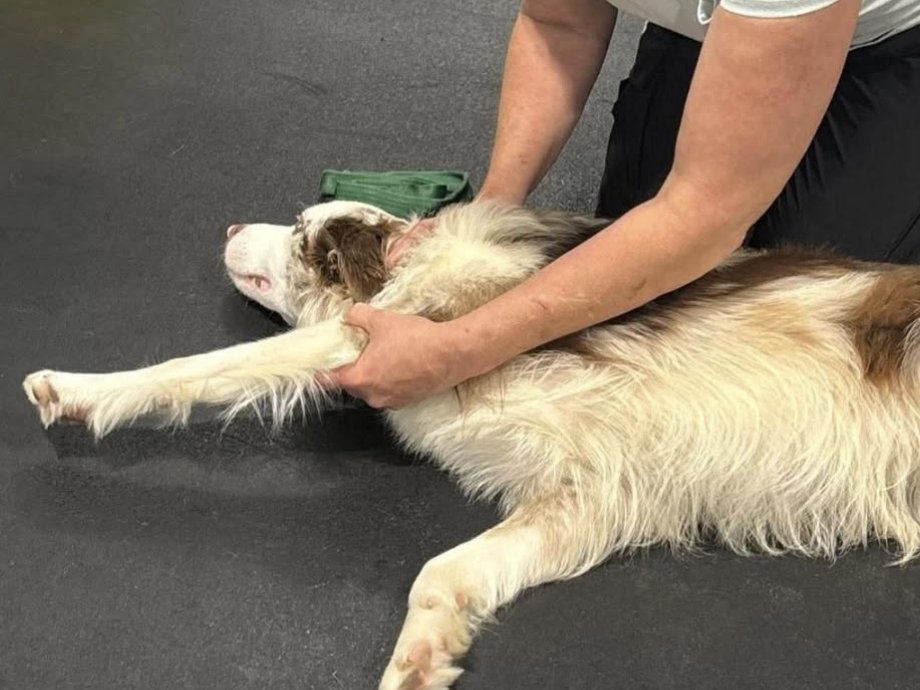
Dog on its side. One hand on the shoulder blade to steady it, the other supporting the leg at the elbow. Draw the leg straight forward, as if the dog were reaching, until resistance. Hold 15 to 30 seconds. Two to three reps per side. This is the stretch that keeps a dog’s front stride long, and the one agility and flyball handlers do religiously because shoulder injuries are the most common ones in those sports.
9. Shoulder flexion (front leg back)
Same position. Bend the elbow and draw the upper arm back so the elbow moves toward the ribs and the leg tucks under, until resistance. Hold 15 to 30 seconds. Two to three reps per side. Smaller range than the extension stretch; don’t force it.
10. Wrist and hock range of motion
Not really a stretch, more a maintenance move for the lower joints. Hold the leg above the joint, and slowly flex and extend the wrist (front) or hock (rear) through its full comfortable range, ten slow cycles. Then the same for the toes if the dog tolerates it. This is the one we add for seniors and for any dog that stands with its wrists or hocks looking dropped, and it’s what a rehab vet calls passive range of motion. Pairs with the weak back legs program.
The five-minute post-walk routine
This is the version in every PetFitness plan. Do it at the end of the walk, before the dog lies down and cools off.
| Order | Stretch | Time |
|---|---|---|
| 1 | Play bow, 3 reps | 30 s |
| 2 | Cookie stretch to each hip, to the chest, and up, 2 reps each | 60 s |
| 3 | Front feet up, 2 x 10 s | 30 s |
| 4 | Hip flexor stretch, 20 s each side | 60 s |
| 5 | Shoulder extension, 20 s each side | 60 s |
| 6 | Slow hands down every leg, feeling for heat or flinching | 30 s |
Steps 1 to 3 alone are fine for the first few weeks, or for any dog that isn’t ready to be handled lying down. Add steps 4 and 5 when the dog is relaxed with your hands on its legs. Steps 7, 9, and 10 go into the routine once or twice a week rather than daily, or every day for seniors.
Seniors, puppies, and dogs in rehab
Senior dogs get more out of stretching than any other group, because range of motion is exactly what they’re losing. Every stretch above applies, with shorter holds (10 to 15 seconds), a longer warm-up, and wrist and hock range of motion daily. Warm the room. Arthritic dogs should be checked by a vet first, and the vet may add or remove stretches depending on which joints are affected. Our guides on exercises for dogs with arthritis and low-impact senior exercises cover what goes around the stretching.
Puppies do the active stretches only: play bow, cookie stretches, and front feet up on a low surface. No passive stretching of a puppy’s joints; the growth plates are open and the ligaments are loose enough already. Teaching a puppy to lie calmly on its side while you handle each leg is worth doing, though, so the passive stretches are easy to add at 12 to 18 months. See puppy exercises.
Dogs in rehab after cruciate surgery, a hip procedure, or a soft tissue injury are stretched on a schedule the rehab vet sets, usually starting with range of motion on the affected joint within days of surgery and progressing from there. Don’t improvise it, and don’t skip it; the protocol matters more in these dogs than in any others. Our guides on exercise after ACL surgery and hip dysplasia exercises describe what usually surrounds it.
Signs you’re doing it wrong
The dog pulls the leg away, tenses up, or turns to look at your hand: too far or too fast. The dog yawns, licks its lips, or won’t settle on its side: not relaxed enough for passive work yet, go back to active stretches and handling. The dog is stiffer the next day: you stretched cold, held too long, or bounced. A joint is warm, swollen, or the dog flinches at the same spot every time: stop and see the vet. And if you find yourself pulling a leg to get it to go farther than yesterday, stop. Range improves over weeks, not reps.
Why does my dog stretch so much on its own?
Usually nothing to worry about. Dogs stretch on waking, before play, and when greeting you, and a dog that stretches a lot is often just a dog that lies down a lot. Repeated stretching of the front end with the rear up, especially if the dog holds it or does it after eating, can be a sign of abdominal discomfort and is worth a vet visit if it’s new. We cover the reasons in why dogs always stretch.
Frequently asked questions
Should I stretch my dog before or after exercise?
After. Stretching before a workout doesn’t prevent injury and can slightly reduce power. A five-minute walk is the warm-up; stretching is the cool-down.
How often should I stretch my dog?
The active stretches and the two main passive ones (hip flexor and shoulder extension) after every walk or session, so most days. The rest once or twice a week. Seniors daily, gently.
How long should I hold a dog stretch?
Passive stretches 15 to 30 seconds, 10 to 15 for seniors. Active stretches (cookie stretches, play bow) 3 to 10 seconds, since the dog is holding the position itself.
Is it safe to stretch my dog’s legs?
Yes, if the dog is warm and relaxed, you support the joint with both hands, move the leg only in the direction it naturally moves, and stop at the first resistance. Never twist, never pull by the paw, never stretch a dog that’s limping or recovering from surgery without the vet’s go-ahead.
Can I stretch a puppy?
Active stretches, yes. Passive stretches, no, until growth plates close at 12 to 18 months depending on breed size.
Does stretching help a dog with arthritis?
Often, as part of a program that also includes strength work, weight control, and whatever the vet prescribes. Gentle range of motion keeps arthritic joints moving. It doesn’t treat the arthritis, and it’s not a substitute for the vet.
What’s a cookie stretch?
Any stretch where you use a treat to lure the dog’s head into a position that stretches the neck and spine: to the hip, to the chest, straight up. The dog controls the range, which makes them the safest stretches there are. Stretches 2 to 4 above.
Is dog yoga a real thing?
“Doga” classes are mostly for the person. The useful parts, play bows and cookie stretches, are on this page and take five minutes at home.
Where this fits in your dog’s plan
Stretching is the flexibility component of a PetFitness conditioning plan, the last five minutes of every session alongside the strength, balance, and stamina work the plan sets for your dog’s breed, age, weight, and goals. If you want the full program with a video for every stretch and exercise, build your dog’s plan here. If you’d rather start on your own, do the three cookie stretches and a play bow at the end of tonight’s walk. That’s the routine.
About the author. Richie Allen is the founder of PetFitness. Every stretch and exercise in the PetFitness program is tested on real dogs before it goes into a plan.
Reviewed by the PetFitness training team. Our Certified Canine Fitness Trainers checked the stretch descriptions, the hold times, and the senior, puppy, and rehab guidance on this page against the standards used in the PetFitness program.
Related guides: Dog conditioning: the complete guide · Core strength exercises for dogs · Dog balance exercises · How to improve dog mobility naturally · Low-impact exercises for senior dogs