
Written by the PetFitness team and reviewed by our Certified Canine Fitness Trainers. Last updated September 8, 2026. PetFitness may earn a commission on some links below; it does not change what we recommend.
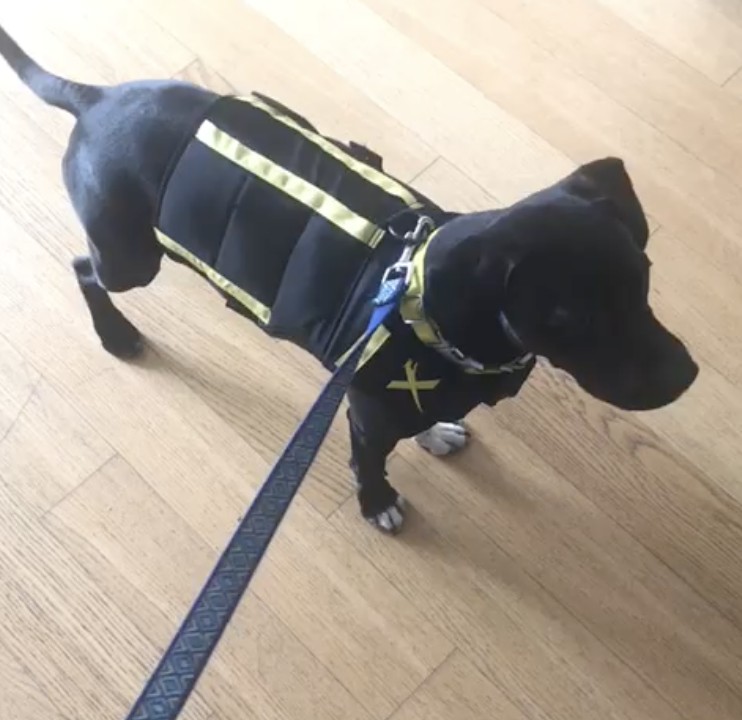
A weighted vest for dogs is a snug harness with pockets that hold small weights, usually between 1 and 20 pounds total. Used correctly, it turns a normal walk into strength work for a healthy adult dog. Used badly, it loads joints that were never meant to carry it. This guide covers the part most articles skip: exactly how much weight, how to size it, how to build up over four weeks, and which vests are worth buying. It’s written by the PetFitness team and reviewed by the Certified Canine Fitness Trainers who build our conditioning programs.
The short version
- Who it’s for: healthy, fully grown dogs (12 to 18 months or older depending on breed) that already walk 30 to 45 minutes a day comfortably.
- Who it’s not for: puppies, overweight dogs, seniors with joint problems, and any dog recovering from injury or surgery.
- How much weight: start with the empty vest, then 2 to 3% of your dog’s body weight. Most conditioning programs cap at 10%.
- What to do in it: walking, hills, and controlled strength moves. Never running, fetch, jumping, or stairs.
- Time to results: visible muscle and stamina changes in 6 to 8 weeks if you also feed enough protein and progress slowly.
Weighted vest for exercise vs. calming vest: not the same product
Before anything else, sort out which one you’re actually looking for, because searches for “weighted dog vest” pull up both.
A calming vest (ThunderShirt, Canada Pooch Weighted Calm Vest, and similar) is a snug wrap, sometimes with a pound or two of evenly spread weight, meant to reduce anxiety through gentle pressure. It’s worn at rest, during storms, fireworks, or car rides. It is not exercise equipment.
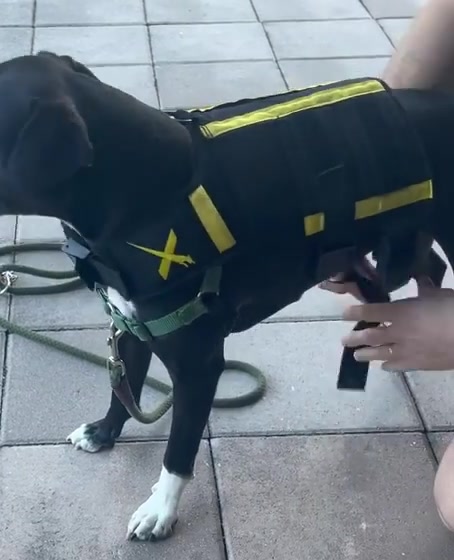
A weighted exercise vest is built like a harness, with removable weights in pockets over the shoulders and back, and it’s worn only during structured activity. That’s what this guide is about. If your dog is anxious rather than under-conditioned, a calming vest is a reasonable thing to try and a weighted exercise vest is not.
Who should use a weighted vest, and who shouldn’t
This is the part we’re strict about, because added weight goes straight to the joints. The rule of thumb our trainers use: the vest is the last thing you add to a fitness routine, never the first.
| Dog | Weighted vest? | Why |
|---|---|---|
| Healthy adult, already fit, walks 30+ min daily | Yes | The vest adds resistance to a base that already exists. |
| Working, sporting, or protection dog in training | Yes, with a trainer | Standard conditioning tool in these programs, but loading should be planned. |
| Puppy or adolescent (under 12 to 18 months) | No | Growth plates are still open. External load can affect how joints form. Large breeds close later. |
| Overweight dog | Not yet | The dog is already carrying extra weight. Lose it first with a structured weight loss plan, then consider a vest. |
| Senior dog | Ask your vet | Some fit seniors do fine with a light vest. Any stiffness, arthritis, or slowing down means no. See low-impact exercise for senior dogs instead. |
| Hip dysplasia, arthritis, spinal issues, cruciate history | No | Load makes each of these worse. The right work for these dogs is on our hip dysplasia exercise page. |
| Recovering from surgery or injury | No | Only if a rehab professional prescribes it, which is rare. Post-surgery exercise has its own progression. |
| Brachycephalic breeds (bulldogs, pugs, Frenchies) | Caution | Breathing limits the workload before the muscles do. Light vest, short sessions, cool weather only, if at all. |
Not sure whether your dog is at a healthy weight to begin with? Check with our body condition guide first. A dog that scores above 5 out of 9 shouldn’t be wearing extra weight.
How much weight should a dog vest carry?
This is the question almost nobody answers with numbers, so here are the ones we use. They are percentages of your dog’s lean, healthy body weight, not current weight if the dog is overweight.
| Dog’s body weight | Week 1 to 2 (empty vest) | Starting load (2 to 3%) | Working load (5%) | Ceiling (10%) |
|---|---|---|---|---|
| 20 lb | 0 lb | 0.5 lb | 1 lb | 2 lb |
| 40 lb | 0 lb | 1 lb | 2 lb | 4 lb |
| 60 lb | 0 lb | 1.5 lb | 3 lb | 6 lb |
| 80 lb | 0 lb | 2 lb | 4 lb | 8 lb |
| 100 lb | 0 lb | 2.5 lb | 5 lb | 10 lb |
Three things people get wrong with this table. First, the empty vest counts. A vest alone often weighs 1 to 3 pounds, and a dog has to get used to the fit and the feel before any weight goes in. Second, the 10% ceiling is a ceiling, not a goal. Most pet dogs never need to go past 5% to get stronger, and the extra load past that adds more joint stress than muscle benefit. Third, you spread the weight evenly across both sides and keep it over the shoulders and ribcage, never over the lower back. A vest that’s heavier on one side or sitting on the lumbar spine will make a dog move crooked, and that’s how strains happen.
Sizing and fit
Most vest sizing runs on chest girth, measured at the widest point of the ribcage just behind the front legs. Measure with a soft tape while the dog is standing, then check the brand’s chart, because sizes are not consistent between manufacturers.
Once it’s on, check these five things:
- Two fingers fit under every strap. Snug, not tight.
- Weight sits over the shoulders and ribs. The back edge of the vest should end before the last rib. If it reaches the hips, it’s too long.
- Full shoulder movement. Watch the front legs on a few steps. Any shortened stride means the vest is restricting the shoulder.
- No rubbing in the armpits. Check after the first walk. Red skin means the wrong size or the wrong vest.
- It doesn’t shift when the dog shakes. A vest that slides sideways is going to load unevenly.
A 4-week starter plan
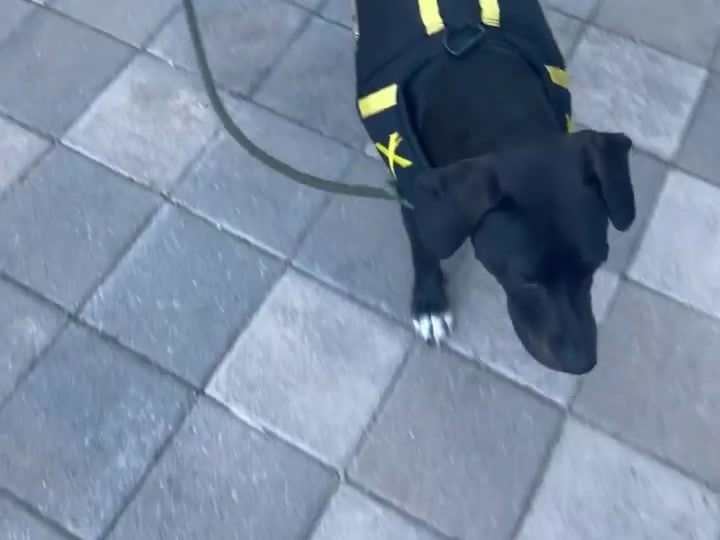
This is the progression we give PetFitness members. Every session is a walk on flat ground unless it says otherwise. If your dog isn’t already walking 30 minutes a day comfortably, build that first using our daily exercise guide, then come back.
| Week | Load | Sessions | Duration | What to watch |
|---|---|---|---|---|
| 1 | Empty vest | 3 to 4 | 10 to 15 min | Fit, rubbing, whether the dog moves normally |
| 2 | Empty vest | 4 | 20 min | Same. Add one gentle hill if the dog is happy. |
| 3 | 2 to 3% body weight | 3 | 15 to 20 min | Panting, slowing down, how the dog moves the next morning |
| 4 | 2 to 3% body weight | 3 to 4 | 20 to 25 min | If all good, hold here for 2 more weeks before moving toward 5% |
After week 4, you add weight in small steps (half a pound for a small dog, one pound for a large dog) no more often than every two weeks, and only if the dog is moving well, eating well, and recovering fully between sessions. Stamina should improve alongside strength; our guide on building a dog’s stamina safely pairs well with this plan.
What to do in the vest, and what never to do
Good in a vest: walking at a steady pace, hill walking, controlled sit-to-stand reps, slow figure-eights, and short stationary strength moves like the ones on our core strength page. All of these are slow, on all four feet, and predictable.
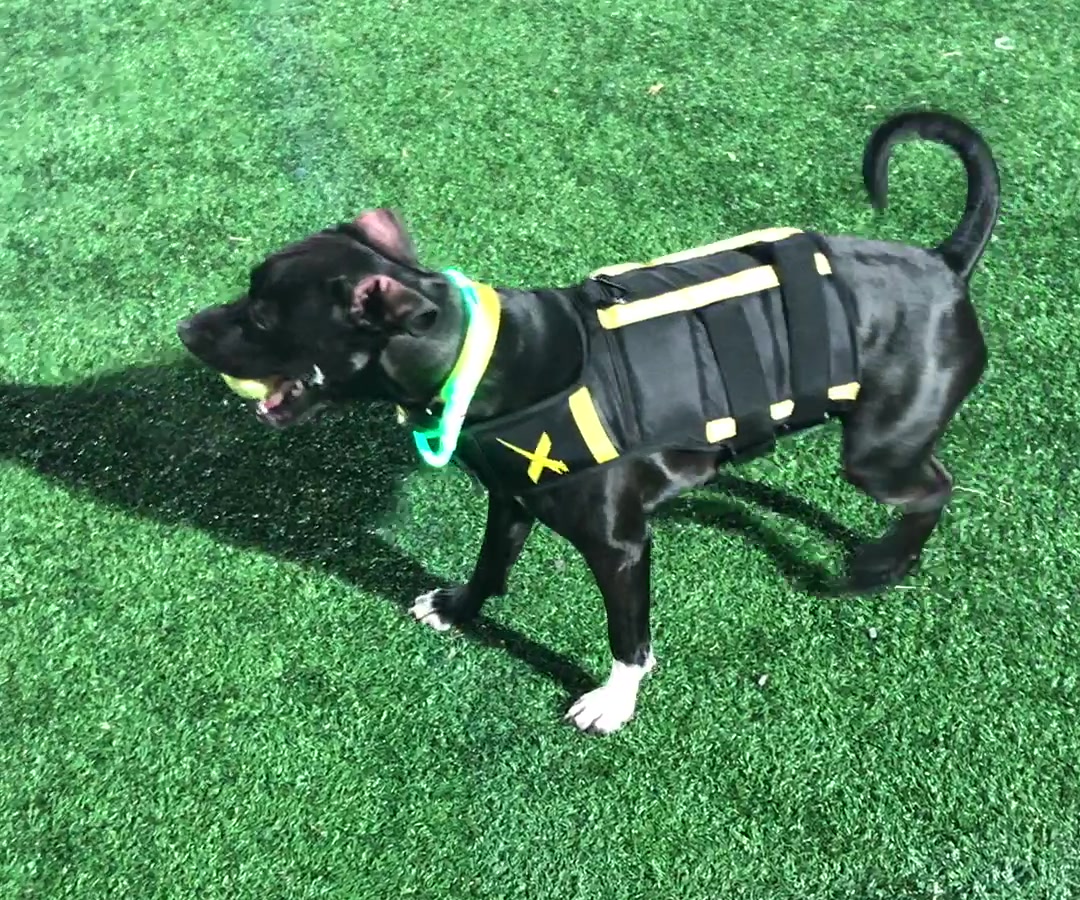
Never in a vest: running, fetch, tug, jumping, catching a frisbee, stairs, playing with other dogs, swimming, or anything off leash. The danger is impact and twisting under load. A dog landing from a jump with 5% extra body weight is loading its front end far harder than it would without the vest, and a sudden turn during play is how cruciate ligaments tear. Take the vest off before play, every time.
Balance and proprioception work (wobble boards, cushions, cavaletti at walking pace) is fine with an empty vest but we don’t combine loaded vests with unstable surfaces. If you want to work on balance, do it separately with the exercises on our dog balance guide.
The best weighted vests for dogs
We’ve used several of these with our own dogs and with clients. Here’s what matters when you’re choosing, then the ones we’d buy.

What to look for: removable weights in small increments (half-pound or one-pound), so you can follow a progression instead of jumping straight to the vest’s full load. Pockets positioned over the shoulders and ribs, not the lower back. A wide chest plate and padded straps. A quick-release buckle. Breathable fabric, because a vest is another layer on a dog that cools through panting.
Canine Athletes Power Max HD Weighted Harness
The one most serious conditioning trainers reach for. Heavy-duty construction, weights that come in usable increments, and it sits correctly on the dog. Best for medium to large dogs and for anyone who plans to actually progress the load over months. See current price at Canine Athletes.
ActiveDogs Weight Vest
Sold by size with fixed maximum loads (their 8 lb medium, for example), which makes it simple but less adjustable. Good build, good fit on deep-chested dogs. Best for owners who want one vest at one working weight and don’t need fine increments. See current price at ActiveDogs.
Bestia Dog Sport Weight Vest
Built for sport and protection dogs. Very robust, a bit more vest than a pet dog needs, but if you have a working breed and a trainer, this is the category. See current price at Bestia.
XDOG Weight & Fitness Vest
The popular choice in the bully and pit bull community, sold with the muscle-building pitch. It’s a decent vest. The muscle-building results come from the program and the food, not the brand, and it works exactly as well as the ones above if you follow the loading table. Widely available on Amazon and from XDOG directly.
Budget and Amazon vests
Plenty of no-name vests exist at a third of the price. Some are fine. The common failures are pockets that sit too far back, straps that loosen, and “weights” that are sandbags you can’t split into increments. If you go this route, buy the one with the most specific sizing chart and plan to add your own small weights (wrist-weight inserts work) so you can progress slowly.
For the rest of the gear that’s actually worth owning for home conditioning, see our dog fitness equipment guide.
Can you make a weighted dog vest at home?
You can, and a lot of people search for how. A snug harness with two small zip pouches sewn or strapped over the shoulders, filled with equal weights, does the job for a light load. The problems show up as the weight goes up: homemade pouches shift, uneven filling loads one side, and there’s no quick release if the dog panics. For anything past the starting load, a purpose-built vest is worth the money. If you do build one, weigh both sides on a kitchen scale before every session.
Weighted vests and building muscle
Most people buying a vest want a more muscular dog, often a pit bull, bully, or similar breed. The vest helps, but it’s the third most important thing. Muscle comes from, in order: enough protein and calories (a working dog on maintenance food won’t build anything), progressive overload over weeks and months, and recovery days. The vest is one way to apply overload; hills, sit-to-stands, and controlled walking on varied terrain are others, and they’re the ones to start with. A dog on a good conditioning program with no vest will out-build a dog wearing a heavy vest twice a week with nothing else. We’ll cover the full muscle-building protocol in a separate guide.
Signs you’ve added too much, too soon
- Panting harder than usual on a route the dog normally handles easily
- Slowing down or stopping in the last third of the walk
- Shortened stride in the front legs while wearing the vest
- Stiffness the next morning, especially getting up or on stairs
- Reluctance when you bring the vest out (dogs that enjoy the work get excited about it)
- Any limping, ever. Stop, take the vest off, and rest for a week before trying again lighter.
Heat changes everything. A vest adds insulation and workload at the same time. In warm weather, cut duration in half and walk early or late, and skip it entirely on hot, humid days. Flat-faced breeds should skip it above about 70°F.
Frequently asked questions
Do weighted vests actually work for dogs?
Yes, for the right dog. A healthy adult dog carrying 3 to 5% of its body weight on regular walks will build strength and stamina faster than the same dog walking without it, the same way it works for people. The effect disappears if the load is too light to matter or too heavy to move well under.
Are weighted vests safe for dogs?
Safe for healthy, grown, already-active dogs at conservative loads. Not safe for puppies, overweight dogs, or dogs with joint or spine problems. The risk is almost entirely from too much weight, wrong placement, or high-impact activity while loaded.
Can a puppy wear a weighted vest?
No. Wait until growth plates have closed, which is roughly 12 months for small breeds and 18 months or later for large and giant breeds. Until then, puppies build fitness through play, short walks, and the routine on our puppy exercise page.
How long can a dog wear a weighted vest?
Only for the session, 15 to 30 minutes, then off. A weighted vest is not a thing a dog wears around the house.
Can my dog run in a weighted vest?
No. Walking and hills only. Running under load multiplies the impact on the front legs and shoulders. Build running stamina without the vest; see why dogs have such strong stamina and how to develop it.
Does a weighted vest help with anxiety?
A calming vest might. A weighted exercise vest won’t, and it shouldn’t be used for that. They are different products; see the section near the top of this page.
What’s the difference between a weighted vest and a weighted collar?
A weighted collar loads the neck, which we don’t recommend for pet dogs at all. A vest spreads the load across the shoulders and ribcage, which is the structure built to carry it.
Where a weighted vest fits in a real fitness plan
A vest is one tool inside a program, not the program. The PetFitness plan builds your dog’s routine from breed, age, weight, and current condition, and tells you when (or whether) a vest belongs in it. If your dog is a fit adult and you want the full progression with video for every exercise, start your dog’s plan here. If your dog isn’t there yet, start with the weight loss or daily exercise guides linked above and come back to this page in a couple of months.
About the author. Richie Allen is the founder of PetFitness. The dog in the photos on this page is his, and every exercise in the PetFitness program is tested on real dogs before it goes into a plan.
Reviewed by the PetFitness training team. Our Certified Canine Fitness Trainers checked the loading percentages, the fit guidance, and the who-should-not list on this page against the standards used in the PetFitness program.
Related guides: Dog conditioning: the complete guide · Core strength exercises for dogs · Dog fitness equipment worth buying · How to increase your dog’s stamina