Written by the PetFitness team and reviewed by our Certified Canine Fitness Trainers. Last updated November 4, 2026.
A DIY dog agility course is the cheapest full-body workout you can give a dog, and one of the few that works the brain as hard as the legs. You don’t need a club, a field or competition equipment. A couple of PVC jumps, a tunnel, some poles stuck in the lawn and a plank on two bricks will keep most dogs busy, fit and focused for years, in a backyard, a garage or a living room. This guide covers who agility is and isn’t for, what to build and what to buy, how to put together a course that fits your space, how to train each obstacle from scratch, a six-week plan, and the safety rules that stop a fun hobby turning into a vet bill. If you just want the one obstacle that gives the most benefit for the least space, skip to weave poles; our weave pole workout is the short version.
The short version
- Who: healthy adult dogs of any size. Puppies do the flat-work (tunnels, poles on the ground, pause table) but no jumping or contact equipment until growth plates close, around 12 to 18 months. Seniors and arthritic dogs do a low-impact version.
- Build: a tunnel ($30 to $60 bought, a kids’ play tunnel works), two or three jumps (PVC or pool noodles on cones), six weave poles (garden stakes or PVC), a pause table (a sturdy low platform), and a plank on the ground. Under $100 for all of it.
- Space: a 15 by 30 foot yard fits a real course. A garage or living room fits a tunnel, poles and a pause table.
- Jump height: start at ground level and never go above the dog’s wither (shoulder) height at home. Lower is fine; you’re building fitness, not competing.
- Train: one obstacle at a time, treats and a target, five to ten minutes a session, three or four sessions a week. Most dogs run a short sequence inside six weeks.
- Surface: grass, rubber matting or packed dirt. Never concrete, tile or wet decking for anything involving jumping or turning.
What agility does for a dog (and who should skip it)
Agility is interval training with a brain workout attached. In a five-minute run a dog sprints, stops, turns, jumps, crouches, climbs and reads your body language the whole time. It builds hind-end power, core strength, balance and body awareness in a way that straight-line running never does, and because every obstacle is a problem to solve, it covers most of a dog’s daily mental stimulation at the same time. It also changes the relationship: a dog that runs a course with you learns to watch you, come when called and work for the fun of working, and that shows up on walks. Our guide to dog sport benefits goes deeper on why structured sports beat free play for fitness.
It’s not for every dog, and it’s not for every dog right now. Puppies under about a year (18 months for giant breeds) should not jump or use ramps and planks at height, because the growth plates in their legs are still open and repetitive landing forces are exactly what damages them; they can and should do tunnels, poles lying on the ground, and a low pause table, which teaches the game without the impact. Our puppy exercise guide covers what’s safe at each age. Overweight dogs should get lean first; jumping while heavy loads the elbows and the knees in a way that leads to the injuries agility is supposed to prevent, so start with the flat-work and a weight loss plan, and add jumps as the weight comes off. Dogs with arthritis, hip dysplasia, a previous cruciate injury or back problems should skip jumping entirely and do the low-impact version in the section near the end, with the vet’s okay. And flat-faced breeds can do agility, but short sessions in cool weather, with a close eye on breathing.
What to build and what to buy
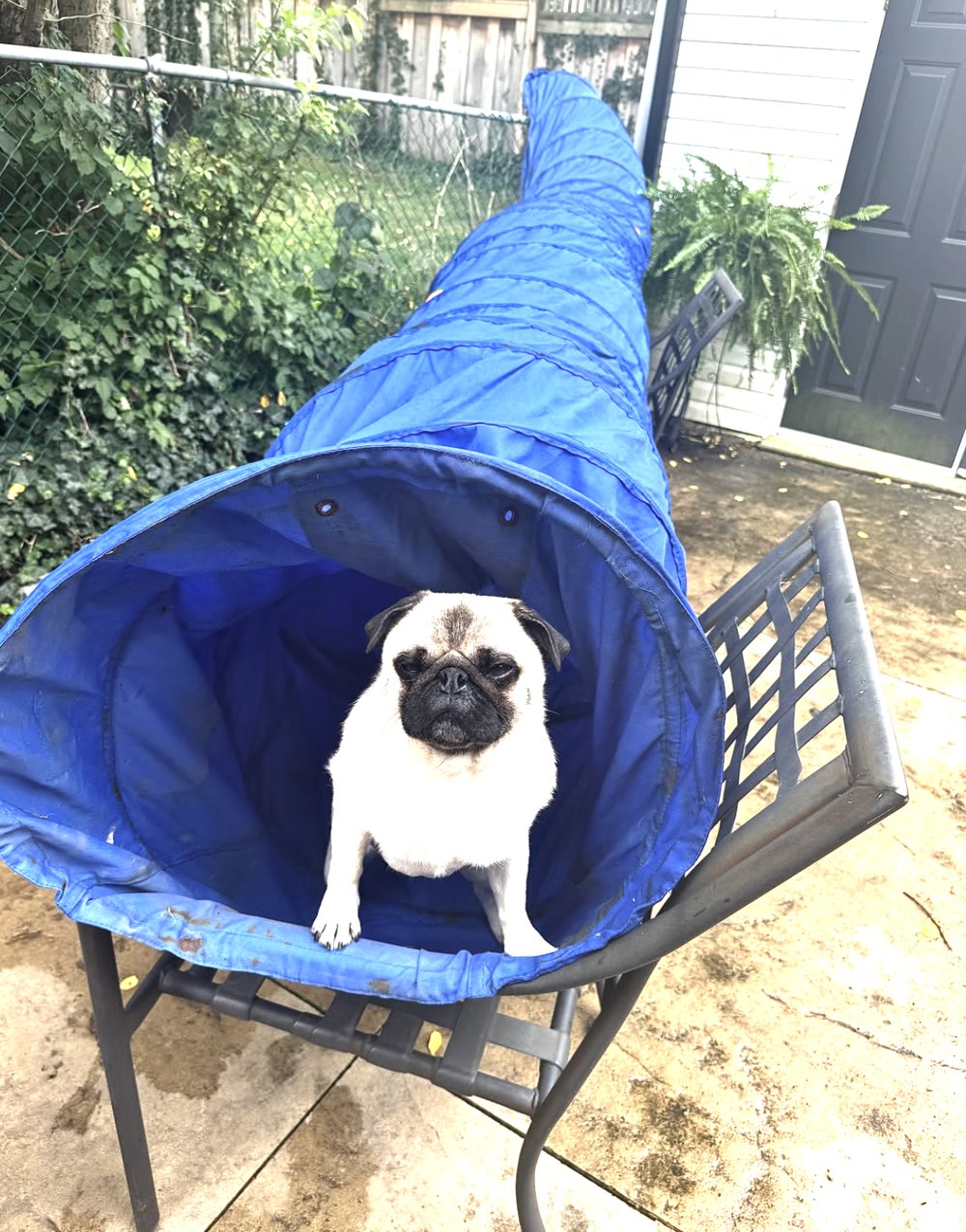
You need five things. Here’s each one, the DIY version, and when buying is worth it.
| Obstacle | DIY version | Buy it when | Cost |
|---|---|---|---|
| Tunnel | A children’s pop-up play tunnel (the pug’s in one above). Weigh the ends down with sandbags or hold them with the legs of a chair so it doesn’t roll. | Large dogs. Kids’ tunnels are 18 to 20 inches across; a Lab needs 24. A proper dog tunnel is heavier and stays put. | $15 kids’ tunnel; $40 to $80 dog tunnel |
| Jumps (2 or 3) | Two cones or buckets with a pool noodle or broom handle across them, or a PVC frame with cups so the bar falls when hit. The bar must fall or roll off when knocked; a fixed bar is how dogs get hurt. | You want adjustable heights quickly, or the dog is big enough to send a bucket flying. | $10 to $20 each DIY; $30 to $60 bought |
| Weave poles (6) | Garden stakes, ski poles or 3/4 inch PVC pushed into the lawn, 24 inches apart in a straight line. Indoors, poles in a PVC base or cones in a line. | Indoors on hard floor, where you need a weighted base. | $10 DIY; $40 to $80 bought |
| Pause table | A sturdy low platform the dog can sit or lie on: a pallet with plywood on top, a large step stool, an ottoman that doesn’t tip. Non-slip surface (a rubber mat screwed on). 8 inches high for small dogs, 12 to 16 for large. | Rarely. The DIY version is fine. | $0 to $30 |
| Plank / dog walk | A 10 to 12 inch wide, 8 foot board flat on the ground, with a non-slip surface (outdoor carpet or sand mixed into paint). Raise it onto bricks or a low block only once the dog walks it confidently flat. Never above 12 inches at home. | Don’t. Competition dog walks and A-frames are tall and need proper construction; leave them to a club. | $15 to $30 |
Skip the tire jump and the teeter at home. A tire with a fixed frame is a real injury risk if the dog misjudges it, and a teeter (seesaw) is the obstacle that scares the most dogs and needs the most careful introduction; both belong in a class with an instructor. Everything in the table is safe to build in an afternoon.
Laying out a course that fits your space
The rule is distance between obstacles. Dogs need room to land, collect themselves and set up for the next thing, and a course that’s too tight teaches a dog to rush and cut corners. Leave at least 12 to 15 feet between jumps for a medium or large dog, and 8 to 10 feet for a small one. Tunnels and weaves can sit a little closer because the dog slows down into them.
Backyard, 15 by 30 feet or more: a simple loop. Jump, tunnel, jump, weave poles, pause table, back to the start. Put the tunnel in a corner with a slight curve so the dog has to commit to it. Keep the poles on the longest straight. You can run that loop in both directions, which doubles the course.
Small yard or driveway: drop the plank, use one jump, and set the tunnel, jump and poles in a line. Run it out and back.
Garage or living room: tunnel, poles (or cones) and a pause table only. No jumping on hard floors, ever; the landing surface is what hurts dogs. Put down rubber mats or an area rug with a non-slip pad. Our indoor exercise guide has more on floor safety.
Whatever the space, the surface decides what you can do on it. Grass and packed dirt are ideal. Rubber gym matting is fine indoors. Concrete, tile, hardwood, gravel and wet decking are not: a dog that slips on a turn is a dog with a cruciate or shoulder injury, and that’s the most common way home agility goes wrong.
Foundations before obstacles
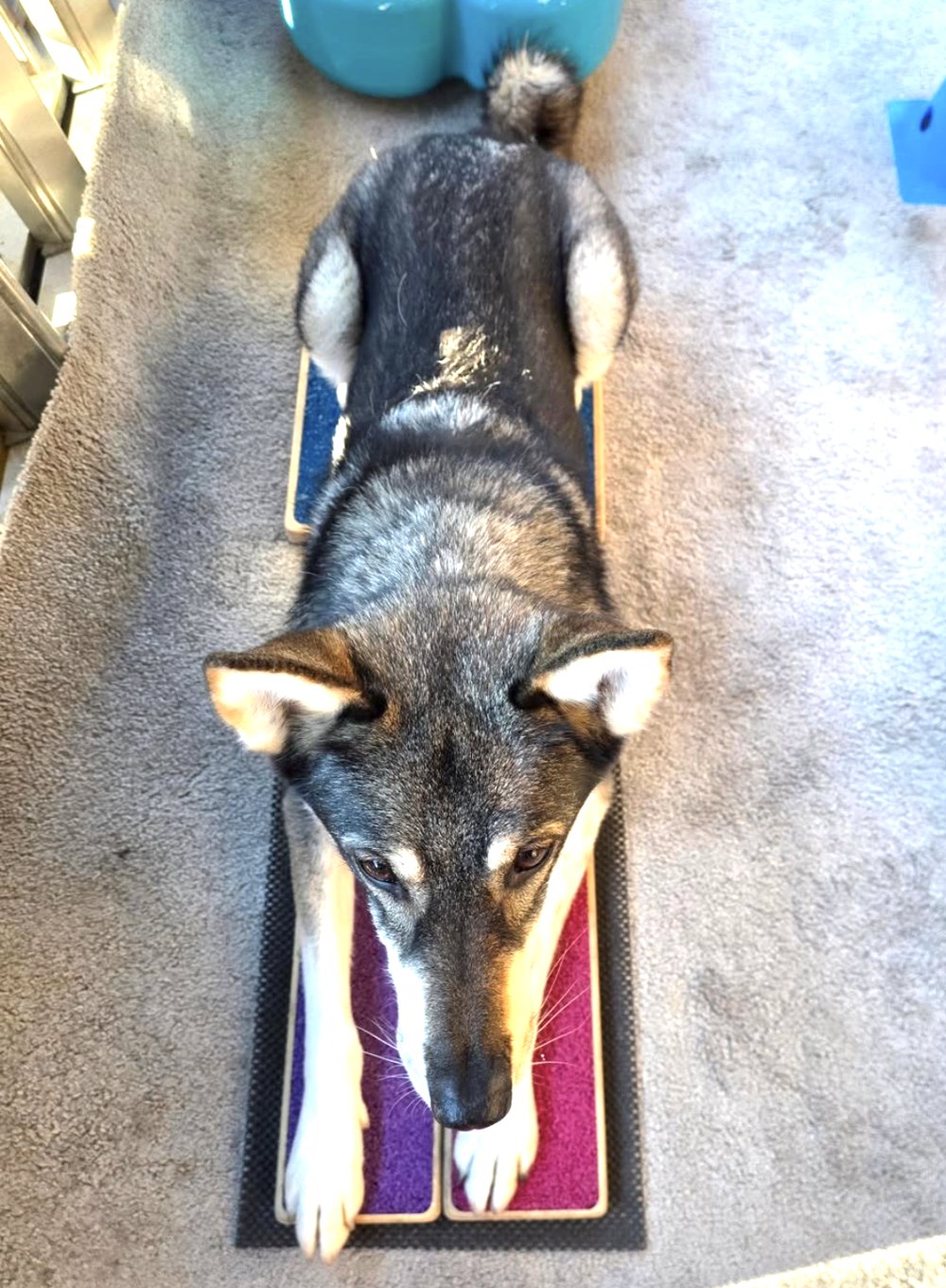
The dogs that pick up agility fastest aren’t the fastest dogs, they’re the ones that know where their feet are. Spend the first week on two things and every obstacle after that comes easier.
Paw targets. Teach the dog to put its front feet on a low platform, a book, a rubber mat, anything slightly raised, and hold them there. Then the back feet. Then front feet on one target and back feet on another, like the husky above. This is hind-end awareness, and it’s what lets a dog place its back feet accurately on a plank or clear a jump without clipping it. Five minutes a day. The exercises in our core strength guide and balance guide build the same thing.
A send and a recall. Agility is you pointing and the dog going. Practice “go” to a target mat a few feet away, then calling the dog back, until the dog drives away from you with confidence. Without this you’ll end up running every obstacle alongside the dog, which gets old quickly.
How to train each obstacle
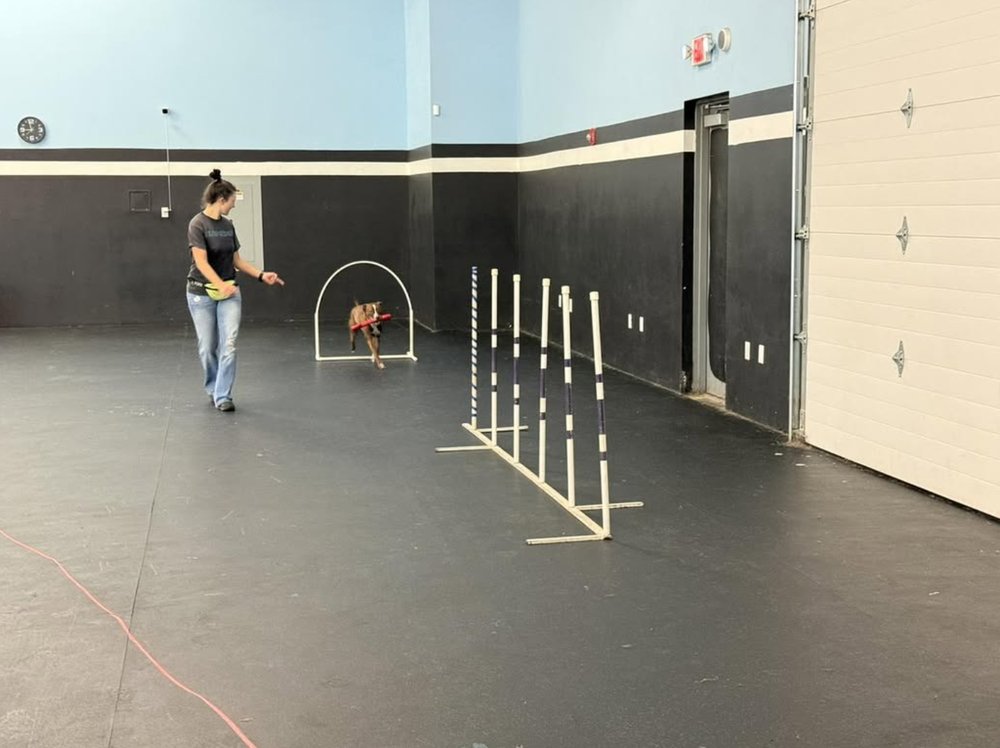
Tunnel
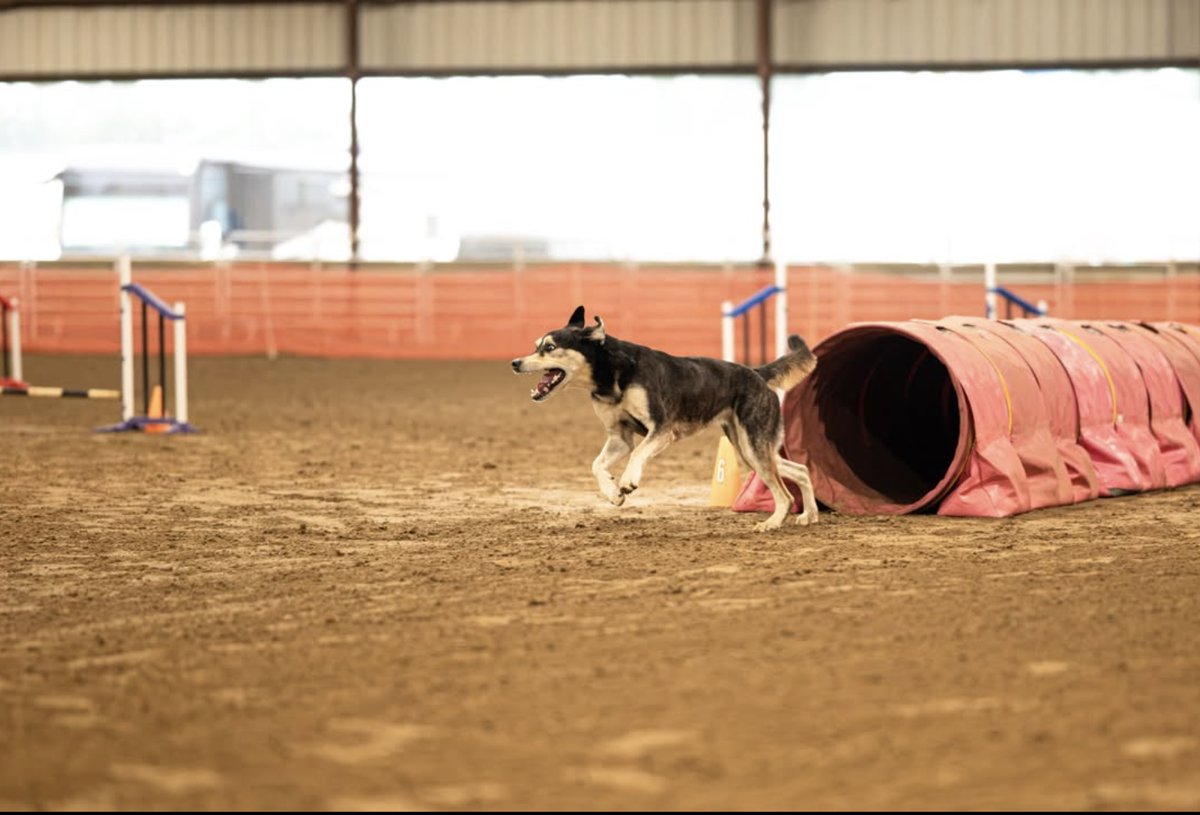
Compress it to its shortest length, have someone hold the dog at one end, and call from the other with a treat visible at the opening. Most dogs go through on the first or second try. Reward at the exit, not inside. Lengthen it a foot at a time, then add a gentle curve once it’s straight and easy. Dogs that balk at a dark tunnel do better with sunlight at the far end, so point the exit at the light. Tunnels are usually the first obstacle a dog falls in love with, and they’re safe for puppies, seniors and almost everyone.
Jumps
Start with the bar on the ground. Walk the dog over it on leash, reward, repeat until the dog trots over it without looking. Raise to a few inches, then to elbow height, and stop there for the first month. Never lure a dog over a jump by throwing a treat ahead; it teaches them to look at the treat instead of the jump and they crash the bar. Instead, send them (“over”), and reward on landing. At home, jumps never need to go above the dog’s shoulder height, and most fitness benefit comes well below that. One more rule: always approach a jump straight on. Angled approaches are a competition skill and a shoulder-injury risk for a beginner.
Weave poles
The slowest obstacle to teach and the best one for fitness, because weaving works the spine, hips and core through their full range. Set six poles 24 inches apart. Start by leading the dog through on leash, slowly, snaking in and out, with a treat at the end. Do that for a week until the dog starts anticipating the pattern. Then unclip the leash and guide with your hand and body. Then start a step back. Then two. The channel method, where you set the poles in two offset rows wide enough for the dog to run straight down the middle and close the gap an inch at a time over weeks, is faster for most dogs and is how the clubs do it. Our weave pole workout has the step-by-step. Expect four to eight weeks before the dog weaves independently, and don’t rush it; a dog that weaves fast and sloppy pops out of the poles and learns to skip them.
Pause table
Easy and important. The dog jumps on, sits or lies down, and holds for five seconds. It teaches the dog that agility includes stopping, which is what makes it safe. Lure on, ask for a sit, count out loud, release with a word. Build to a reliable five-second hold before adding it to a sequence. It’s also a great tool for over-excited dogs: a table in the middle of a course resets them.
Plank
Flat on the ground first, walking the dog along it on leash, reward at the end. The goal is all four feet staying on the board; a dog that steps off casually will step off at height. Once that’s clean for a week, raise one end onto a brick, then both, never above 12 inches at home. Teach the dog to walk, not run, and to stop at the end on cue. This is the obstacle where the paw-target work pays off.
Putting it together: a six-week plan
| Week | Focus | Sessions |
|---|---|---|
| 1 | Paw targets, send and recall, tunnel (short and straight), pause table. | 4 sessions, 5 to 8 minutes |
| 2 | Tunnel lengthened and curved. Jump bar on the ground. Weave poles on leash. Plank flat. | 4 sessions, 8 minutes |
| 3 | Jump at a few inches, sent not lured. Weaves still on leash. First two-obstacle sequence: tunnel to table. | 4 sessions, 10 minutes |
| 4 | Jump at elbow height. Weaves off leash with hand guidance. Plank on one brick. Three-obstacle sequences. | 3 or 4 sessions, 10 minutes |
| 5 | Two jumps in a line. Weaves with you a step back. Full loop at a walk or slow trot. | 3 sessions, 10 to 12 minutes |
| 6 | Full loop at speed, both directions. Pause table holds in the middle. Start varying the order. | 3 sessions, 12 minutes |
After week six, two or three sessions a week of 10 to 15 minutes keeps a dog fit and sharp. Change the course order every couple of weeks so the dog keeps reading you instead of running a memorized pattern, and keep raising the challenge through sequencing and speed rather than jump height. If the dog loves it, that’s the point to look at a local club: the instructors, the full-size equipment and the other dogs take it to a level a backyard can’t.
Safety rules we don’t bend
Warm up first: five minutes of walking and a few sit-to-stands before any jumping, and a few minutes of walking after. No jumping for puppies, overweight dogs or dogs with joint problems. Bars that fall when hit, never fixed. Jump heights at home that stay at or below the dog’s shoulder. Grass, dirt or rubber only; never concrete, tile, hardwood or anything wet. Straight approaches to jumps. Nails trimmed, no collar that can catch on equipment (a flat collar or harness, nothing dangling). Stop at the first sign of a limp, a skipped stride or a dog that starts refusing an obstacle it used to do; refusals are usually pain, not stubbornness. And sessions short. A tired dog is a sloppy dog, and sloppy dogs get hurt. Ten good minutes beats thirty.
Low-impact agility for seniors and dogs with joint problems
Take the jumping out and most of agility remains. Tunnels, weave poles at a walk, poles lying flat on the ground as cavaletti to step over, a pause table at 6 to 8 inches and a plank flat on the lawn give an older or arthritic dog the body awareness, the gentle range-of-motion work and the mental engagement without the landing forces. Keep it to five minutes, on grass, and let the dog set the pace. It’s one of the best things you can do for a stiff senior, because the weaving and stepping move the hips and spine through ranges a straight walk never reaches. Pair it with our arthritis exercise guide, and get the vet’s okay first if the dog has a diagnosed joint condition.
Frequently asked questions
How much does a DIY dog agility course cost?
Under $100 for a tunnel, two or three jumps, six weave poles, a pause table and a plank if you build the jumps and poles from PVC or garden stakes and use a kids’ play tunnel. Buying everything ready-made runs $150 to $300.
What age can a dog start agility?
Flat-work (tunnels, poles on the ground, a low table, paw targets) from about four months. Jumping and raised planks only after growth plates close, around 12 months for most breeds and 18 for giant breeds. Puppies that jump early are the ones that end up with elbow and shoulder problems later.
How high should my dog jump?
At home, no higher than the dog’s shoulder, and most of the benefit comes well below that. Start with the bar on the ground, build to elbow height over a month, and stop there unless the dog is young, lean, fit and loving it.
Can small dogs do agility?
Yes, and they’re often the most enthusiastic. Use lower jumps, a narrower tunnel, poles closer together (20 to 22 inches) and a lower table. Flat-faced small breeds like Pugs and Frenchies can do it in short sessions in cool weather.
How long should an agility session be?
Five to ten minutes for beginners, 10 to 15 for a trained dog, three or four times a week. Shorter is better. Agility is intense, and most injuries happen in the last tired minutes of a session that ran too long.
Can I do agility indoors?
Tunnels, poles, cones, a pause table and paw targets, yes, on rubber mats or a rug with a non-slip pad. No jumping indoors on hard floors; the landing is what hurts dogs.
My dog is scared of the tunnel. What do I do?
Shorten it as far as it goes, point the exit at daylight, sit at the far end with a treat, and let the dog choose to walk through. Never push or drag. Most dogs are through within a session or two; if yours isn’t, leave the tunnel out for a few days with treats scattered inside and let curiosity do it.
Is agility good exercise for weight loss?
Once the dog is lean enough to jump safely, yes, because it’s interval work that burns more than a walk of the same length. Until then, do the flat-work version and let the food side of the plan do the heavy lifting.
Where this fits in your dog’s plan
A backyard agility course is the fun end of a fitness plan: it’s where the strength, balance and body awareness work pays off, and it’s the thing most dogs would choose if you asked them. A PetFitness plan puts it in the right place for your dog, with the warm-up, the strength work that protects the joints, and the right amount of it for your dog’s age and condition. If you’d like one built, start your dog’s plan here. If you’d rather start this weekend: buy a kids’ play tunnel, push six garden stakes into the lawn two feet apart, and you have a course.